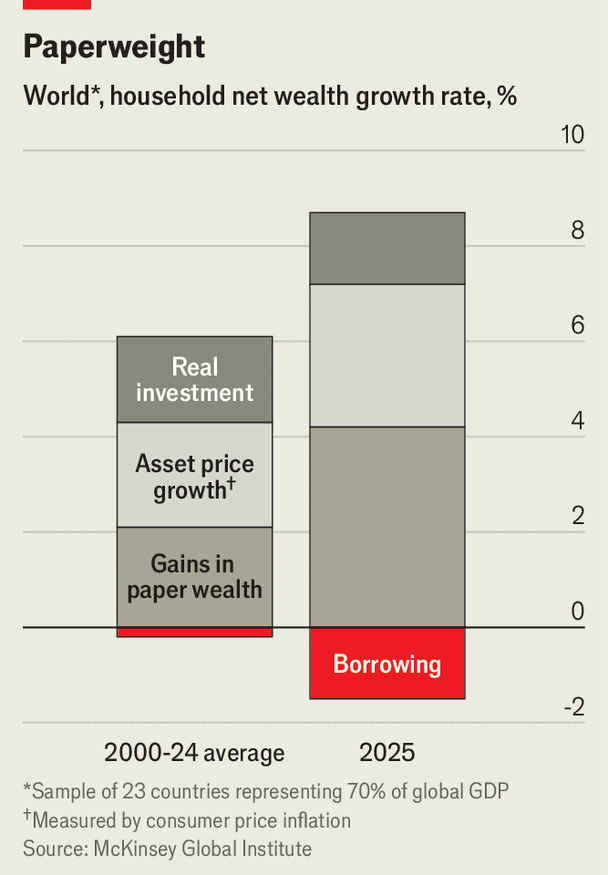
How rich is the world economy? The conventional(传统的;常规的) answer is about $120trn. That corresponds to global GDP, encompass(包含;涵盖)ing all the goods and services the world produced last year. It is, if you like(可以说;如果你愿意), the planet’s annual income.
全球经济有多富裕?传统答案是约120万亿美元。这对应全球GDP,涵盖去年世界生产的所有商品和服务。可以说,这就是地球的年收入。
But if you were to ask how rich are the world’s billionaires, you would not want to know their annual income.(但如果你要问全球亿万富翁有多富,你不会想知道他们的年收入。) They are not called billionaires because they take home ten-figure(十位数的) salaries. What matters are their assets, from their mansions to their stockholding(持股;股票持有)s.
但如果你要问全球亿万富翁有多富,你不会想知道他们的年收入。他们被称为亿万富翁,并非因为拿着十位数的薪水。重要的是他们的资产,从豪宅到持股。
Finding an equivalent measure for the world economy is tricky. The data are patchy(零散的;不完整的). And every financial asset—deposit, loan, bond or equity—is also a liability(负债;债务) for some other Earth-bound entity (a bank, person, government or firm). At the planetary level, they cancel out(抵消). What remains are “real” assets: property, minerals, machinery, infrastructure and intellectual property. These treasures, when combined with labour, yield the goods and services that underpin the world’s standard of living.(这些财富与劳动结合,产生支撑世界生活水平的商品和服务。)
为全球经济找到对等的衡量标准很棘手。数据零散不全。而且每项金融资产——存款、贷款、债券或股票——也是地球上某个其他实体(银行、个人、政府或公司)的负债。在行星层面,它们相互抵消。剩下的就是“实物”资产:房地产、矿产、机械、基础设施和知识产权。这些财富与劳动结合,产生支撑世界生活水平的商品和服务。