East London’s neglected docklands have found a new life. In squat windowless buildings racks of computer servers purr(发出咕噜声;低沉轰鸣) in air-conditioning that sweaty local residents would kill for. These data centres were built a stone’s throw from Canary Wharf, a financial hub. Such proximity means superfast internet speeds, a crucial advantage in trading where a millisecond’s head-start can mint(铸造;创造(财富)) fortunes. The firms using these are often secretive(隐秘的;守口如瓶的); to enter Telehouse South, a new data centre, your correspondent(记者;通讯员) passed through five layers of security. Some customers demand 12 separate checks, iris scans included.
伦敦东部被遗忘的码头区焕发了新生。在低矮无窗的建筑里,一排排计算机服务器在空调中嗡嗡作响,这种空调是汗流浃背的当地居民梦寐以求的。这些数据中心建在距离金融中心金丝雀码头仅一步之遥的地方。这种近距离意味着超快的网速,在交易中这是一个关键优势——一毫秒的领先就能创造财富。使用这些设施的公司通常很神秘;为了进入新数据中心Telehouse South,本报记者通过了五层安保。一些客户要求进行12次独立检查,包括虹膜扫描。
Server farms are not just niche(小众的;专门的) tech for financiers. They have become vital for all: to stream television, run video games, and power chatbots and artificial-intelligence tools. Demand is booming(激增的;繁荣的). “If we built six more facilities tomorrow,” says Julian Hennessy of Telehouse, “we would have customers to fill them.” Yet Britain has only a third as much data-centre capacity(容量;能力) per person as America. By 2030 Britain hopes to have at least six gigawatts (GW) of capacity, up from 2GW now. America could reach over 90GW by then, up from 29GW today.
服务器农场不再是金融家的专属小众技术。它们已变得对所有人至关重要:用于流媒体电视、运行视频游戏、驱动聊天机器人和人工智能工具。需求正在激增。“如果我们明天再建六座设施,”Telehouse的朱利安·亨尼西说,“我们就会有客户来填满它们。”然而,英国的人均数据中心容量仅为美国的三分之一。到2030年,英国希望至少拥有6吉瓦(GW)的容量,而目前为2GW。届时美国可能达到90GW以上,而目前为29GW。
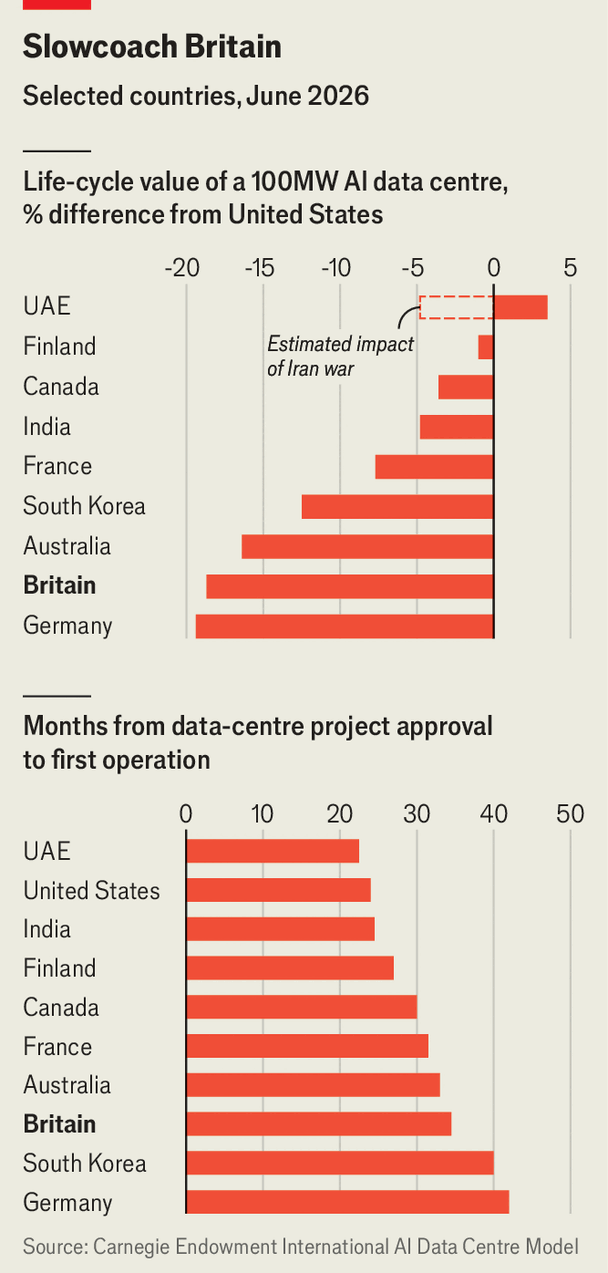
Britain’s data-centre woes(困境;问题) are depressingly familiar for British economists. Crippling industrial electricity prices (almost four times higher than in America) make the facilities expensive to run. Sclerotic planning rules and a long queue for connecting the centres to the electricity grid make them hard to build in the first place(首先;一开始). Hugh Milward of Microsoft, a software giant, complains: “It can take 18 months to build a data centre but eight years to get a grid connection.(建造一个数据中心只需18个月,但获得电网连接却需要八年。)” These delays are a serious liability(不利因素;负债) in a world where the speed of building, as opposed to(而不是;与…相反) cost or location, is the decisive factor for impatient investors.
英国数据中心的困境对英国经济学家来说令人沮丧地熟悉。高昂的工业电价(几乎是美国的四倍)使得设施运营成本高昂。僵化的规划规则以及连接电网的漫长排队使得数据中心从一开始就难以建设。软件巨头微软的休·米尔沃德抱怨道:“建造一个数据中心只需18个月,但获得电网连接却需要八年。”在一个建设速度(而非成本或位置)对不耐烦的投资者来说是决定性因素的世界里,这些延误是一个严重的劣势。
When speed is of the essence
当速度至关重要时