
Several years ago, Zachary Dunn was selling cars in a small Georgia town when he realised that he “was sick of making other people rich”.(几年前,扎卡里·邓恩在佐治亚州的一个小镇卖车时,意识到自己“厌倦了让别人发财”。) Soon he quit and began hawking(兜售,叫卖) hats emblazoned with(印有……图案或文字) slogans online with a college roommate. (Recent hits include “DADDY” and “Put it on my husband’s tab”.) Their business, The Mad Hatter Company, is set to(即将,一定会) make eight figures(八位数(千万美元级别)) in sales this year. Mr Dunn says he will never work for someone else again.
几年前,扎卡里·邓恩在佐治亚州的一个小镇卖车,当他意识到自己“厌倦了让别人发财”时,便很快辞职,与一位大学室友开始在线上兜售印有标语的帽子。(近期的热门款式包括“DADDY”和“Put it on my husband’s tab”。)他们的公司“疯帽子公司”今年销售额有望达到八位数。邓恩表示,他再也不会为别人打工了。
He is not alone. Since the beginning of 2024 an average of 466,000 new-business applications have been filed(提交(申请)) each month in America, according to data from the Census Bureau. This June saw(见证(某事件发生)) 531,000 applications, nearly double(几乎是……的两倍) the average monthly figure in 2019 (see chart).
他并非个例。根据人口普查局的数据,自2024年初以来,美国每月平均提交46.6万份新企业申请。今年6月,申请量达到53.1万份,几乎是2019年月均水平的两倍(见图表)。
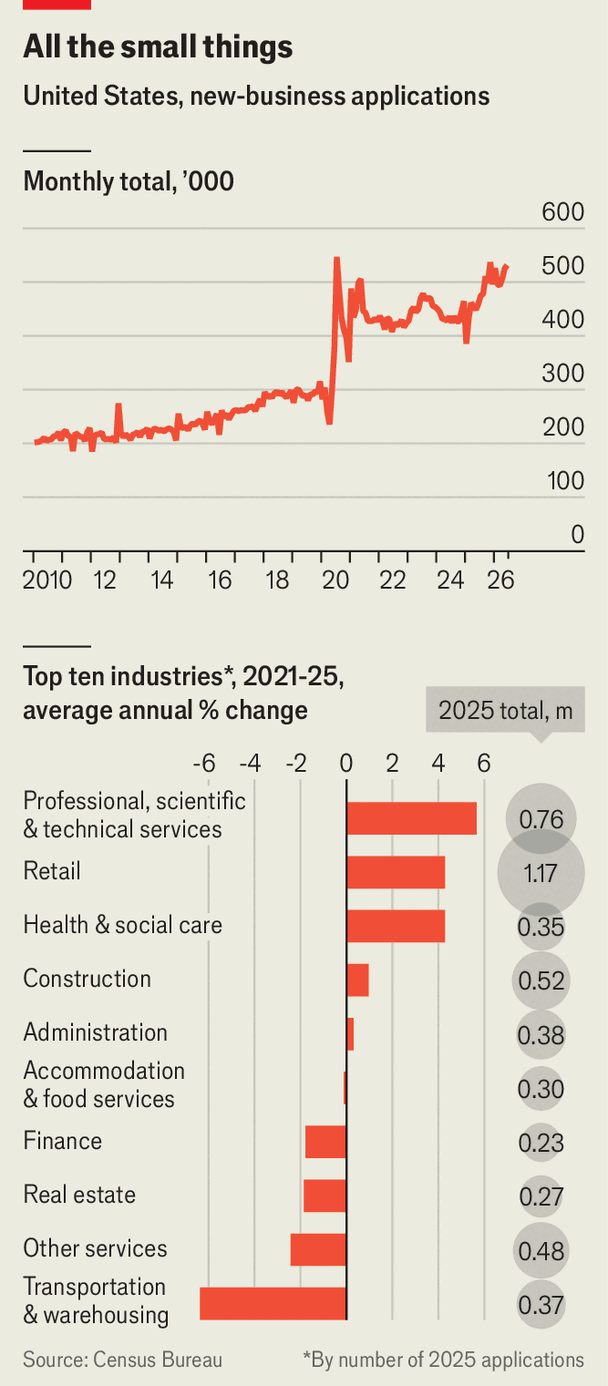
Americans have long loved the idea of being their own boss. (The term itself originates from colonial New Yorkers’ twisting of the Dutch word baas.) For at least two decades around 60% of them have said they would prefer to start their own business than to toil(辛苦工作,劳作) for someone else, according to Gallup(盖洛普(美国民调机构)), a pollster. Yet until recently fewer and fewer were living out that dream(实现那个梦想). As large firms lured(引诱,吸引) workers with the promise of stability, the share of self-employed Americans fell from 36% in 1910 to less than 10% in 2020, noted a report from the American Enterprise Institute, a think-tank(智库,智囊团).
美国人长期以来一直热爱自己当老板的想法。(这个词本身源于殖民地时期纽约人对荷兰语 baas 的改造。)根据民调机构盖洛普的数据,至少二十年来,约60%的美国人表示他们更愿意自己创业,而不是为别人辛苦工作。然而,直到最近,实现这一梦想的人却越来越少。智库美国企业研究所的一份报告指出,随着大公司以稳定承诺吸引工人,美国自雇人士的比例从1910年的36%下降到2020年的不足10%。
Flying solo
单飞