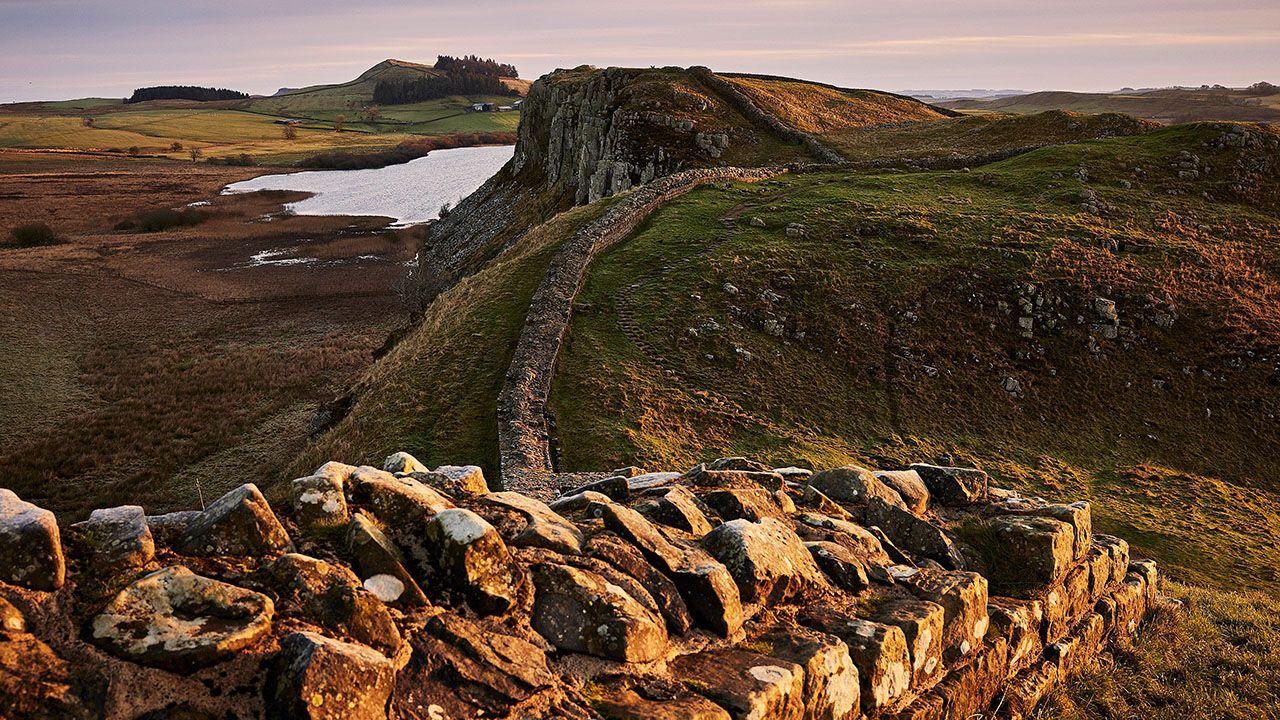
To Caledonian(喀里多尼亚的,古苏格兰的) tribesmen, it must have looked awesome(令人敬畏的,令人惊叹的). At Winshields Crags, the highest point of Hadrian’s Wall, the fortification runs toweringly atop a steep escarpment(陡坡,悬崖). For the legionaries(罗马军团士兵) who built it in the second century AD, hauling up the rocks would have been backbreaking. Today walkers carrying only water bottles can find themselves out of puff(气喘吁吁). “These Romans”, one pants, “must have been mad.”
在喀里多尼亚部落民看来,它一定显得令人敬畏。在哈德良长城的最高点温希尔德峭壁,防御工事高耸于陡峭的悬崖之上。对于公元二世纪建造它的罗马军团士兵来说,搬运石块定是极其艰苦的。如今,只带着水瓶的徒步者也会气喘吁吁。“这些罗马人,”一个人喘着气说,“一定是疯了。”
For almost 300 years Hadrian’s Wall was guarded by Syrian archers, Thracian cavalrymen and other forces dispatched by Rome to this northerly imperial redoubt(堡垒,防御工事). Tread this picturesque(风景如画的) stretch of northern England now, and you instead encounter history-hungry(渴望历史的) Americans, well-equipped Scandinavians and parents trying to stop their offspring eating the snacks too soon. The wall is an impressive monument—but, visitors may wonder, as they might at many ancient ruins, a monument to what?(这堵墙是一座令人印象深刻的纪念碑——但游客们可能会像在许多古代遗迹前那样好奇:它究竟纪念着什么?)
近三百年来,哈德良长城由叙利亚弓箭手、色雷斯骑兵以及罗马派遣到这座北方帝国堡垒的其他部队守卫。如今踏上英格兰北部这段风景如画的地带,你遇到的却是渴望历史的美国人、装备精良的斯堪的纳维亚人,以及试图阻止孩子过早吃零食的父母。城墙是一座令人印象深刻的纪念碑——但游客们可能会像在许多古代遗迹前那样好奇:它究竟纪念着什么?
To power, runs one answer. Let there be a wall, the emperor Hadrian decree(下令,颁布法令)d in 122ad, and in fairly short order(相当迅速地)—at least compared with recent border-wall projects—there was. His ran 117km across the Roman province of Britannia at its narrowest point. Today, in the ruins of its watchtowers, castles and forts, you try to imagine yourself as a Roman soldier facing barbarians, harsh military discipline, the biting(刺骨的,凛冽的) westerly wind and frigid(严寒的,冰冷的) winters. The lucky ones were sent warm socks and underwear from home.
一个答案是:权力。公元122年,哈德良皇帝下令“要有墙”,然后——至少与近期的边界墙项目相比——相当迅速地,墙就建成了。他的墙横跨罗马不列颠尼亚行省最窄处,全长117公里。如今,在瞭望塔、城堡和要塞的废墟中,你试图想象自己是一名罗马士兵,面对蛮族、严苛的军纪、刺骨的西风和寒冷的冬天。幸运的人会收到家里寄来的保暖袜子和内衣。