
Germany’s chancellor, Friedrich Merz, flew to Dublin on July 28th just to hand-deliver(亲手递送) a four-letter message: Nein. The recipient, Micheál Martin, his Irish counterpart(对应的人或职位), took over the rotating presidency of the Council of the European Union at the start of the month, and a new seven-year EU budget needs to be hammered out(经过艰苦谈判达成). Embattled(处境艰难的,四面楚歌的) at home, in part because of spending cuts and tax increases, Mr Merz insisted that the current proposal, around €1.7trn ($2trn), was unacceptable. “We need a budget draft that cuts across the board(全面地,整体地)—to the tune of(高达……(金额)) several hundred billion euros.”
德国总理弗里德里希·默茨于7月28日飞往都柏林,只为亲手递送一个四个字母的信息:Nein(不)。收信人是他的爱尔兰 counterpart 米歇尔·马丁,后者于本月初接任欧盟理事会轮值主席国,而一项新的七年期欧盟预算亟待敲定。默茨在国内因削减开支和增税而处境艰难,他坚称目前约1.7万亿欧元(合2万亿美元)的提案不可接受。“我们需要一份全面削减的预算草案——削减幅度达数千亿欧元。”
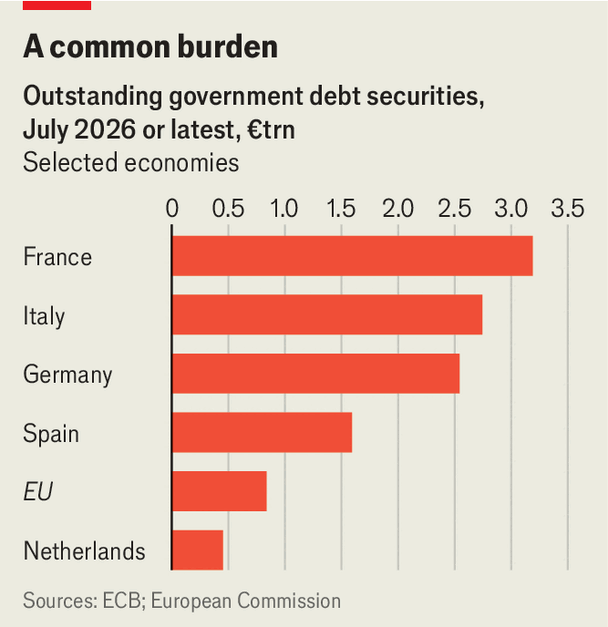
The cuts have to be even larger if the EU also has to start repaying its debt. The bloc has issued €840bn (worth about 4.5% of GDP) in the past, mostly to back its post-pandemic recovery fund (see chart). Servicing(支付(债务)利息) and repaying that will take about €168bn out of the budget. The European Commission would like to add more debt, above what is already planned for a defence-loan programme and €90bn in help for Ukraine; it wants a debt-funded tool, worth over €300bn, to respond to unforeseen crises. Perhaps Mr Merz should consider the upside(好处,积极面). A more debt-funded EU could help create a thriving(繁荣的,蓬勃发展的) market in European rather than(而不是) national bonds.
如果欧盟还必须开始偿还债务,削减幅度就必须更大。欧盟过去已发行了8400亿欧元(约占GDP的4.5%),主要用于支持其疫情后复苏基金(见图表)。偿还这些债务将耗去约1680亿欧元的预算。欧盟委员会希望在已计划的国防贷款项目和900亿欧元对乌援助之外再增加债务;它想要一个价值超过3000亿欧元的债务融资工具,以应对未预见的危机。或许默茨先生应该考虑一下好处。一个更多依赖债务融资的欧盟,有助于创造一个繁荣的欧洲债券市场,而非各国国债市场。
So far, EU debt is trading at a discount(折价,低于面值) to equivalent German paper, the continental benchmark(基准,参照标准): yields are about 0.3 percentage points higher. This is largely because the EU has no tax-raising powers and in a crisis Germany would surely honour(履行,兑现(承诺)) its own debts first. Nor is EU debt permanent; it is supposed to be repaid and not rolled over(展期,滚动续期). That is one reason why it is omitted(被排除,被省略) from sovereign-bond indices—which is unlikely to change, says an executive at an index provider. “You also need compensation for the lower liquidity(流动性),” adds Konstantin Veit of Pimco, a fixed-income asset manager. A liquid futures market for EU debt, say, would make hedging(对冲,套期保值) risk cheaper. Today’s derivatives market is too thin((市场)清淡,不活跃).
迄今为止,欧盟债券的交易价格相对于同等德国债券(欧洲大陆的基准)存在折价:收益率高出约0.3个百分点。这主要是因为欧盟没有征税权,而且在危机中德国肯定会优先偿还自己的债务。欧盟债券也不是永久性的;它需要偿还,不能展期。这就是它被排除在主权债券指数之外的原因之一——一家指数提供商的高管表示,这种情况不太可能改变。“你还需要为较低的流动性获得补偿,”固定收益资产管理公司Pimco的康斯坦丁·维特补充道。例如,一个流动性强的欧盟债券期货市场将使对冲风险更便宜。而如今的衍生品市场过于薄弱。