
At 8pm every weekday Trizza files into(鱼贯而入) a lift with other workers, sits at her desk in Manila, the capital of the Philippines, and starts calling personal-injury(人身伤害) lawyers in northern Virginia. Her job involves finding new business for an American chiropractic(脊椎按摩疗法) firm; it teams up with(与…合作) lawyers to treat their injured clients. Like many offshore staff in the Philippines, Trizza works long hours late at night in a language that is not her native tongue. But one thing has recently made her job easier: these days she dictates(口述) her emails to ChatGPT(人工智能聊天机器人), which quickly rewrites them in a “professional” tone.
每个工作日的晚上8点,特里扎和其他员工一起挤进电梯,在菲律宾首都马尼拉的办公桌前坐下,开始给北弗吉尼亚的人身伤害律师打电话。她的工作是为一家美国脊椎按摩诊所寻找新业务;该诊所与律师合作,为受伤客户提供治疗。和菲律宾许多离岸员工一样,特里扎在深夜长时间工作,使用的语言并非她的母语。但最近有一件事让她的工作变得轻松了:如今她口述邮件内容给ChatGPT,后者会迅速以“专业”的语气重写这些邮件。
Trizza is surprisingly enthusiastic about a technology that some have predicted will crush her industry.(特里扎对一种技术出人意料地热情,而一些人曾预测这种技术将摧毁她的行业。) Artificial intelligence is, in theory, increasingly capable of doing much of the offshore services industry’s traditional work, such as transcribing(转录,转写) notes or resolving customer queries(查询,疑问). In July last year Sam Altman(OpenAI首席执行官), OpenAI’s boss, declared that customer-support jobs would soon be “totally, totally gone” because of AI.
特里扎对一种技术出人意料地热情,而一些人曾预测这种技术将摧毁她的行业。理论上,人工智能越来越有能力完成离岸服务业的许多传统工作,例如转录笔记或解决客户查询。去年7月,OpenAI的老板萨姆·奥尔特曼宣称,由于人工智能,客户支持岗位将很快“彻底、彻底消失”。
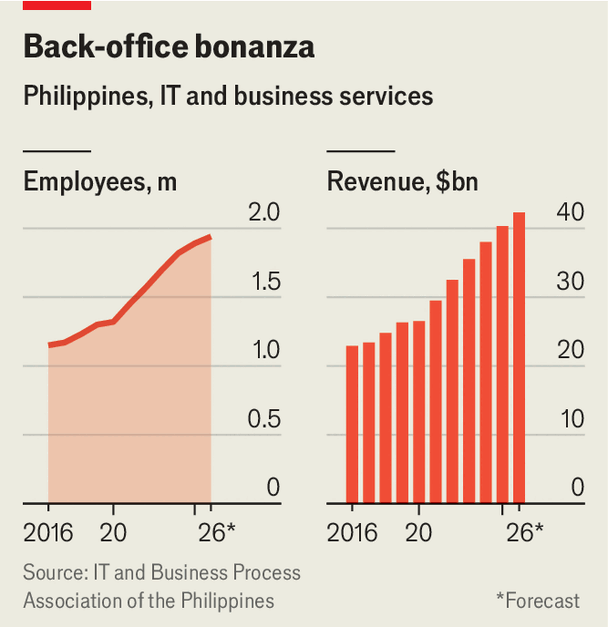
Yet in the Philippines—the world’s call-centre capital, where offshoring generates roughly 8% of GDP—business has so far held up(保持良好,未衰退) better than expected. IBPAP(菲律宾信息技术与业务流程协会), an industry body, reckons(估计,认为) around 1.9m Filipinos were working in “IT and business process management”, which includes all sorts of offshore services, at the end of 2025. That is 4% higher than in the previous year and 20% up from 2022. It expects revenue(收入,收益) from the services they export to rise 5% in 2026, to $42bn, following 6% growth in 2025.
然而,在菲律宾——世界呼叫中心之都,离岸外包约占其GDP的8%——迄今为止,业务表现好于预期。行业机构IBPAP估计,截至2025年底,约有190万菲律宾人从事“IT和业务流程管理”工作,其中包括各种离岸服务。这比上一年增长了4%,比2022年增长了20%。该机构预计,继2025年增长6%之后,2026年他们出口服务的收入将增长5%,达到420亿美元。
Tough calls
艰难抉择