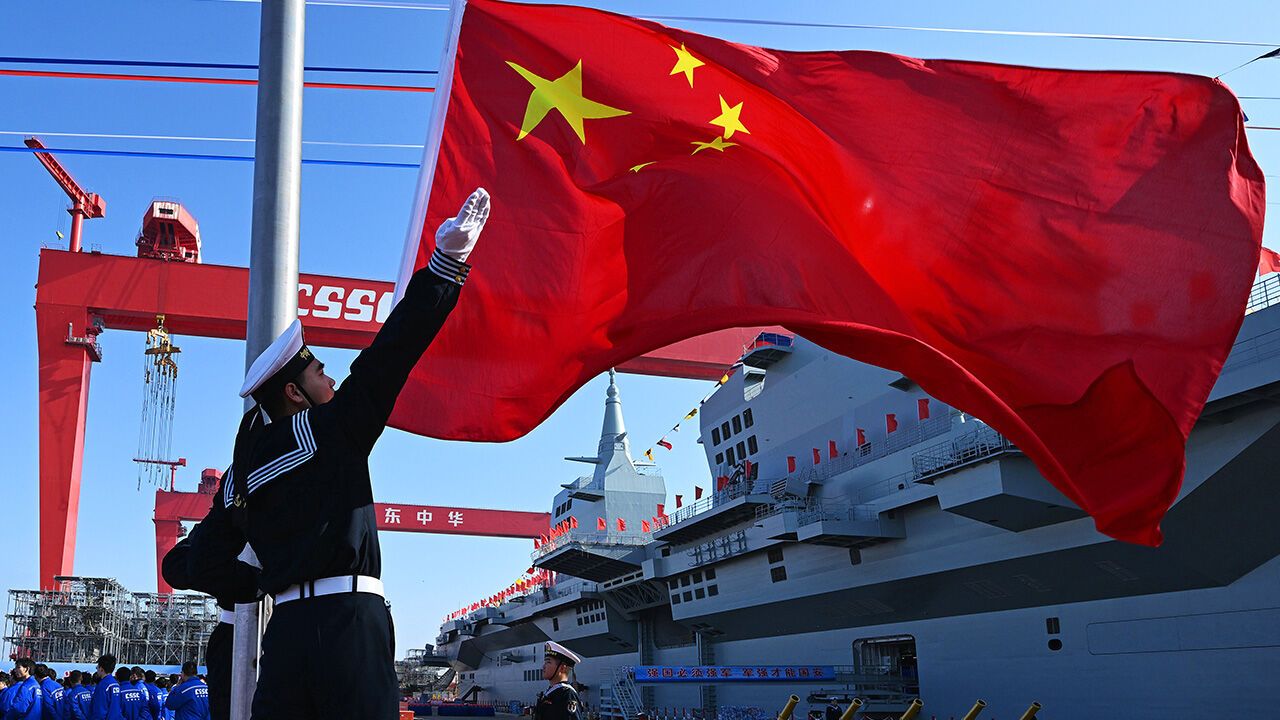
“The floating bulwark(壁垒;防御物) of our island” is how William Blackstone, an 18th-century British politician, described the Royal Navy. These days it is America, not Britannia, that rules the waves(称霸海洋). Yet the country’s naval dominance is increasingly under threat, as China has built a floating bulwark of its own.(然而,随着中国也建起了自己的浮动壁垒,美国的海洋主导地位正日益受到威胁。)
“我们这座岛屿的浮动壁垒”,这是18世纪英国政治家威廉·布莱克斯通对皇家海军的描述。如今,称霸海洋的是美国,而非不列颠。然而,随着中国也建起了自己的浮动壁垒,美国的海洋主导地位正日益受到威胁。
China’s efforts to control what it regards as its territorial waters (despite the objections of its neighbours) and project power globally have demanded a fast-expanding navy.(中国试图控制其视为领海的海域并在全球投射力量,这要求其海军快速扩张。) This has grown in short order(迅速地) from a small coastal-defence force to become the largest navy in the world, according to a report in 2020 by what was at the time America’s Department of Defence. China’s 350 “battle force” vessels—including battleships, aircraft carriers, minesweepers and auxiliary craft(辅助舰艇)—outnumbered America’s 293, a figure that had barely increased in two decades.
中国试图控制其视为领海的海域(尽管邻国反对)并在全球投射力量,这要求其海军快速扩张。根据2020年美国国防部(当时名称)的一份报告,中国海军已迅速从一支小型海岸防御力量成长为世界上最大的海军。中国的350艘“战斗部队”舰艇——包括战列舰、航空母舰、扫雷舰和辅助船只——超过了美国的293艘,而美国这一数字在二十年间几乎没有增长。
China’s plans to expand its armada(舰队) to 435 ships by 2030 seem plausible(看似合理的). America’s hopes of adding 58 to its fleet by 2031—and the construction of a “Trump Class” nuclear-powered battleship, proposed by the president last year—are far-fetched(牵强的;不切实际的). That is because China has something America sorely lacks: its rise as a naval power has been underpinned by a vast commercial-shipbuilding industry.(这是因为中国拥有美国所严重缺乏的东西:其海军强国的崛起得到了庞大商用造船业的支撑。)
中国计划到2030年将其舰队扩充至435艘舰船,这似乎可行。而美国希望在2031年前为其舰队增加58艘舰船——以及总统去年提出的建造“特朗普级”核动力战列舰——则显得不切实际。这是因为中国拥有美国所严重缺乏的东西:其海军强国的崛起得到了庞大商用造船业的支撑。