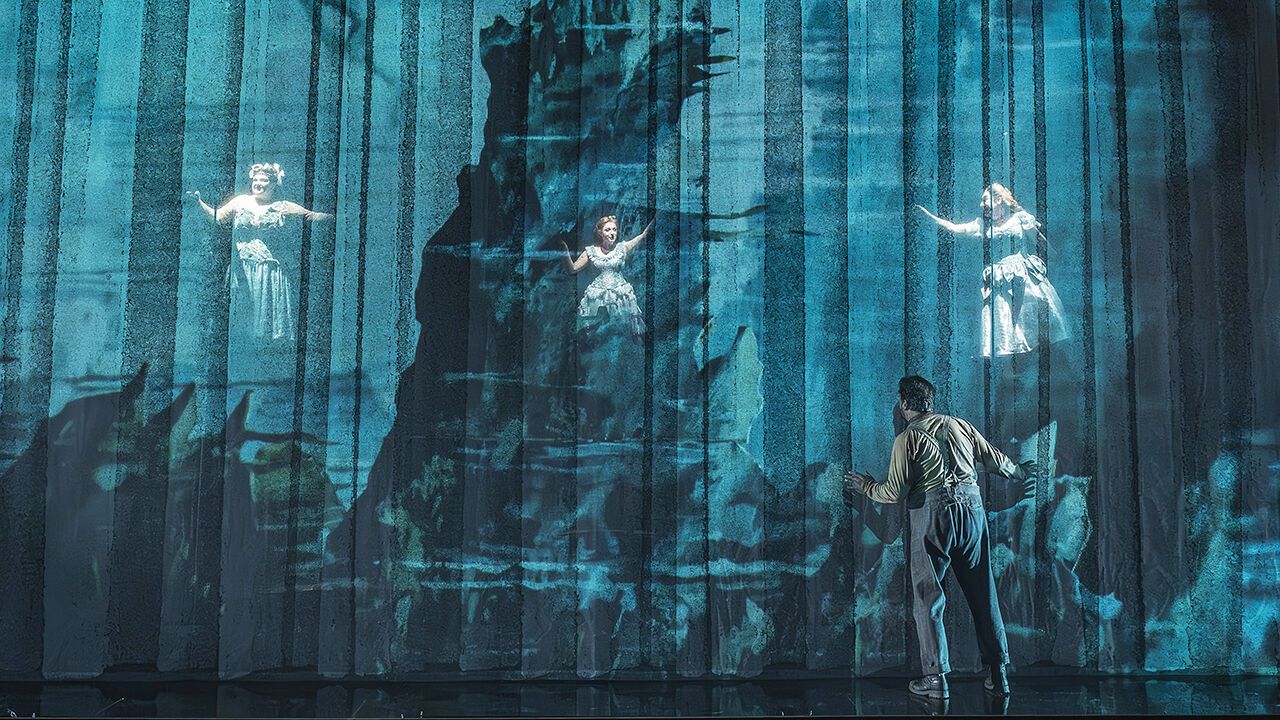
KAISER WILHELM I was there. So was Ludwig II of Bavaria, who had footed(支付(费用)) much of the bill. Dom Pedro II of Brazil had sailed over. Friedrich Nietzsche, a philosopher, was also present—though he pretended he hadn’t been. Bayreuth was a Bavarian backwater(闭塞的地方;死水), but 150 years ago it seemed like the centre of the world. The “Ring of the Nibelung” (known as the “Ring” cycle), which Richard Wagner had composed and written over 26 years, had its first complete performance in August 1876 in the opera house that he had built to present the monumental work.(《尼伯龙根的指环》在瓦格纳自建歌剧院首演。)
德皇威廉一世在场。巴伐利亚的路德维希二世也在,他承担了大部分费用。巴西的佩德罗二世乘船而来。哲学家弗里德里希·尼采也在场——尽管他假装自己没去过。拜罗伊特曾是巴伐利亚的一个闭塞小镇,但150年前它似乎是世界的中心。理查德·瓦格纳历时26年创作并撰写的《尼伯龙根的指环》(即《指环》系列)于1876年8月在他为呈现这部巨作而建造的歌剧院中首次完整演出。
In his influence, audacity(大胆;放肆) and divisiveness(分裂性;引起分歧), Wagner was art’s analogue(类似物;对应物) of Elon Musk. His ideas “overran intellectual discourse for several generations”, writes Alex Ross in “Wagnerism”. His works remain lodged in Western culture’s subconscious, revealing both the human condition and the age that encounters them. That is especially true of the “Ring”, the most magnum of Wagner’s opuses. If you’ve read or watched “The Lord of the Rings”, you’ve fallen under its spell at second hand(间接地;二手的). If you experience it you may find yourself obsessing the way Wagner’s contemporaries did.(如果你亲身体验,你可能会像瓦格纳的同代人那样痴迷。)
在影响力、大胆和争议性方面,瓦格纳是艺术界的埃隆·马斯克。亚历克斯·罗斯在《瓦格纳主义》中写道,他的思想“主导了数代人的思想话语”。他的作品仍深植于西方文化的潜意识中,既揭示了人类境况,也揭示了遭遇它们的时代。《指环》尤其如此,它是瓦格纳最宏大的作品。如果你读过或看过《指环王》,你已间接中了它的魔咒。如果你亲身体验,你可能会像瓦格纳的同代人那样痴迷。
Though royalty attended its birth, the “Ring” is a child of revolution. In 1849, a year of European insurgency(叛乱;起义), Wagner was doing his bit(尽自己的一份力) to dethrone(废黜;推翻) the king of Saxony by reporting troop movements. He fled to Zurich soon after starting work on the “Ring” cycle. His starting point was Germanic and Scandinavian legends written down in the 13th century, in particular the “Nibelungenlied(《尼伯龙根之歌》,中世纪日耳曼史诗)”, the Icelandic Eddas and the Volsunga saga. This was natural source material for a revolutionary who wanted Germany’s patchwork(拼凑之物;拼布) of principalities to become a nation state.
尽管有皇室出席其诞生,《指环》却是革命的产物。1849年,欧洲叛乱之年,瓦格纳通过报告军队调动来尽自己的一份力,试图推翻萨克森国王。他开始创作《指环》系列后不久便逃往苏黎世。他的出发点是13世纪记载的日耳曼和斯堪的纳维亚传说,尤其是《尼伯龙根之歌》、冰岛《埃达》和《沃尔松格萨迦》。对于一个希望德国各公国拼凑而成的国家成为民族国家的革命者来说,这是自然的素材。
Forever Rhine
永远的莱茵
Beyond Valhalla
超越瓦尔哈拉