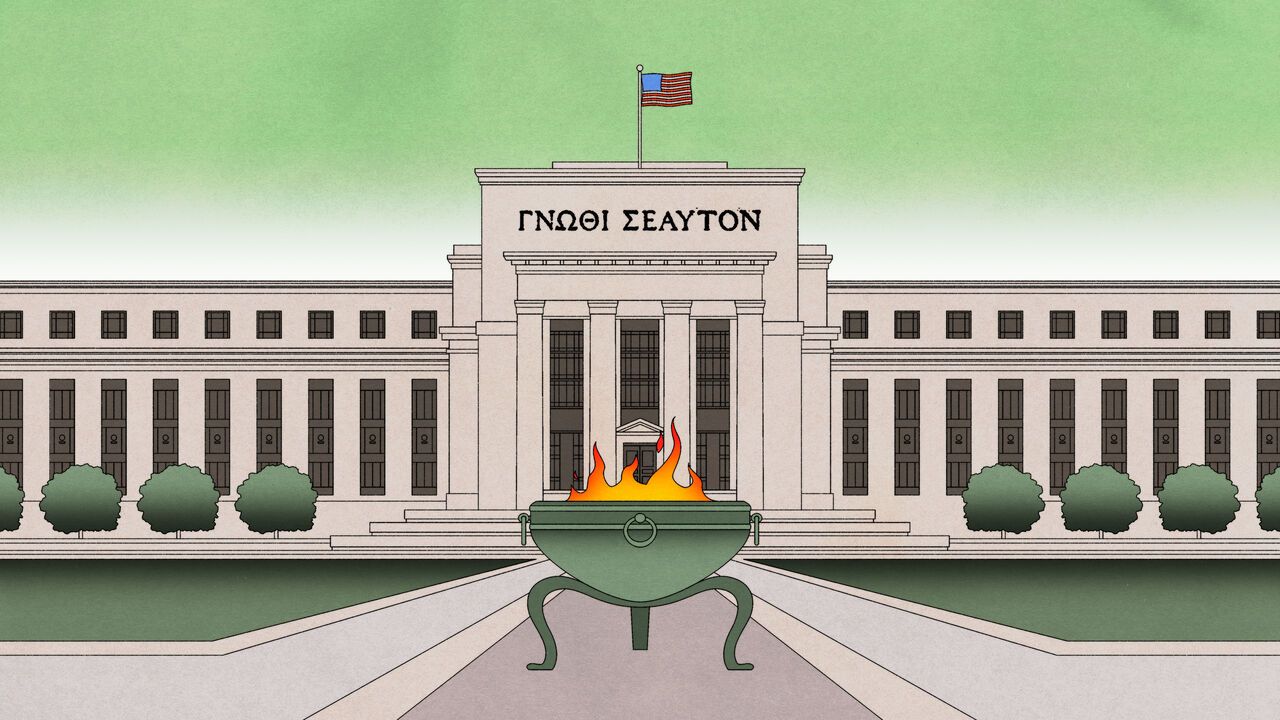
THE ORACLE of Delphi had a gift for being right. Seated in Apollo’s temple, the Pythia delivered her prophecies in riddle(谜语;谜团)s. When Croesus, king of Lydia, asked whether he should attack Persia, she replied that he would “destroy a great empire”. So he did: his own. The philosopher Heraclitus described the Delphic method as one that “neither conceals nor reveals, but gives a sign”. Her commanding pronouncements demanded attention; their ambiguity made them almost impossible to prove wrong.(她那威严的宣告引人注目;其模糊性使它们几乎不可能被证明是错误的。)
德尔斐神谕有一种正确无误的天赋。皮提亚坐在阿波罗神庙中,以谜语的形式传达她的预言。当吕底亚国王克罗伊斯询问是否应进攻波斯时,她回答说,他将“摧毁一个伟大的帝国”。他确实做到了:摧毁的是他自己的帝国。哲学家赫拉克利特将德尔斐的方法描述为“既不隐藏也不揭示,而是给出一个征兆”。她那威严的宣告引人注目;其模糊性使得它们几乎不可能被证明是错误的。
For much of the 20th century central bankers cultivated a similar mystique(神秘感;神秘气氛). Their authority rested on the impression that they were omniscient(无所不知的) and omnipotent(无所不能的). Since in truth they were neither, obscurantism(蒙昧主义;故弄玄虚) was useful. Montagu Norman, governor of the Bank of England from 1920 to 1944, was said to operate by the maxim(格言;准则) “never explain, never excuse”. In 1981 Karl Brunner, a Swiss economist, described central banking as thriving on the impression that it was “an esoteric(深奥的;秘传的) art”. Alan Greenspan, the late former chairman of the Federal Reserve, perfected this art with “Fedspeak(美联储腔;美联储式含糊言辞)”. He had learned, he said, to “mumble with great incoherence(含糊不清地嘟囔)”.
在20世纪的大部分时间里,央行行长们培养了一种类似的神秘感。他们的权威建立在一种印象之上,即他们无所不知、无所不能。既然事实上他们两者都不是,蒙昧主义便是有用的。1920年至1944年担任英格兰银行行长的蒙塔古·诺曼据说奉行“永不解释,永不辩解”的准则。1981年,瑞士经济学家卡尔·布伦纳将央行描述为依靠“一种深奥艺术”的印象而蓬勃发展。已故的美联储前主席艾伦·格林斯潘用“美联储腔”完善了这门艺术。他说,他已经学会了“含糊其辞地嘟囔”。
Kevin Warsh is trying to restore a little Delphic mystery to the Fed. After his second press conference in late July commentators described his words as “confusing”, “internally contradictory(相互矛盾的)” and “nonsense”. The words are also sparse(稀疏的;简练的)r. Under Mr Warsh, policy statements have shrunk from roughly 340 words to half that or less. “Forward guidance”—language indicating where policy may be headed—has been stripped out. In June he declined to submit his own interest-rate projection(预测;投影) and said his colleagues’ forecasts had been written in pencil with “big erasers”(用铅笔写,还带着大橡皮擦). He is also considering fewer policy meetings and press conferences.
凯文·沃什正试图为美联储恢复一点德尔斐式的神秘感。在7月底的第二次新闻发布会后,评论人士将他的言论描述为“令人困惑”、“自相矛盾”和“胡说八道”。他的措辞也更加简练。在沃什的领导下,政策声明已从大约340个单词缩减到一半或更少。“前瞻性指引”——即表明政策可能走向的语言——已被剔除。6月,他拒绝提交自己的利率预测,并表示他同事的预测是用铅笔写的,还带着“大橡皮擦”。他还在考虑减少政策会议和新闻发布会的次数。
Humble drag
谦逊的拖累