
IF THE HYPE about artificial intelligence is to be believed, India’s tech industry should bear the brunt of(首当其冲,承受主要冲击) any incoming wave of AI job losses. Before the breakthroughs that made chatbots functional, tech types quip(打趣,俏皮地说)ped that AI stood for “actually Indians”, as seemingly whizzy(炫酷的,高科技的) tech was really the work of humans in Hyderabad or Bangalore. But now the sort of tasks outsourced to India—software development and routine business processes such as payroll—are among those AI is best placed to take over from people.(但现在外包给印度的这类任务——软件开发以及薪资处理等日常业务流程——正是人工智能最有可能从人类手中接管的任务。)
如果关于人工智能的炒作可信,那么印度科技行业应首当其冲,承受即将到来的人工智能失业潮。在让聊天机器人变得实用的技术突破之前,科技界人士曾打趣说,AI代表“实际上是印度人”(actually Indians),因为看似炫酷的技术其实是海得拉巴或班加罗尔的人类的工作。但现在,外包给印度的这类任务——软件开发以及薪资处理等日常业务流程——正是人工智能最有可能从人类手中接管的任务。
Yet evidence of job losses is not easy to come by(获得,找到). That is partly because data are patchy(不完整的,零散的). Around 6m Indians work in information technology, according to Nasscom, the industry body. Almost anywhere else, that would be a vast number (roughly equal to the population of Denmark). But it is just a tiny slice(部分,份额), around 1%, of India’s workforce. It is also a group that statistics agencies find hard to sample, says Rosa Abraham, an economist at Azim Premji University. IT workers are rich by Indian standards and often live in gated communities(封闭式社区) to which survey-takers cannot get access. Zealous security guards turn away those without prior approval.
然而,失业的证据并不容易找到。部分原因是数据不完整。根据行业机构Nasscom的数据,约有600万印度人从事信息技术工作。几乎在其他任何地方,这都将是一个庞大的数字(大致相当于丹麦的人口)。但这只是印度劳动力的一小部分,约占1%。阿齐姆·普雷姆吉大学的经济学家罗莎·亚伯拉罕表示,这也是统计机构难以抽样的群体。按印度标准,IT工作者收入较高,通常住在调查人员无法进入的封闭式社区。热心的保安会赶走那些未经事先批准的人。
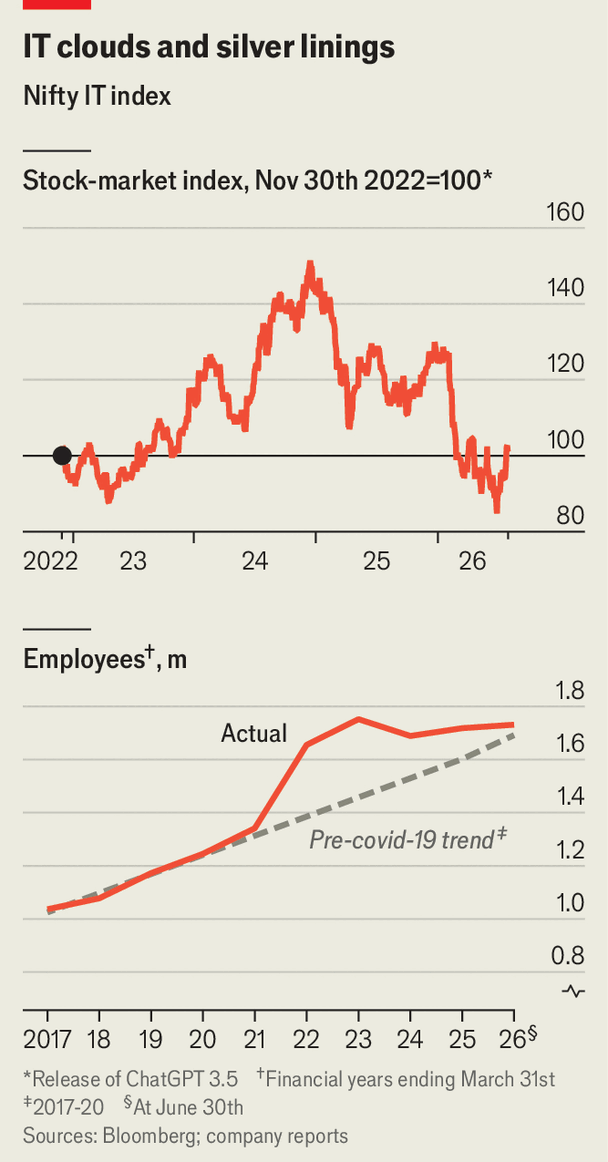
But it is also because AI is not making much of a dent. AI booster(拥护者,支持者)s can point to job cuts at India’s IT giants, including Tata Consultancy Services (TCS) and Infosys. For years employment at companies in the Nifty IT index, a group of listed big consultancies, grew by around 6% a year. Since the release of ChatGPT in late 2022 headcount(员工人数,人头数) has declined—from 1.71m in 2023 to 1.66m at the end of June, according to The Economist’s estimates. But that is not solely down to(归因于,由于) chatbots. Aggregate headcount is still 9% above the pre-pandemic trend (see chart), and the consultancies are pulling back after a hiring boom. The Indian operations of Capgemini, Cognizant and Accenture, three big foreign firms, display a similar pattern.
但这也因为人工智能并未产生太大影响。AI的拥护者可以指出印度IT巨头(包括塔塔咨询服务公司和印孚瑟斯)的裁员。多年来,Nifty IT指数(一组上市大型咨询公司)中企业的就业人数每年增长约6%。自2022年底ChatGPT发布以来,员工人数有所下降——根据《经济学人》的估计,从2023年的171万降至6月底的166万。但这并不完全归因于聊天机器人。总员工人数仍比疫情前趋势高出9%(见图表),咨询公司在招聘热潮后正在收缩。凯捷、高知特和埃森哲三家大型外国公司在印度的业务也呈现出类似模式。
Bankable skills
可获利的技能