Morita Akio, a physics graduate, co-founded(共同创立) the Tokyo Telecommunications Engineering Corporation, an electronics-maker, in 1946. The startup’s 20 employees toiled(辛苦劳作) in a small room in a firebombed department store in Tokyo, handmaking heated cushions and voltmeters. Determination and resourcefulness(足智多谋) turned the firm into a $140bn electronics giant today called Sony. Other well-known Japanese firms such as Honda, launched in a ruined factory also in 1946, or more recently SoftBank, beginning in 1981 as a small software distributor run by 24-year-old Son Masayoshi, have similar tales of battling against the odds(与逆境抗争). Yet in recent decades Japan has lost its knack(诀窍,本领) for producing startups that make an impact.
物理系毕业生盛田昭夫于1946年与人共同创立了东京通信工业公司,这是一家电子产品制造商。这家初创企业的20名员工在东京一家被烧毁的百货商店的小房间里辛苦劳作,手工制作电热垫和电压表。决心和足智多谋使这家公司变成了如今价值1400亿美元的电子巨头索尼。其他知名的日本公司,如同样于1946年在一座废墟工厂中创立的本田,以及较近期的软银(1981年由24岁的孙正义创办,起初是一家小型软件分销商),都有类似与逆境抗争的故事。然而近几十年来,日本已经失去了打造有影响力的初创企业的诀窍。
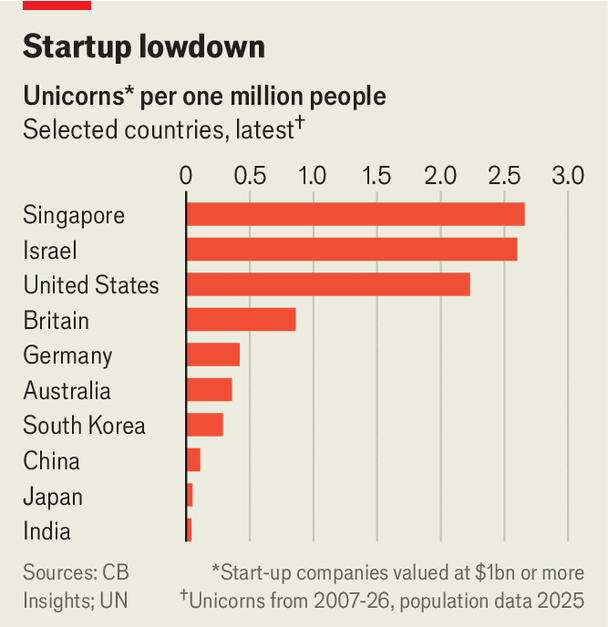
Only six of the current 1,400 unicorns(独角兽公司) (startups worth over $1bn) worldwide were born in Japan, according to CB Insights, a research firm. The country has yet to spawn(催生,产生) a “decacorn(十角兽,估值超百亿美元)”, a startup worth more than $10bn. South Korea and Australia have bred five and six, respectively, and also lead in unicorns by size of population (see chart). A new wave of venture capitalists and entrepreneurs, backed by the state, are trying to put that right(纠正,改善). They will have to confront(面对,正视) three problems.
根据研究公司CB Insights的数据,目前全球1400家独角兽(估值超过10亿美元的初创企业)中,只有6家诞生于日本。日本尚未培育出“十角兽”,即估值超过100亿美元的初创企业。韩国和澳大利亚分别培育了5家和6家,并且在按人口规模计算的独角兽数量上也领先(见图表)。由国家支持的新一波风险投资家和企业家正试图扭转这一局面。他们将不得不面对三个问题。
The first is Japan’s shortage(短缺,不足) of risk-taking(冒险的,承担风险的) venture capital. A decade ago traditional VC funds were rare. In 2015 only $1bn in VC capital was deployed(部署,投入) across fewer than 500 deals, according to Pitchbook, a data firm. Though VC fund-raising has grown to around $6bn in 2025, that compares unfavourably with(相形见绌) markets such as Australia, an economy half the size of Japan’s which raised $5bn last year. Seemingly natural backers of Japanese startups, such as Softbank’s VC arm, plough(投入(大量资金)) the vast majority of their funds into overseas firms.
第一个问题是日本缺乏敢于冒险的风险投资。十年前,传统的风投基金还很罕见。根据数据公司Pitchbook的数据,2015年仅有10亿美元的风投资本被部署到不到500笔交易中。尽管到2025年风投募资额已增长至约60亿美元,但与澳大利亚等市场相比仍相形见绌——澳大利亚的经济规模只有日本的一半,去年却筹集了50亿美元。日本初创企业看似天然的投资者,如软银的风投部门,却将绝大部分资金投入海外公司。