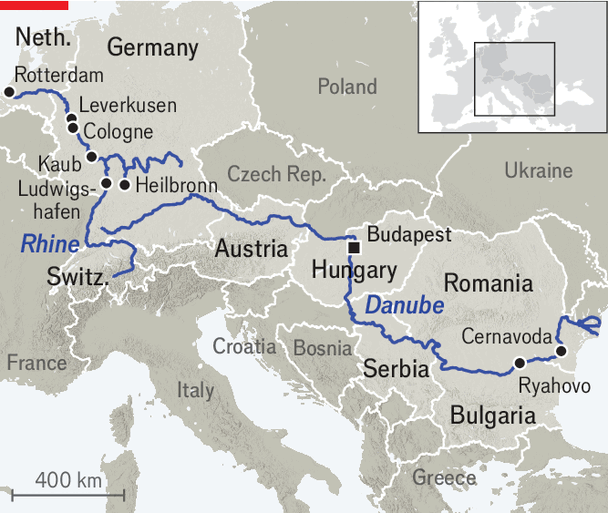
Western Europe is facing its fifth heatwave(热浪,持续高温天气) this year, and the waters of the Rhine and Danube rivers are the lowest since official records began in 1880. The gauge in Kaub, a medieval town in Rhineland-Palatinate, serves as the benchmark for the 1,230km-long river because it is near the Middle Rhine’s shallowest section.(考布镇的水位计因靠近中莱茵河最浅处,成为整条河的基准。) On August 12th it showed a maximum depth of 12cm. The previous record, during a drought in 2018, was 25cm. It could fall to single digits(个位数) in the next few days, according to Germany’s association of inland shipping. That would cut the navigable Rhine in two.
西欧正面临今年第五次热浪,莱茵河和多瑙河的水位已降至自1880年有官方记录以来的最低点。考布是莱茵兰-普法尔茨州的一座中世纪小镇,其水位计因靠近中莱茵河最浅河段,成为这条1230公里长河流的基准。8月12日,该水位计显示最大水深为12厘米。此前的纪录是2018年干旱期间的25厘米。据德国内河航运协会称,未来几天水位可能降至个位数。这将使可通航的莱茵河一分为二。
The Danube, the second-longest river in Europe (after Russia’s Volga), is hardly doing better(情况也好不到哪里去). A gauge in Budapest shows 26cm, well below the previous record low(历史最低纪录) of 33cm in 2018. That threatens the electricity supply. Paks, a nuclear plant near Budapest that produces 30% of Hungary’s electricity, and Cernavoda, Romania’s state-owned nuclear plant, have been partly or completely switched off(关闭,切断): they use the Danube’s water for cooling. Both countries’ governments have asked industry and households to cut back(削减,减少) electricity use as much as possible. Car companies such as Audi in Hungary and Dacia in Romania have scaled back(缩减,缩小规模) production.
多瑙河是欧洲第二长河(仅次于俄罗斯的伏尔加河),情况也好不到哪里去。布达佩斯的水位计显示水深26厘米,远低于2018年33厘米的此前最低纪录。这威胁到电力供应。布达佩斯附近的帕克斯核电站(生产匈牙利30%的电力)和罗马尼亚国有的切尔纳沃德核电站已部分或完全关闭,因为它们使用多瑙河水冷却。两国政府已要求工业界和家庭尽可能减少用电。匈牙利奥迪和罗马尼亚达契亚等汽车公司已缩减产量。
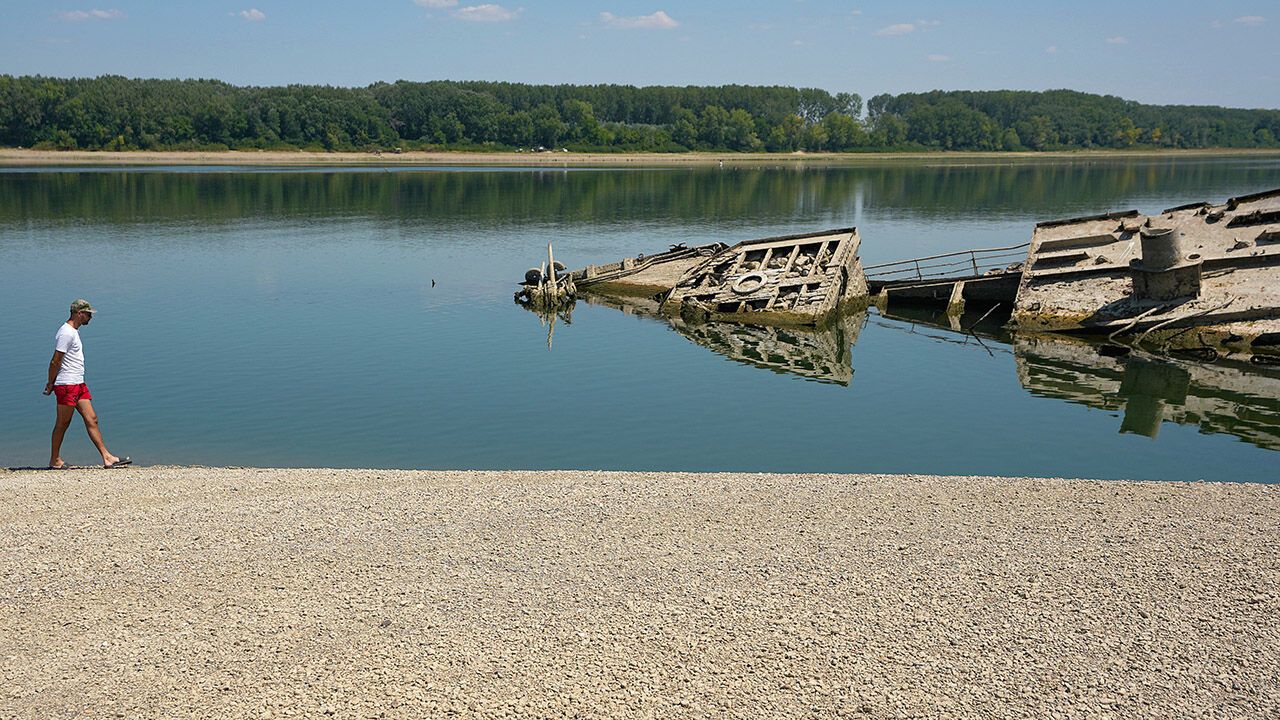
Along both rivers the low waters have exposed “hunger stones(饥饿石,历史低水位标记)”, river boulders(巨石,大圆石) carved between the 15th and 19th centuries to mark low water levels and warn of crop failures and famine. In Budapest they laid bare(暴露,揭露) a Wehrmacht(德国国防军(纳粹时期)) motorcycle from the second world war. Near the village of Ryahovo in Bulgaria, the remains of a mammoth(猛犸象) became visible. In the Serbian stretch of the Danube a fleet of Nazi-era warships were revealed, among some 200 the Germans scuttled in September 1944 to stop Soviet troops from using the river.(塞尔维亚多瑙河段暴露了约200艘1944年德国凿沉的纳粹战舰。)
两条河流沿岸的低水位暴露了“饥饿石”,这些河石雕刻于15至19世纪,用于标记低水位并警示农作物歉收和饥荒。在布达佩斯,它们暴露了一辆二战时期的国防军摩托车。在保加利亚里亚霍沃村附近,一头猛犸象的遗骸清晰可见。在塞尔维亚境内的多瑙河段,一批纳粹时代的战舰被揭露,这些是1944年9月德国人凿沉的约200艘船只中的一部分,目的是阻止苏联军队利用该河。