
TRACKING sexually transmitted infections (STIs) is not easy. Many who carry them show no symptoms. Testing is patchy(不均衡的,零散的). And risky behaviour tends to go unnoticed, since sex (thankfully) is usually performed in private.(而且高风险行为往往不被注意,因为性行为(幸好)通常在私下进行。) But public-health authorities do their best(尽力而为), and in recent years they have reported a sharp increase in cases of STIs in Europe.
追踪性传播感染(STI)并非易事。许多携带者没有症状。检测覆盖不均衡。而高风险行为往往不被注意,因为性行为(幸好)通常在私下进行。但公共卫生当局尽力而为,近年来他们报告欧洲的性传播感染病例急剧增加。
Rates are up dramatically over the past decade (see chart), though they dipped(下降,下滑) during the pandemic because of a combination of less diligent surveillance and less casual shagging(性交(俚语)). After 2021 they leapt(猛增,跳跃) upwards. In May the European Union’s Centre for Disease Prevention and Control (ECDC) reported that in 2024, the most recent year for which it has figures, there were some 100,000 cases of gonorrhoea in Europe, over three times as many as in 2015.(今年5月,欧盟疾病预防与控制中心(ECDC)报告称,2024年(其拥有数据的最新年份)欧洲约有10万例淋病病例,是2015年的三倍多。) Cases of syphilis(梅毒) more than doubled(增加了一倍多), to around 46,000. Chlamydia is an exception: after peaking in 2022, prevalence has fallen back to the level of 2015.
过去十年,感染率大幅上升(见图表),尽管疫情期间因监测不够勤勉和随意性行为减少而有所下降。2021年后,感染率急剧攀升。今年5月,欧盟疾病预防与控制中心(ECDC)报告称,2024年(其拥有数据的最新年份)欧洲约有10万例淋病病例,是2015年的三倍多。梅毒病例增加了一倍多,达到约4.6万例。衣原体是个例外:在2022年达到峰值后,其流行率已回落至2015年的水平。
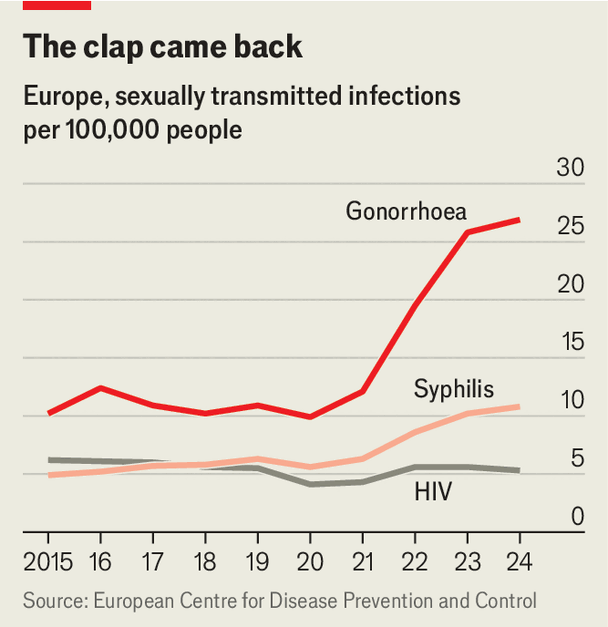
The jump(激增,跳跃) just after covid could be partly explained by testing facilities coming back online(恢复运转), says Dr Andrew Winter, an STI specialist in Glasgow. But the continued rise since then cannot. “There is a true increase in transmission happening,” says Dr Stela Bivol, who runs the World Health Organisation’s European office for STIs.(“传播确实在增加,”世界卫生组织欧洲性传播感染办公室主任斯特拉·比沃尔博士说。)
格拉斯哥的性传播感染专家安德鲁·温特博士表示,疫情刚结束时的病例激增可部分归因于检测设施恢复运转。但此后的持续上升则无法用此解释。“传播确实在增加,”世界卫生组织欧洲性传播感染办公室主任斯特拉·比沃尔博士说。