
EACH DOLLAR given to charity may soon do less good. In the coming years the marginal cost(边际成本) of saving a child’s life from disease or starvation could jump from about $5,000 to $15,000, or more. This sounds worrying. In fact it is good news, argues Alexander Berger of Coefficient Giving, one of Silicon Valley’s most influential grantmakers. Non-profits like his spend on cheap, scalable interventions first—say, by buying malaria nets before malaria vaccines. If an influx of donations pays for all the inexpensive ways of doing good, then the rest flows into costlier acts of altruism that can save yet more lives.(如果大量捐款支付了所有廉价的善举,剩余资金就会流向更昂贵的利他行为,从而拯救更多生命。)
每一美元捐给慈善机构,其效用可能很快就会降低。未来几年,从疾病或饥饿中拯救一个孩子生命的边际成本可能会从约5000美元跃升至15000美元甚至更高。这听起来令人担忧。但硅谷最具影响力的资助机构之一Coefficient Giving的亚历山大·伯杰认为,这其实是好消息。像他这样的非营利组织会先花钱购买廉价且可扩展的干预措施——比如在购买疟疾疫苗之前先购买蚊帐。如果大量捐款支付了所有廉价的善举,那么剩余的资金就会流向更昂贵的利他行为,从而拯救更多生命。
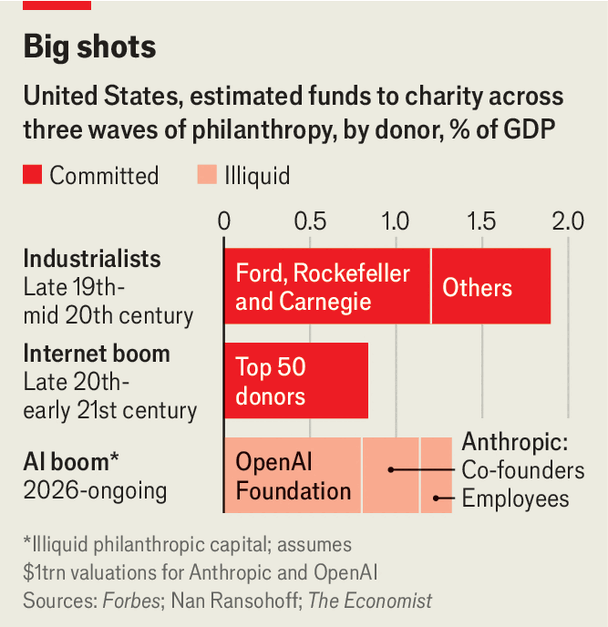
Just such a deluge(洪水般的泛滥) of cash may be coming. Non-profits are preparing for the largest one-time surge in philanthropic giving in history. The boom in AI is making a lot of tech types in Silicon Valley very rich. The initial public offerings (IPOs) of shares in Anthropic and OpenAI, which could happen as early as this year, could value the AI labs at more than $1trn apiece—enriching their founders, employees and investors.(Anthropic和OpenAI的首次公开募股最早可能今年发生,这两家AI实验室的估值可能各自超过1万亿美元——这将使它们的创始人、员工和投资者致富。) Many are thinking about how to give their cash away; cumulatively(累积地) they have already promised to donate an estimated $430bn, roughly equivalent to two Marshall Plans(马歇尔计划) in today’s money.
这样一股巨额资金洪流可能即将到来。非营利组织正在为历史上最大规模的一次性慈善捐赠激增做准备。人工智能的繁荣让硅谷的许多科技人士变得非常富有。Anthropic和OpenAI的首次公开募股(IPO)最早可能今年发生,这两家AI实验室的估值可能各自超过1万亿美元——这将使它们的创始人、员工和投资者致富。许多人正在考虑如何捐出他们的钱;累计起来,他们已经承诺捐赠约4300亿美元,大致相当于今天的两个马歇尔计划。
The industrial age produced Carnegie, Rockefeller and Ford(卡内基、洛克菲勒和福特), whose fortunes endowed universities and built concert halls. The internet age created the Giving Pledge(捐赠誓言): Bill and Melinda Gates, Mark Zuckerberg and their ilk(他们这类人) supported farming, schooling and health care for the world’s poorest. Nan Ransohoff, who works on public goods at Stripe, a payments company, predicts that AI may now create a third, much larger wave of giving. The ambition that led many of today’s newly minted rich to build world-altering businesses now leads them, like their predecessors, to want to cure the world’s ills.(当年引领许多新晋富豪创建改变世界的企业的雄心,如今像他们的前辈一样,引导他们想要治愈世界的弊病。)
工业时代产生了卡内基、洛克菲勒和福特,他们的财富资助了大学并建造了音乐厅。互联网时代创造了“捐赠誓言”:比尔和梅琳达·盖茨、马克·扎克伯格等人支持世界上最贫困人口的农业、教育和医疗保健。支付公司Stripe负责公共产品的南·兰索霍夫预测,人工智能现在可能创造第三波规模大得多的捐赠浪潮。当年引领许多新晋富豪创建改变世界的企业的雄心,如今像他们的前辈一样,引导他们想要治愈世界的弊病。
Give me a reason
给我一个理由
Give it away, give it away now
捐出去,现在就捐出去