That science’s best days are behind it, and its rate of progress is slowing, is an old claim.(科学最佳时期已过、进步放缓,这是老说法。) And, since science itself is a perfectly good subject for scientists to investigate, many have looked into it.
科学的最佳时期已经过去、其进步速度正在放缓,这是一个由来已久的说法。而且,由于科学本身就是一个非常适合科学家研究的课题,许多人对此进行了探究。
One notable(值得注意的,显著的) contribution came in 2023, when Michael Park, then a PhD student at the University of Minnesota, and his colleagues published a paper in Nature. It analysed citation patterns in 45m scientific papers and 3.9m patents and concluded that the “disruptiveness(颠覆性)” of both had fallen off a cliff(急剧下降,暴跌) since the 1950s. This was widely reported (including in The Economist). Its findings found their way into(进入,渗入) Congressional hearings(国会听证会) and speeches by White House officials.
一个值得注意的贡献出现在2023年,当时明尼苏达大学的博士生迈克尔·帕克及其同事在《自然》杂志上发表了一篇论文。该论文分析了4500万篇科学论文和390万项专利的引用模式,并得出结论:自20世纪50年代以来,两者的“颠覆性”都急剧下降。这一结果被广泛报道(包括《经济学人》)。其发现还进入了国会听证会和白宫官员的演讲中。
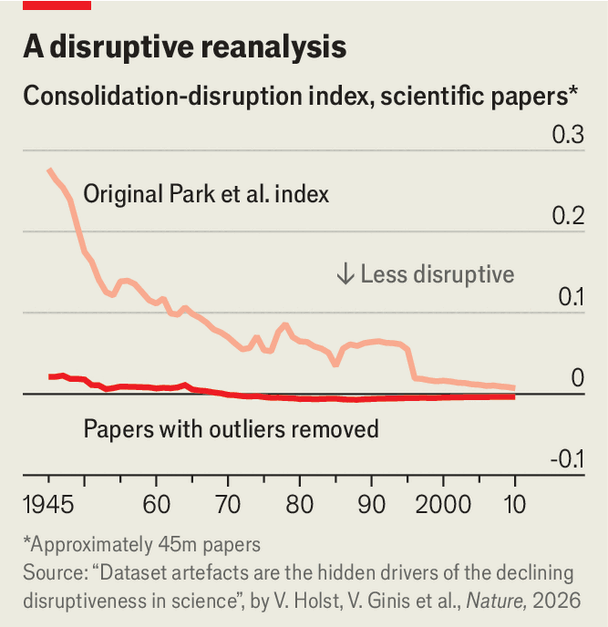
On August 12th came a twist(转折,意外变化). Nature published a follow-up paper arguing that Dr Park and his colleagues’ conclusions were mostly illusory(虚幻的,错觉的), caused by problems with the data set they had analysed. Correct those, argues Vincent Holst, a PhD student at Vrije University, in Brussels, and his co-authors, and most of the decline in disruptiveness goes away (see chart).(纠正这些问题,大部分下降就会消失。)
8月12日出现了转折。《自然》发表了一篇后续论文,认为帕克博士及其同事的结论大多是虚幻的,是由他们分析的数据集的问题造成的。布鲁塞尔自由大学的博士生文森特·霍尔斯特及其合著者认为,纠正这些问题后,颠覆性下降的大部分现象就消失了(见图表)。