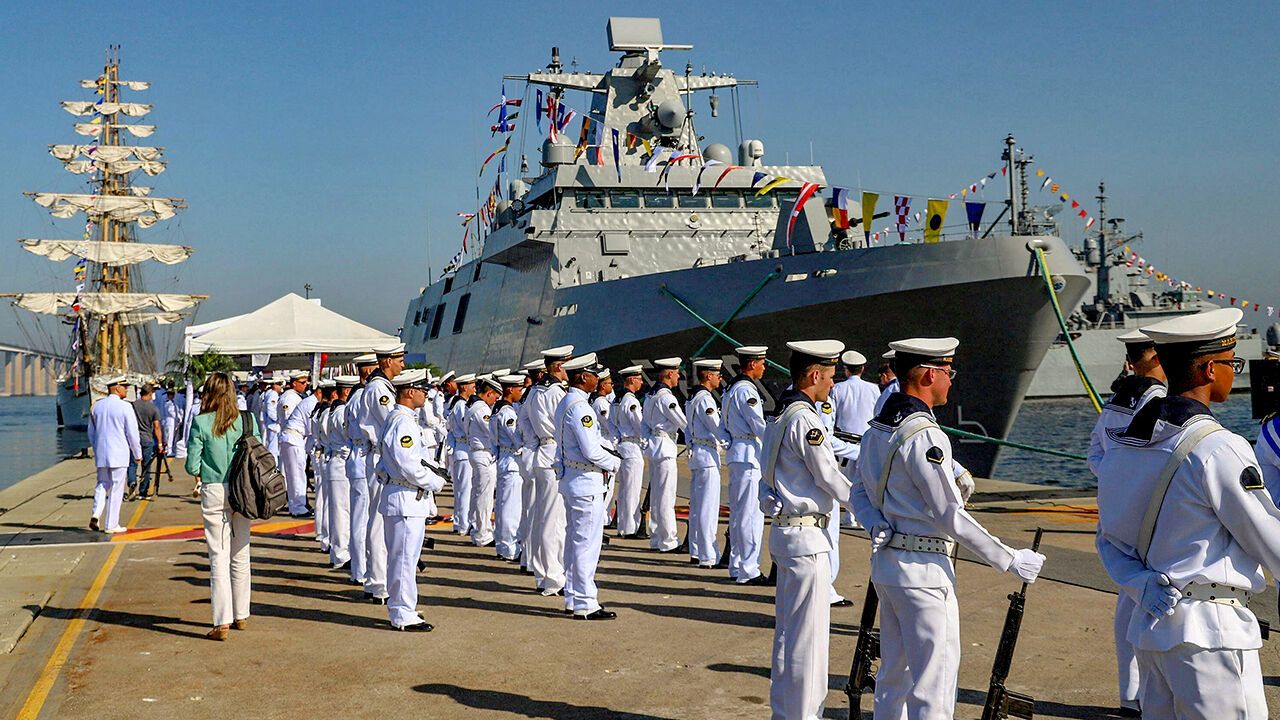
Over the past few decades Brazil’s naval shipbuilding efforts have mostly sunk without trace(消失得无影无踪) (literally, in the case of one aircraft-carrier, which was scuttled(凿沉(船)) in an effort to hide its uselessness). Since the 1970s the country has launched and abandoned at least three warship programmes. But in April it commissioned(正式启用(军舰)) a new frigate(护卫舰)-class ship, the Tamandaré, the first of four to be built entirely in Brazil. The construction of a second batch of four has been provisionally(暂时地,临时地) agreed. The vessel(舰船,船只) can detect submarines and fire missiles and torpedoes(鱼雷). A helicopter pad(直升机停机坪) allows for wide areas to be patrolled without a fleet of costly destroyers. The craft would be a decent staple(主要产品,主食) for any navy.
过去几十年,巴西的海军舰艇建造努力大多石沉大海(字面意义上的:有一艘航空母舰因无用而被凿沉以掩盖其缺陷)。自20世纪70年代以来,该国至少启动并放弃了三个军舰项目。但今年4月,巴西服役了一艘新的护卫舰“塔曼达雷”号,这是四艘完全在巴西建造的舰艇中的第一艘。第二批四艘的建造已初步达成协议。该舰能探测潜艇,发射导弹和鱼雷。直升机甲板使其无需一支昂贵的驱逐舰舰队就能巡逻广阔区域。这艘舰艇对任何海军来说都是不错的主力装备。
Thyssenkrupp Marine Systems (TKMS), a German shipbuilding company, agreed to work with Embraer, Brazil’s aerospace champion(冠军,佼佼者), to construct the ships in Itajaí, in the southern state of Santa Catarina. Their successful production is a dramatic improvement for a country that lacks a reputation for military muscle. Brazil has hitherto(迄今为止) used second-hand(二手的,用过的) European frigates built in the 20th century. The structure of the project is designed to encourage domestic supply chains(供应链) and create a skilled local workforce(劳动力,员工队伍). The country has previously built some small warships at home, but the Tamandaré-class is a big step up(重大进步,飞跃).
德国造船公司蒂森克虏伯海事系统(TKMS)同意与巴西航空航天巨头巴西航空工业公司合作,在南部圣卡塔琳娜州的伊塔雅伊建造这些舰艇。它们的成功生产对一个缺乏军事力量声誉的国家来说是一个巨大的进步。巴西迄今一直使用20世纪建造的二手欧洲护卫舰。该项目的结构旨在鼓励国内供应链并培养熟练的本地劳动力。该国此前曾在国内建造过一些小军舰,但塔曼达雷级是一个巨大的飞跃。
This success marks a broader effort to beef up(加强,增强) defence. As a share of GDP, Brazil’s military spending has for 30 years been flat(持平的,无增长的) or falling. It is now 1.1%. That will rise. Brazil spent $24bn on its armed forces last year, an increase of 13% from 2024. As well as the new frigates, it also has plans to build nuclear-powered(核动力的) submarines, which would be a first for a non-nuclear power(无核国家). In 2022 the government ordered 19 tactical(战术的) and refuelling(加油的) aircraft. In March it unveiled(公布,推出) the first supersonic(超音速的) fighter assembled(组装) in Brazil, a Gripen(鹰狮战斗机) jet built in partnership with Sweden’s Saab.
这一成功标志着加强国防的更广泛努力。作为GDP的一部分,巴西的军费开支30年来一直持平或下降。目前为1.1%。这一比例将会上升。巴西去年在武装部队上花费了240亿美元,比2024年增长13%。除了新护卫舰,它还计划建造核动力潜艇,这将是首个非核国家这样做。2022年,政府订购了19架战术和加油飞机。今年3月,它推出了第一架在巴西组装的超音速战斗机,这是与瑞典萨博公司合作制造的“鹰狮”喷气式飞机。
Already anxious
早已焦虑