FOR NEARLY two decades Torigoe Atsushi, who is 50, has worked in the stockrooms(仓库,储藏室) of a fashion firm in Tokyo. His income rose only modestly, and it recently fell after his employer cut bonuses and reworked its pay scheme; he now earns about ¥3.6m ($22,600) a year.(他的收入增长缓慢,最近因雇主削减奖金和调整薪酬方案而下降;目前年收入约360万日元。) Then he spotted(发现,注意到) the firm’s recruitment ads, offering newcomers higher salaries(为新员工提供更高薪水). “It’s great that younger people are getting better pay,” he says. “But why not raise mine?”
近二十年来,50岁的鸟越淳在东京一家时装公司的仓库工作。他的收入增长缓慢,最近因雇主削减奖金并调整薪酬方案而有所下降;目前年收入约360万日元(合2.26万美元)。后来他看到了公司的招聘广告,为新员工提供更高的薪水。“年轻人得到更好的报酬是好事,”他说,“但为什么不提高我的呢?”
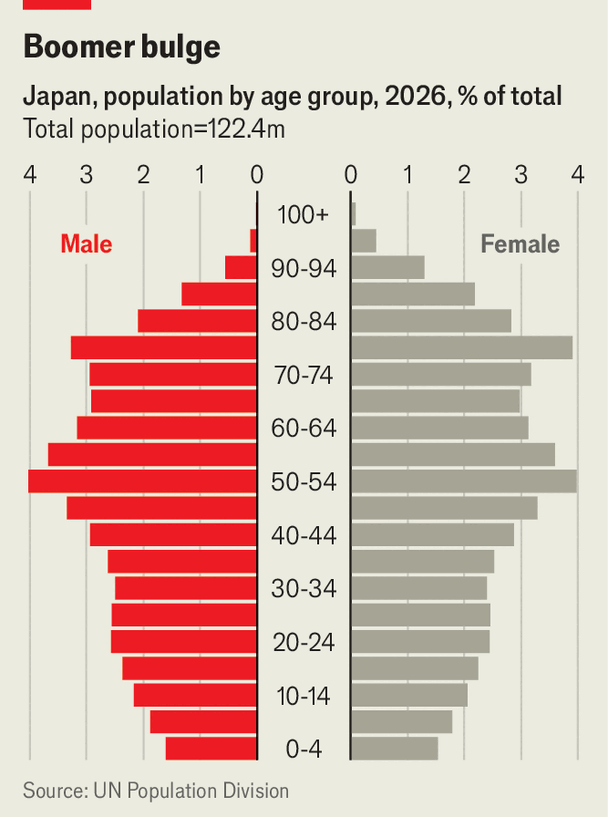
Mr Torigoe belongs to Japan’s “ice-age” generation: workers who entered the labour market between 1993 and 2004, after the country’s economic bubble burst(破裂,爆发) and many companies stopped hiring. The ice-agers often endured years of insecure work and low pay. Now in their 40s and 50s (thus Generation X), they are losing out(吃亏,失利) again. Japan is emerging from decades of deflation(通货紧缩), prices are rising and companies are handing out(发放,分发) their biggest pay increases in a generation. But the ice-agers are not benefiting. Worse may come when this cohort of baby-boomers’ children—the last bulge in Japan’s population pyramid (see chart)—drifts into retirement.(当婴儿潮一代的子女(人口金字塔最后凸起)退休时,情况可能更糟。)
鸟越先生属于日本的“冰河期”一代:即1993年至2004年间进入劳动力市场的劳动者,当时日本经济泡沫破裂,许多公司停止招聘。冰河期一代常常多年从事不稳定工作,收入微薄。如今他们已四五十岁(即X世代),再次吃亏。日本正走出数十年的通缩,物价上涨,企业正发放一代人以来最大幅度的加薪。但冰河期一代并未受益。当这批婴儿潮一代的子女——日本人口金字塔的最后一块凸起(见图表)——逐渐退休时,情况可能更糟。
The ice-agers’ fortunes contrast starkly(鲜明地,明显地) with those of the generation that came just before. During the bubble years of the 1980s, companies hired voraciously(贪婪地,大量地). College students found their mailboxes stuffed with(塞满,填满) offer letters, or were treated to fancy meals by employers keen to woo(争取,追求) them. Everything changed as the bubble popped in the early 1990s. Japan’s rigid(僵化的,严格的) employment system made it hard for firms to shed(摆脱,去除) existing workers, so they cut hiring instead. The ratio of job openings to college applicants fell from nearly three at its peak to below one by 2000. Nagai Toshihisa, who graduated in 1999, shortly after the Asian financial crisis, abandoned his hope of working for a securities firm.(永井敏久1999年毕业,在亚洲金融危机后不久,放弃了在证券公司工作的希望。) “It felt utterly stupid looking for jobs,” he recalls. Many in his generation sent out dozens, even hundreds, of applications, to no avail(毫无效果). It did not help that the ice-age cohort was such a big one, adding to the oversupply.
冰河期一代的境遇与之前的一代形成鲜明对比。在20世纪80年代的泡沫时期,公司大量招聘。大学生发现邮箱里塞满了录用通知,或被渴望吸引他们的雇主请吃大餐。随着90年代初泡沫破裂,一切都变了。日本僵化的就业制度使企业难以裁减现有员工,于是它们转而减少招聘。职位空缺与大学毕业生的比例从峰值时的近3比1下降到2000年的1比1以下。1999年毕业的永井敏久,在亚洲金融危机后不久,放弃了在证券公司工作的希望。“找工作感觉极其愚蠢,”他回忆道。他这一代许多人发出几十份甚至几百份申请,却毫无结果。冰河期一代人数众多,加剧了供过于求,这也无济于事。