BOND MARKETS are unsettled(不安的,动荡的), and so, in turn(反过来,相应地), is America’s government. On August 19th the Treasury said that from next month it would increase its own purchases of longer-dated debt.(8月19日,财政部表示将从下月起增加对较长期债务的购买。) This reflects “increasing administration unease(不安,忧虑)” about yields, believe analysts at Deutsche Bank.
债券市场动荡不安,美国政府也随之不安。8月19日,美国财政部表示,从下个月起将增加对较长期限债务的购买。德意志银行的分析师认为,这反映出“政府日益加剧的不安”情绪。
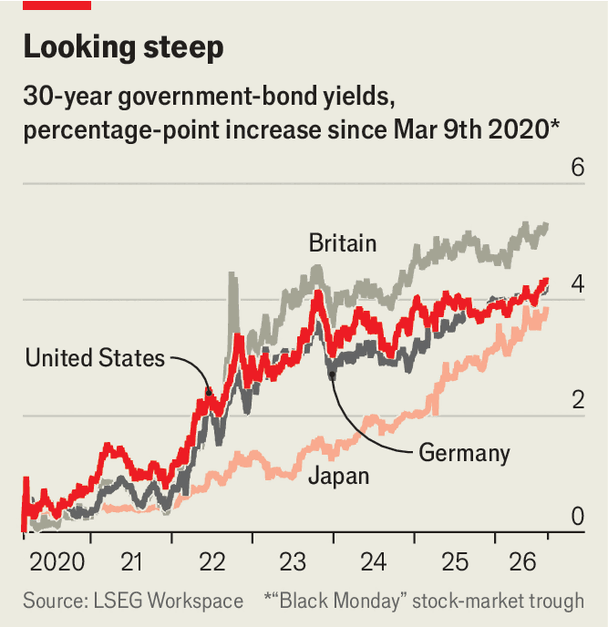
Officials have good reason to worry about rising borrowing costs. The yield(收益率) on ten-year Treasuries reached its highest since January 2025 on August 18th. Scarier still(更可怕的是), that on 30-year bonds briefly passed 5.3%, its highest since 2007. And America is not alone. Bondholders are demanding more from governments across much of the rich world (see chart). Yields on British, French and German long-dated bonds have all reached levels not seen in more than a decade. Japanese 30-year yields, long the lowest in big economies, are close to an all-time high. The rout(溃败,抛售潮) eased somewhat on August 19th. But yields are unlikely to fall much soon. What is amiss(不对劲,有毛病)?
官员们有充分的理由担心借贷成本上升。8月18日,十年期美国国债收益率升至2025年1月以来的最高水平。更令人恐惧的是,30年期国债收益率一度突破5.3%,为2007年以来的最高水平。而且美国并非个例。债券持有人正要求富裕世界大部分国家的政府支付更高的回报(见图表)。英国、法国和德国的长期国债收益率均达到十多年未见的水平。日本30年期国债收益率长期以来在主要经济体中最低,如今已接近历史高位。8月19日,抛售潮有所缓解,但收益率短期内不太可能大幅下降。到底出了什么问题?
For one thing(首先,其一), unlike equity investors, bond traders appear to be reading the news. The Strait of Hormuz remains largely shut and looks likely to stay that way for a while. Fuel prices in America—particularly for diesel, on which much of commercial haulage relies—have soared in turn. The fund managers surveyed monthly by Bank of America, most of whom are heavily invested in stocks, are sanguine.(美国银行每月调查的基金经理大多重仓股票,他们持乐观态度。) On average, they expect Brent crude(原油), the global oil benchmark(基准), to trade at $76 a barrel by the end of the year, only slightly up from before the start of the war. Bond markets seem less sure.
首先,与股票投资者不同,债券交易员似乎正在关注新闻。霍尔木兹海峡基本仍处于关闭状态,而且可能还会持续一段时间。美国的燃料价格——尤其是商业运输所依赖的柴油——随之飙升。美国银行每月调查的基金经理大多重仓股票,他们持乐观态度。平均而言,他们预计全球石油基准布伦特原油到年底将交易在每桶76美元,仅比战前略有上涨。债券市场似乎不那么确定。