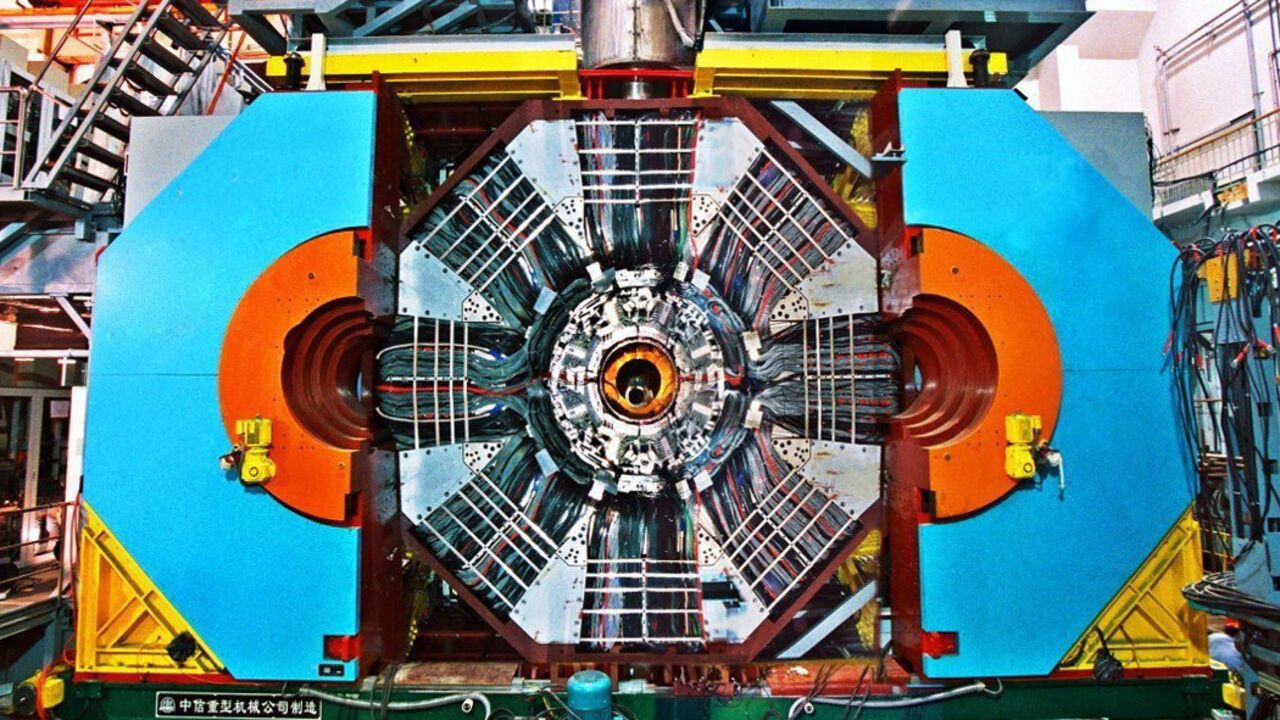
A NEW subatomic(亚原子的) particle has made the leap(实现飞跃) from theory to reality. So say the scientists of the Beijing Spectrometer III (BESIII), a Chinese physics experiment. Speaking on their behalf at the International Conference on High Energy Physics (ICHEP) on August 5th, Jin Shan, of Nanjing University, announced that the team have discovered a glueball—a hitherto hypothetical particle that is unlike any which physicists have seen before.(金山代表团队在ICHEP上宣布发现胶球,这是一种前所未有的假设粒子。)
一种新的亚原子粒子已从理论跃入现实。北京谱仪III(BESIII)——一项中国物理实验——的科学家们如此宣称。8月5日,在国际高能物理会议(ICHEP)上,南京大学的金山代表团队宣布,他们发现了一种胶球——一种迄今仍属假设的粒子,与物理学家此前见过的任何粒子都不同。
The nuclei(核(复数)) of atoms are held together by a phenomenon called the strong nuclear force(强核力). What better name, then, for the particle responsible for carrying this force than the “gluon”? Gluons interact with quarks, another type of fundamental particle, wrangling(强行控制,使就范) them into pairs and triplets to create protons, neutrons and other such “composite(复合的,合成的)” particles. But gluons also interact with other gluons, raising the possibility of gluons gluing themselves together into a different kind of composite particle: the glueball.
原子核由一种称为强核力的现象束缚在一起。那么,对于负责传递这种力的粒子,还有什么名字比“胶子”更贴切呢?胶子与夸克(另一种基本粒子)相互作用,将它们束缚成对或三体,形成质子、中子等“复合”粒子。但胶子之间也相互作用,这提高了胶子自身粘合形成另一种复合粒子的可能性:胶球。
Physicists’ theories predict glueballs. Finding one is another matter, since those theories also suggest glueballs will be difficult to distinguish from the torrents of more mundane quark-based particles produced in machines like the Beijing Electron-Positron Collider II, to which BESIII is attached.(找到胶球是另一回事,因为理论表明胶球难以与普通粒子区分。) Almost half a century of searching has left researchers empty-handed(空手而归,一无所获).
物理学家的理论预言了胶球的存在。但找到胶球又是另一回事,因为这些理论还表明,胶球将难以与北京正负电子对撞机II(BESIII所依附的装置)等机器中产生的大量更普通的夸克基粒子区分开来。近半个世纪的搜寻让研究人员一无所获。