
“HEALTH-CARE reform...is the great unfinished business(未竟的事业) of our society,” observed Ted Kennedy, a Democratic senator, before he died in 2009. America was the only large rich country that did not have universal health care. Instead, its system was a patchwork(拼凑之物,杂烩). The old, hard-up(缺钱的,贫困的) and disabled were covered by government programmes. Most working-age Americans got insurance through their jobs. But pity those without such coverage, who had to navigate the expensive and often bewildering individual insurance market.(但那些没有此类保障的人就可怜了,他们不得不在昂贵且常常令人困惑的个人保险市场中摸索。)
“医疗改革……是我们社会未竟的伟大事业,”民主党参议员泰德·肯尼迪在2009年去世前如此感叹。美国是唯一没有全民医保的大型富裕国家。相反,其医疗体系如同拼凑之物。老年人、贫困者和残疾人由政府项目覆盖。大多数处于工作年龄的美国人通过工作获得保险。但那些没有此类保障的人就可怜了,他们不得不在昂贵且常常令人困惑的个人保险市场中摸索。
The Affordable Care Act, passed in 2010, tried to fix that. It kept America’s system more or less(大致,差不多) intact, but expanded Medicaid, the public programme for the impecunious(贫穷的,身无分文的), and created new “exchanges” where individuals could compare and purchase plans. Even Obamacare’s most fervent(热情的,热烈的) advocates acknowledged, in private, that it was an imperfect bandage(创可贴,绷带), particularly for those on the individual market. It was never enough for the likes of Bernie Sanders(伯尼·桑德斯,美国左翼参议员), a leftist senator who called for a single-payer system(单一支付者体系). That cause is now being taken up by a new generation of Democrats, such as Abdul El-Sayed, the party’s Senate nominee in Michigan, who has made health-care-for-all central to his campaign. New data explain the urgency: Obamacare’s bandage is unravelling(瓦解,崩溃).
2010年通过的《平价医疗法案》试图解决这个问题。它大致保持了美国医疗体系的完整,但扩大了针对贫困者的公共项目医疗补助,并创建了新的“交易所”,个人可以在那里比较和购买保险计划。即使是奥巴马医改最狂热的支持者也私下承认,它是一块不完美的创可贴,尤其是对个人市场而言。对于伯尼·桑德斯这样的左翼参议员来说,这永远不够,他呼吁建立单一支付者体系。这一事业现在正被新一代民主党人接手,比如密歇根州参议员提名人阿卜杜勒·埃尔-赛义德,他将全民医保作为竞选的核心。新数据解释了紧迫性:奥巴马医改的创可贴正在脱落。
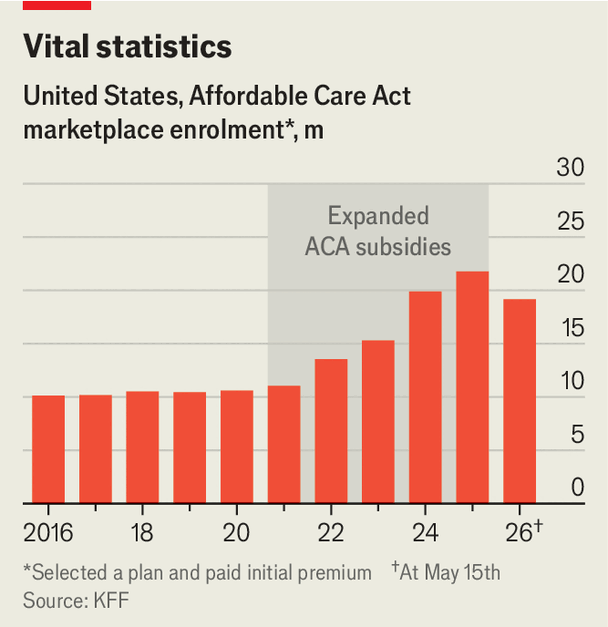
That’s in part(部分地) due to cuts to Medicaid. It’s also because the exchanges are in bad health. Obamacare offered some subsidies to defray(支付,承担费用) the cost of individual plans. But the law’s mandate(强制要求,授权) to buy insurance was in effect(实际上,事实上) eliminated in 2019, and uptake(接受率,参与率) on the exchanges was limited until 2021, when Congress made subsidies more generous for those who had already qualified and available to some who hadn’t. Enrolment then nearly doubled by 2025. Democrats sought unsuccessfully to extend the extra financial assistance, which would have cost about $35bn this year—about as much as the direct costs of the Iran war, according to the Pentagon’s estimate.(民主党试图延长这项额外财政援助,但未成功,这项援助今年本将花费约350亿美元——根据五角大楼的估计,大约相当于伊朗战争的直接成本。) Now that those subsidies are diminished, the individual market looks more frail than ever.
这在一定程度上是由于医疗补助的削减。也因为交易所本身状况不佳。奥巴马医改提供了一些补贴来支付个人计划的费用。但该法案强制购买保险的规定实际上在2019年被取消,交易所的参保率一直有限,直到2021年国会为那些已有资格的人提供了更慷慨的补贴,并让一些原本没有资格的人也能获得补贴。到2025年,参保人数几乎翻了一番。民主党试图延长这项额外财政援助,但未成功,这项援助今年本将花费约350亿美元——根据五角大楼的估计,大约相当于伊朗战争的直接成本。如今,随着这些补贴减少,个人市场看起来比以往任何时候都更加脆弱。