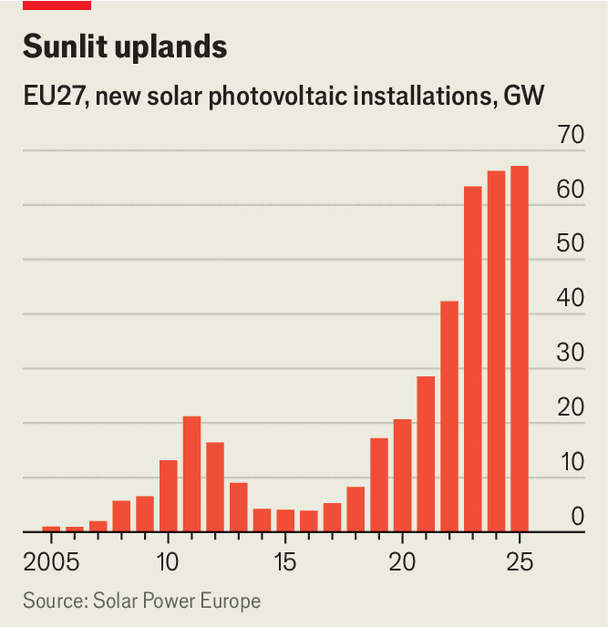
Europe likes to think of itself as a champion of renewable energy. In fact the rate of solar-power installation on the continent is plateauing(趋于平稳,进入停滞期). In 2025 the European Union added 67.2 gigawatts (GW) of new generating capacity, scarcely(几乎不,简直没有) more than in the previous year (see chart). This year new deployments(部署,安装) are set to(预计将,即将) fall in every big EU country except Italy.
欧洲喜欢把自己视为可再生能源的冠军。事实上,欧洲大陆的太阳能安装速度正趋于平稳。2025年,欧盟新增发电装机容量67.2吉瓦(GW),几乎与上年持平(见图表)。今年,除意大利外,所有欧盟大国的新增部署预计都将下降。
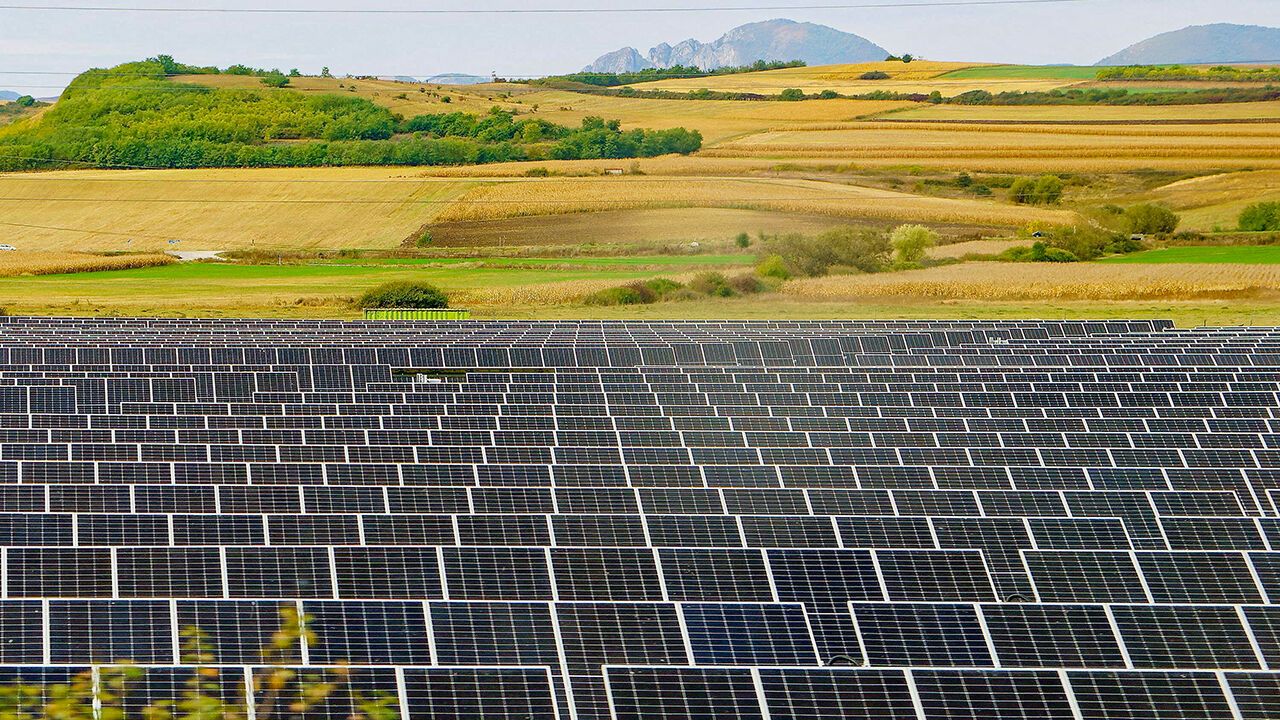
The problem is the grid(电网). On sunny days, solar farms can generate so much electricity that they overload networks’ capacity to move it to where it can be used or stored.(在晴天,太阳能发电厂能产生大量电力,以至于超出电网输送能力。) At peak hours generators may have to disconnect, if they can, or pay users to offload(卸下,转移) their excess power, turning prices negative. In the first half of 2026, hours with negative prices(负电价) were up 33% in Germany and 237% in Spain compared with(与……相比) the first half of 2024. European grid operators plan to spend hundreds of billions of euros on upgrades in the coming decade.
问题在于电网。在阳光充足的日子里,太阳能发电厂能产生大量电力,以至于超出电网将其输送至使用或储存地点的能力。在高峰时段,发电商可能不得不断开连接(如果可能的话),或付费让用户消纳多余电力,导致电价变为负值。2026年上半年,与2024年上半年相比,德国负电价小时数增加了33%,西班牙增加了237%。欧洲电网运营商计划在未来十年投入数千亿欧元进行升级。
One way to beat grid congestion(拥堵,堵塞) is with batteries. The EU estimates it will need enough batteries by 2030 to supply 150GW of power from storage. By the end of 2025 it only had 37GW-worth installed. Member states are doing a mixed job(表现参差不齐) of enacting the slew(大量,许多) of reforms necessary to boost battery deployment. These include streamlining(简化,精简) taxation, speeding up permitting approval and achieving closer co-ordination among Europe’s bewildering(令人困惑的) kaleidoscope(万花筒,千变万化) of grid operators.
解决电网拥堵的一个方法是使用电池。欧盟估计,到2030年需要足够的电池,以提供150吉瓦的储能电力。截至2025年底,其安装量仅为37吉瓦。成员国在实施一系列必要的改革以促进电池部署方面表现参差不齐。这些改革包括简化税收、加快审批许可,以及在欧洲令人眼花缭乱的电网运营商之间实现更紧密的协调。