“GOVERNOR: THE Silent Saviour”, a Bollywood(宝莱坞,印度电影业) film released earlier this year, manages to make a hero out of(把……塑造成英雄) a central banker. It follows a fictionalised version of Sri Venkitaramanan, head of the Reserve Bank of India (RBI) between 1990 and 1992, coping with the fallout(后果,余波) from an American war in the Middle East. He persuades the government to let American fighter jets refuel in Mumbai, a sop(讨好,安抚之物) to the IMF’s largest shareholder, and secretly arranges to have Indian gold flown to Switzerland and Britain as collateral(抵押品) for an IMF loan. In a revision of history, he convinces Manmohan Singh, the reformist finance minister, of the need to dismantle the socialist, growth-sapping Licence Raj(许可证制度,印度旧经济体制).
今年早些时候上映的宝莱坞电影《行长:沉默的救世主》成功将一位央行行长塑造成英雄。影片讲述了一个虚构版的S·文基塔拉马南——1990年至1992年间担任印度储备银行(RBI)行长——如何应对美国在中东发动战争带来的后果。他说服政府允许美国战斗机在孟买加油,以此讨好国际货币基金组织(IMF)的最大股东,并秘密安排将印度的黄金运往瑞士和英国,作为IMF贷款的抵押品。在历史的改写中,他说服了改革派财政部长曼莫汉·辛格,让他认识到必须废除扼杀增长的社会主义“许可证制度”。
Sanjay Malhotra, the current governor, does not have the benefit of a sympathetic(同情的,有好感的) film-maker. Still, he has had a good war—not least(尤其是,特别) in stabilising the rupee. The currency fell by 4.2% against the dollar in the first month of America’s latest Gulf conflict, a consequence of India’s huge oil-import bill. Since mid-May, however, it has traded sideways(横盘交易,价格持平). That is partly due to a scheme to attract dollars from India’s 37m-strong diaspora(侨民,海外同胞). The RBI’s Foreign Currency Non-Resident (Bank) (FCNR(B)) programme provides subsidised hedging(对冲,套期保值) to retail banks on dollar deposits, allowing them to pay higher rates and entice(诱使,吸引) Indians abroad to shift greenbacks to India.
现任行长桑杰·马尔霍特拉没有幸运地遇到一位同情他的电影制片人。尽管如此,他打了一场漂亮的仗——尤其是在稳定卢比方面。在美国最新一次海湾冲突的第一个月,卢比兑美元贬值4.2%,这是印度巨额石油进口账单的后果。然而,自5月中旬以来,卢比一直横盘整理。这在一定程度上要归功于一项吸引印度3700万海外侨民美元存款的计划。印度储备银行的“外币非居民(银行)账户”(FCNR(B))计划为零售银行的美元存款提供补贴性对冲,使它们能够支付更高的利率,吸引海外印度人将美元汇回印度。
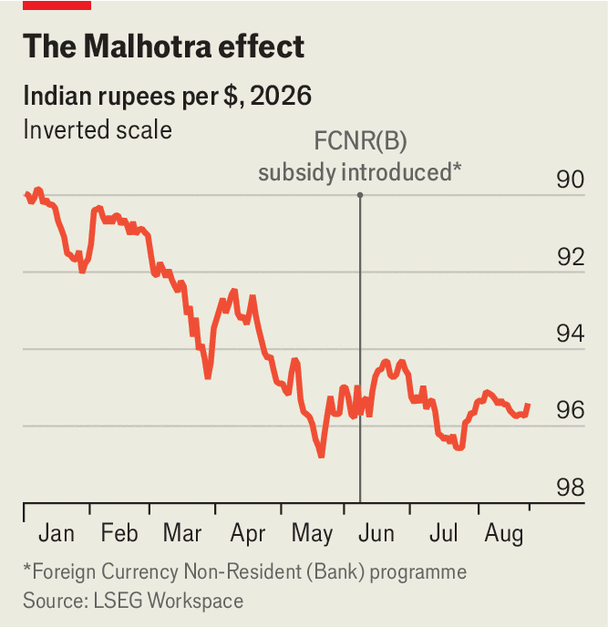
Despite the scheme’s success, Mr Malhotra said on August 14th that it would close at the end of August, a month ahead of schedule(提前). It is expected to have secured around $100bn (2.5% of GDP) for India’s banks. “Flows have been stronger than we expected,” Mr Malhotra told the Financial Express, a newspaper, noting that each dollar had a diminishing marginal benefit(边际收益递减). For the diaspora it amounted to a rare free lunch(免费午餐,不劳而获). Although they had to keep the money tied up(锁定,占用) for three to five years, they could earn 7% a year by shifting their dollars to India, against just 4% on deposits in America. Encouraged by the RBI, Indian banks then used leverage(杠杆,借贷经营) to let them make annual returns of 15-27% with no foreign-exchange risk (but a lot of interest-rate risk(利率风险)).
尽管该计划取得了成功,马尔霍特拉先生于8月14日表示,该计划将在8月底结束,比原计划提前一个月。预计该计划已为印度银行带来了约1000亿美元(占GDP的2.5%)的资金。“资金流入比我们预期的要强劲,”马尔霍特拉先生对《金融快报》表示,并指出每美元的边际收益都在递减。对侨民来说,这相当于一顿难得的免费午餐。尽管他们必须将资金锁定三到五年,但他们可以通过将美元汇往印度获得每年7%的收益,而美国存款利率仅为4%。在印度储备银行的鼓励下,印度银行随后利用杠杆,让他们获得15%-27%的年回报率,且没有外汇风险(但存在大量利率风险)。