“WE HOPE POPE LEO will see us as his soldiers(士兵;比喻为事业奋斗的人),” says Matthew Harvey Sanders, the boss of Longbeard, a Catholic startup(初创公司). In a room near the Pontifical Gregorian University in Rome, the firm’s robots scan ancient books, manuscripts and codices(手抄本(codex 的复数)). Scholars have long struggled to make accessible much of the “great wisdom sitting on shelves” of Catholic institutions, he says, but advances in AI mean “we can now understand the insights” of even the most worn, ancient texts. His firm then feeds this corpus(语料库;文集) into a more modern form of religious communication: Magisterium AI, a chatbot that draws on(利用;借鉴) a curated(精心挑选的) library of Catholic doctrine and scholarship. According to Mr Sanders, it has millions of users across 190 countries, who use it to get “answers to profound(深刻的;深奥的) questions”.
“我们希望教皇利奥能将我们视为他的士兵,”天主教初创公司 Longbeard 的老板马修·哈维·桑德斯说道。在罗马宗座额我略大学附近的一个房间里,该公司的机器人正在扫描古籍、手稿和抄本。他说,学者们长期以来一直难以让天主教机构“书架上的伟大智慧”变得易于获取,但人工智能的进步意味着“我们现在能够理解”即使是最破旧的古代文本中的洞见。他的公司随后将这些语料输入一种更现代的宗教传播形式:Magisterium AI,一个基于天主教教义和学术精选库的聊天机器人。据桑德斯先生称,该机器人在 190 个国家拥有数百万用户,他们用它来获取“深刻问题的答案”。
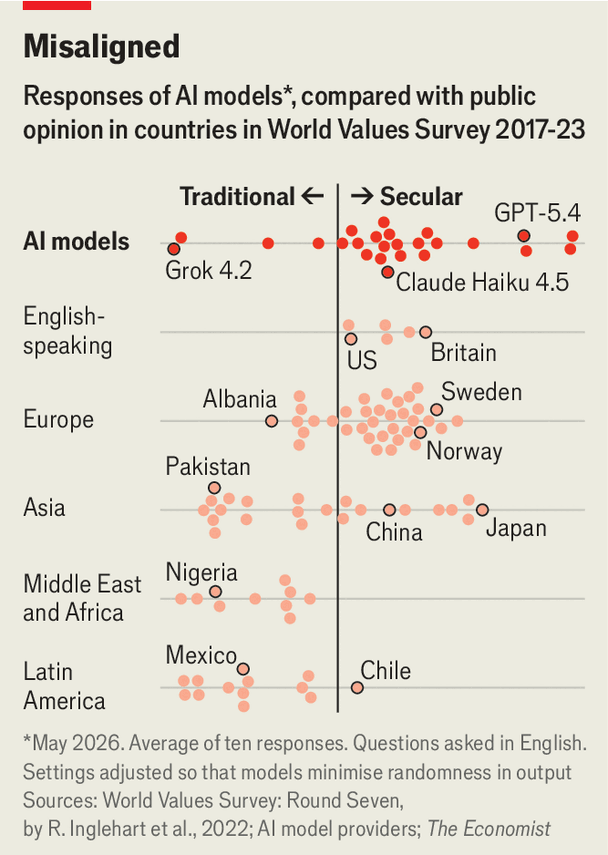
Longbeard’s work shows how the world’s most cutting-edge(最前沿的;尖端的) technology is changing its oldest traditions. It also illuminates(阐明;照亮) religious institutions’ and firms’ scramble(争夺;争抢) to influence how AI is being developed and used. The technology is beginning to perform tasks that religions have carried out for millennia(千年(millennium 的复数)): shaping people’s outlook(观点;前景) on life and helping them find meaning in it. The leading models are being developed by labs in Silicon Valley and China, without much religious input, which worries religious leaders. Pope Leo XIV argued in his first encyclical(教皇通谕) in May that technology is never neutral and takes on “characteristics of those who devise(设计;发明), finance, regulate and use it”. The fear is that AI will be unduly(过度地;不当地) secular, and will undermine or even supplant(取代;排挤) religious beliefs.
Longbeard 的工作展示了世界最前沿的技术如何改变其最古老的传统。它也揭示了宗教机构和公司争相影响人工智能开发和使用的局面。这项技术正开始执行宗教已履行数千年的任务:塑造人们的人生观,并帮助他们在其中找到意义。领先的模型正由硅谷和中国的实验室开发,几乎没有宗教输入,这令宗教领袖感到担忧。教皇利奥十四世在五月份的首份通谕中辩称,技术绝非中立,它会带有“那些设计、资助、监管和使用它的人的特征”。人们担心人工智能将过度世俗化,并削弱甚至取代宗教信仰。
AI is changing religion in ways that many of the pious(虔诚的) find troubling. Some are mundane(平凡的;世俗的), such as clerics(神职人员)’ growing use of it to prepare sermons(布道;讲道) and instruction. The Mormon church discourages(劝阻;不鼓励) sermons written by AI because “People ought to use their own feeling and inspiration,” says Gerrit Gong, one of its leaders. Wrestling with original texts, rather than AI summaries of them, is essential to the practice of Judaism, among other faiths. And homilies(讲道;布道) that rely on AI may include hallucinations(幻觉;AI 生成错误信息) such as misquoted scripture(经文;圣典).
人工智能正在以许多虔诚者感到不安的方式改变宗教。有些方式很平常,例如神职人员越来越多地使用它来准备布道和教诲。摩门教会不鼓励由人工智能撰写的布道,因为“人们应该运用自己的感受和灵感”,其一位领袖格里特·龚说。钻研原始文本,而不是人工智能的摘要,对犹太教等信仰的实践至关重要。而且依赖人工智能的讲道可能包含幻觉,例如错误引用的经文。
Pastoral, but godless
牧养,但无神
Artificial, but spiritual
人工,但有灵性