New technologies often create good conditions for middlemen(中间商,经纪人). In the 1960s entrepreneurs snapped up(抢购,迅速买下) mainframes(大型主机计算机) from IBM and leased them to banks and defence companies. In the dotcom era “domainers(域名投机者)” bought website addresses and sold them at a higher price. Artificial intelligence is no different(并无不同,同样如此). Consider the neoclouds, such as CoreWeave, which buy specialist(专业的,专门的) AI chips and rent them out. They are among the fastest-growing companies in the AI industry. But they are also some of the most vulnerable(脆弱的,易受伤害的).
新技术往往为中间商创造良好条件。20世纪60年代,企业家们抢购IBM的大型主机,然后租给银行和国防公司。在互联网时代,“域名投机者”购买网址,再以更高价格出售。人工智能也不例外。以CoreWeave为代表的新云服务商购买专用AI芯片并将其出租。它们是AI行业中增长最快的公司之一,但也是最脆弱的公司之一。
Neoclouds have thrived(蓬勃发展,兴旺) over the past few years, for two reasons. The first is that demand for AI has grown more quickly than America’s “hyperscalers(超大规模云服务商)” have been able to expand their computing capacity. Many neoclouds started off as(最初是,起步于) crypto miners, and subsequently repurposed(重新利用,改变用途) their data centres. And because they have focused exclusively on(专注于,只关注) AI, rather than a broader range of cloud services, they have been able to concentrate(集中,专注) their investments. As a result, their biggest customers are model-makers(模型制造商(指AI模型开发公司)), such as OpenAI, and the hyperscalers themselves, who often lease extra capacity from the neoclouds. The second reason for their rise is that Nvidia, the leading maker of AI chips, which is eager to reduce its reliance on the hyperscalers’ custom, has provided various forms of financial support to help them buy more of its chips.(它们崛起的第二个原因是,英伟达急于减少对超大规模云服务商客户的依赖,因此提供了各种财务支持帮助它们购买更多芯片。)
新云服务商在过去几年蓬勃发展,原因有二。首先,对AI的需求增长速度快于美国“超大规模云服务商”扩展计算能力的速度。许多新云服务商最初是加密货币矿工,后来将数据中心改作他用。由于它们专注于AI,而非更广泛的云服务,因此能够集中投资。结果,它们最大的客户是模型制造商(如OpenAI)以及超大规模云服务商本身,后者经常从新云服务商那里租用额外容量。它们崛起的第二个原因是,AI芯片领先制造商英伟达(Nvidia)急于减少对超大规模云服务商客户的依赖,因此提供了各种形式的财务支持,帮助它们购买更多其芯片。
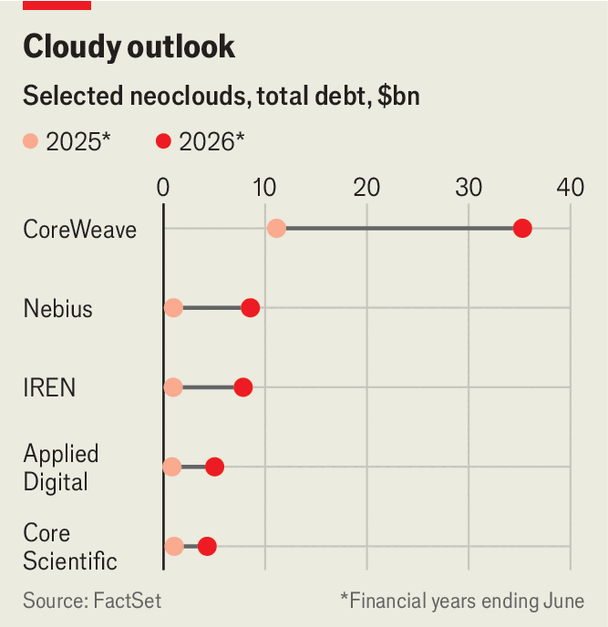
The combined(合计的,联合的) annual revenue of the five largest listed neoclouds—CoreWeave, Nebius, IREN, Applied Digital and Core Scientific—has risen to $18bn over the past 12 months, up from $3bn in 2024. Although they are still far behind the hyperscalers, they are gaining ground(取得进展,迎头赶上). Dell Oro, a research firm, estimates(估计,估算) that in total neoclouds have 1.5-2.5 gigawatts(吉瓦(功率单位)) (GW) of data-centre capacity between them, compared with(与…相比) a combined 20-24GW for Alphabet, Amazon, Microsoft and Meta. But they are roughly(大约,粗略地) doubling their capacity each year, which is about triple(三倍的) the rate that the hyperscalers are managing.
五大上市新云服务商——CoreWeave、Nebius、IREN、Applied Digital和Core Scientific——的合计年收入在过去12个月中从2024年的30亿美元升至180亿美元。尽管它们仍远落后于超大规模云服务商,但正在迎头赶上。研究公司Dell Oro估计,新云服务商合计拥有1.5至2.5吉瓦(GW)的数据中心容量,而Alphabet、亚马逊、微软和Meta合计为20至24吉瓦。但它们每年大约将容量翻一番,这大约是超大规模云服务商增速的三倍。