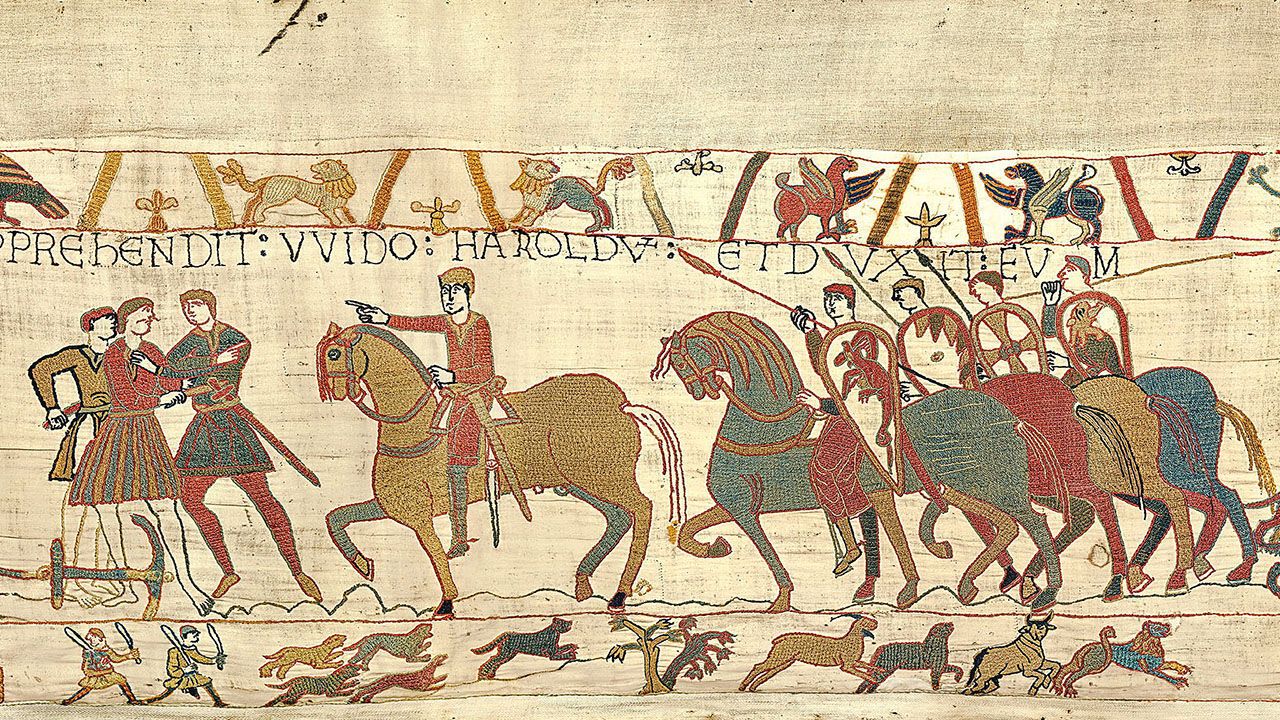
Days before the liberation(解放,解救) of Paris in 1944, Heinrich Himmler, Hitler’s SS chief, sent an urgent coded(编码的,加密的) message. “Do not forget to bring the Bayeux tapestry to a place of safety,” he urged the city’s Nazi commander, who surely had other things to worry about. The Nazis were obsessed(痴迷的,着迷的) with this artwork depicting the Norman conquest of England, seeing it as an icon(偶像,象征) of Aryan glory(雅利安荣耀,纳粹种族主义概念). Himmler planned to display it in Wewelsburg Castle, an SS hangout(常去的地方,据点) he hoped would become the “centre of the new world”. Instead, British codebreakers intercepted(截获,拦截) the order and shared it with the French resistance(抵抗组织,反抗), who hid the tapestry in the Louvre’s basement.
1944年巴黎解放前几天,希特勒的党卫军头目海因里希·希姆莱发出了一条紧急加密信息。“别忘了把贝叶挂毯带到安全的地方,”他催促巴黎的纳粹指挥官,而这位指挥官显然还有更紧迫的事要操心。纳粹对这幅描绘诺曼人征服英格兰的艺术品痴迷不已,视其为雅利安荣耀的象征。希姆莱计划将其陈列在韦沃尔斯堡城堡——一个他希望成为“新世界中心”的党卫军据点。然而,英国密码破译员截获了这一命令,并将其告知法国抵抗组织,后者将挂毯藏在了卢浮宫的地下室里。
Trajan had his column. Napoleon had his arch. William of Normandy’s tapestry is less imposing(宏伟的,壮观的) yet somehow more memorable. Its strip-cartoon style is jaunty, memeable and has been used to satirise everything from Brexit negotiations to Andy Burnham’s “Northern conquest” (the man he replaced as Britain’s prime minister, Sir Keir Starmer, was pictured on the cover of the New Statesman with an arrow in his eye, like the hapless King Harold).(它的连环画风格轻快易传播,被用来讽刺从脱欧到伯纳姆的各种事件。) Now the tapestry is back in England for the first time since it was stitched(缝制,刺绣), probably by defeated Anglo-Saxons in Canterbury, nearly 1,000 years ago. It will be on view at the British Museum from September 10th. It offers three lessons for modern viewers.
图拉真有他的纪功柱,拿破仑有他的凯旋门。诺曼底公爵威廉的挂毯虽不那么宏伟,却不知为何更令人难忘。它的连环画风格轻快活泼、易于传播,曾被用来讽刺从英国脱欧谈判到安迪·伯纳姆的“北方征服”等一切事物(伯纳姆取代的英国首相基尔·斯塔默爵士,曾被画在《新政治家》杂志封面上,眼中插着一支箭,就像倒霉的哈罗德国王一样)。如今,这幅挂毯自约1000年前缝制以来首次回到英格兰——它很可能是在坎特伯雷由战败的盎格鲁-撒克逊人缝制的。它将于9月10日起在大英博物馆展出,为现代观者带来三条启示。
First, to survive against the odds(尽管困难重重,逆势而上), it is sometimes best not to attract too much attention. For several centuries the tapestry is believed to have been rolled up(卷起来), stored in a chest and brought out just once a year, to be displayed in the nave((教堂的)中殿) of Bayeux cathedral. For about two-thirds of its existence, it was not famous at all. Only in the early 1700s did a broader audience start noticing it. Its low profile(低调,不引人注目) helped ensure its safety.
首先,要在逆境中生存,有时最好不要太引人注目。几个世纪以来,人们认为这幅挂毯一直被卷起来存放在箱子里,每年只取出一次,在巴约大教堂的中殿展出。在它存在的大约三分之二的时间里,它根本不出名。直到18世纪初,才有更广泛的受众开始注意到它。低调行事帮助确保了它的安全。