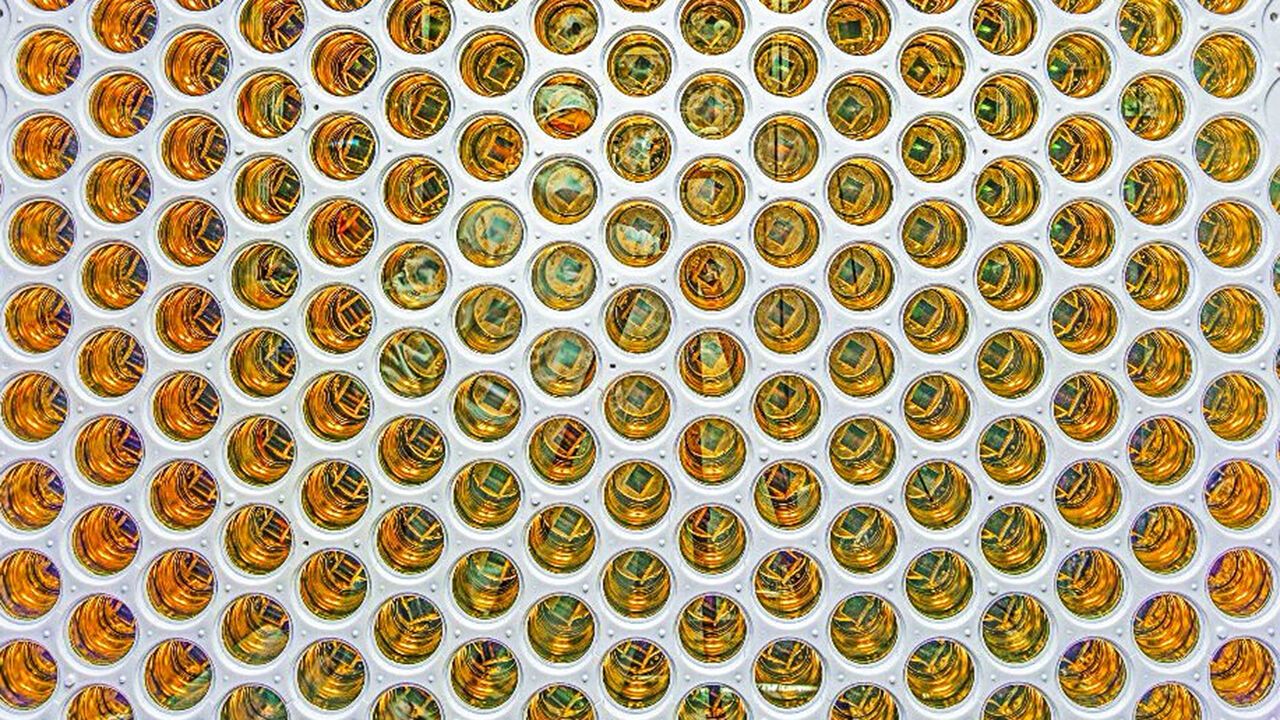
ON JUNE 16TH 2023 a strange blip(短暂信号,异常脉冲) showed up in the detectors of the LUX-ZEPLIN (LZ) experiment, an underground dark-matter detector (pictured) in South Dakota. That should raise eyebrows(引起惊讶或质疑). Physicists have been trying and failing to detect dark matter for almost a century. Speaking on the experiment’s behalf at the TeV Particle Astrophysics conference on September 1st, Sam Eriksen of the University of Bristol announced that the team has reason to believe the blip could be a “weakly interacting massive particle” (WIMP), a long-suspected candidate for the universe’s elusive dark matter.(在9月1日的会议上,Sam Eriksen代表团队宣布,他们有理由相信该信号可能是WIMP。)
2023年6月16日,位于南达科他州的地下暗物质探测器LUX-ZEPLIN(LZ)实验(如图)的探测器中出现了一个奇怪的信号。这理应引起人们的关注。近一个世纪以来,物理学家一直在尝试探测暗物质,但均告失败。9月1日,在TeV粒子天体物理学会议上,布里斯托大学的Sam Eriksen代表该实验团队宣布,他们有理由相信这个信号可能是一种“弱相互作用大质量粒子”(WIMP),这是长期以来被怀疑构成宇宙中难以捉摸的暗物质的候选粒子。
Physicists are pretty sure dark matter exists. Their best measurements suggest it makes up around 85% of the universe’s total mass and is responsible for a number of important jobs, such as making sure galaxies do not break apart.(最精确的测量表明,暗物质约占宇宙总质量的85%,并承担重要职责。) But nothing is known of what the stuff is actually made from. It does not emit(发射,发出), absorb(吸收) or reflect light or other electromagnetic radiation, and is “seen” only by its gravitational pull(引力,引力作用).
物理学家相当确信暗物质存在。他们最精确的测量表明,暗物质约占宇宙总质量的85%,并承担着许多重要职责,例如确保星系不会分崩离析。但人们对其实际构成一无所知。暗物质不发射、不吸收也不反射光或其他电磁辐射,只能通过其引力作用被“看到”。
Over the years, physicists have come up with(提出,想出) a motley crew(形形色色的一群) of suspects that could be behind the phenomena. WIMPs are one of the most promising. These hypothetical heavy, sluggish(缓慢的, sluggish) particles interact with other matter only through gravity and an esoteric(深奥的, esoteric) phenomenon called the weak nuclear force. The theory suggests such particles could have been knocking about soon after the Big Bang. But as the universe expanded and cooled, their abundance was frozen at just the right value to give the density of dark matter seen today.(但随着宇宙膨胀和冷却,其丰度被冻结在恰到好处的数值,形成了今天的暗物质密度。)
多年来,物理学家提出了形形色色的候选粒子来解释这些现象。WIMP是最有希望的候选者之一。这些假设中的重而缓慢的粒子仅通过引力以及一种称为弱核力的深奥现象与其他物质相互作用。该理论认为,这类粒子可能在大爆炸后不久就四处游荡。但随着宇宙膨胀和冷却,它们的丰度被冻结在恰到好处的数值,从而形成了今天所见的暗物质密度。