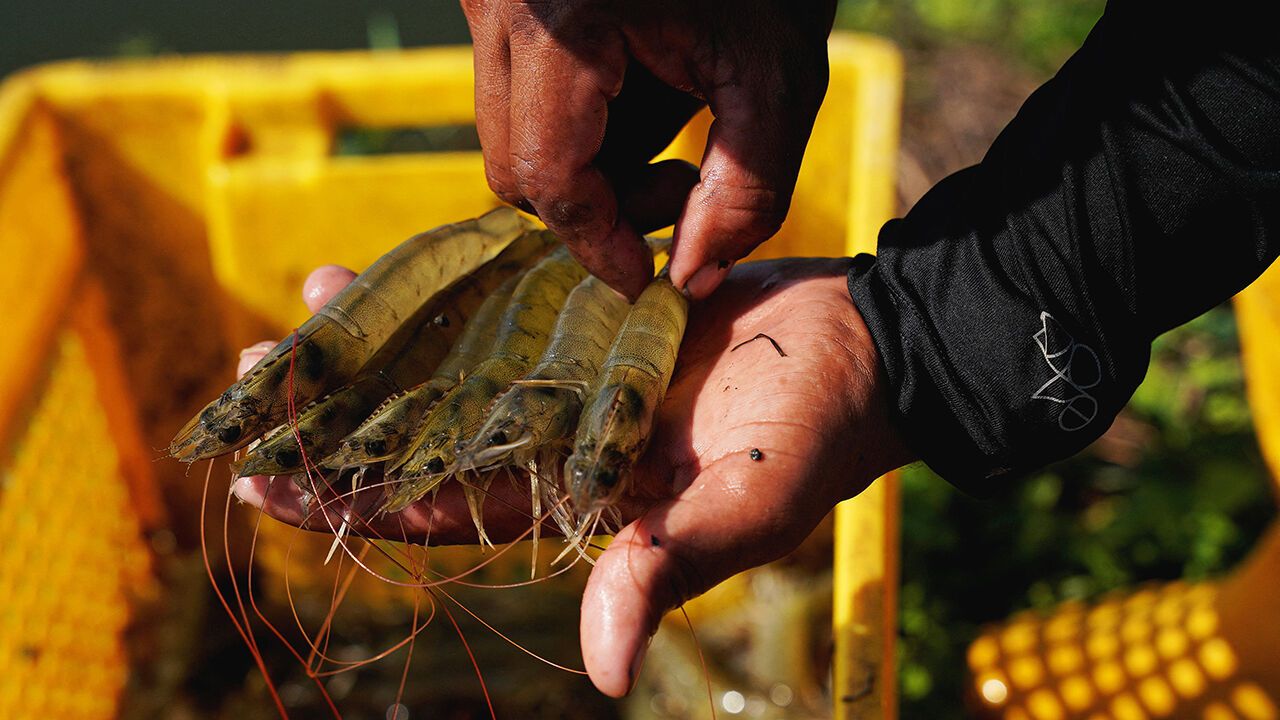
The production of prawns in Ecuador is lean manufacturing(精益生产,一种高效管理理念) incarnate. Vast rectangular pools tessellate(镶嵌,密铺) the Guayas delta, centre of the aquaculture belt. Its brackish(微咸的,半咸的) waters hide billions of translucent(半透明的) bodies. Larvae are cultivated in greenhouse-style hatcheries, fattened in open-air ponds, hoovered into lorries, then taken to packaging plants where they are frozen.(虾苗在温室孵化场培育,在露天池塘育肥,吸入卡车,运往包装厂冷冻。) Inefficiencies are constantly hunted down(追捕,穷追不舍). Containers filled with bricks of prawns known as “HOSO(带头带壳虾的缩写)” (head-on, shell-on) cross the oceans, mostly east to west across the Pacific. “It is like a factory,” says Wolfgang Harten of Grupo Almar, the country’s second-largest producer.
厄瓜多尔的虾生产是精益制造的化身。广阔的矩形池塘镶嵌在瓜亚斯三角洲——水产养殖带的核心地带。咸淡水中隐藏着数十亿半透明的虾体。虾苗在温室式孵化场中培育,在露天池塘中育肥,被吸入卡车,然后运往包装厂冷冻。低效之处不断被消除。装满被称为“HOSO”(带头带壳)虾砖的集装箱漂洋过海,大多从东向西穿越太平洋。“这就像一座工厂,”该国第二大生产商阿尔马尔集团的沃尔夫冈·哈滕说。
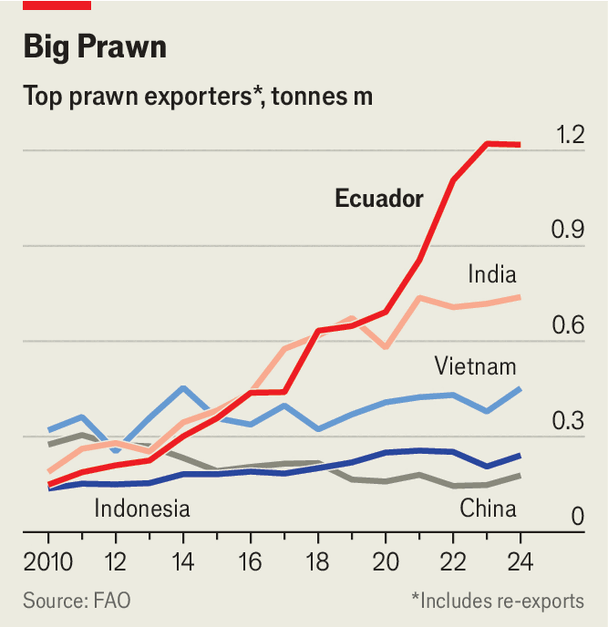
That factory is running flat out(全速运转,全力以赴). Shipments have quadrupled(翻了两番,变为四倍) in the past decade. In 2020 Ecuador surpassed(超过,超越) India as the world’s top exporter (see chart). Last year it sold more than $8bn-worth of prawns, more than India, Vietnam and Indonesia combined. Once an oil nation, Ecuador has become a pesco-state(渔业国家(pesco- 鱼)). Prawn production provides employment for about 1.6% of the population and furnishes(提供,供应) 6% of GDP, a larger share than carmaking contributes in Germany. The sector has developed the country’s most advanced technology. The lorries that move prawns are escorted by armed guards. For coastal communities, a job at a prawn-processing mill is a ticket to(……的门票,通往……的途径) the middle class.
那座工厂正满负荷运转。过去十年,出货量翻了两番。2020年,厄瓜多尔超越印度成为世界最大出口国(见图表)。去年,它售出了价值超过80亿美元的虾,超过印度、越南和印度尼西亚的总和。厄瓜多尔曾是石油国家,如今变成了“渔业国家”。虾生产为约1.6%的人口提供了就业,并贡献了6%的GDP,这一比例高于汽车制造业在德国的贡献。该行业开发了该国最先进的技术。运送虾的卡车有武装警卫护送。对于沿海社区来说,在虾加工厂工作是一张通往中产阶级的门票。
Business wasn’t always this good. When Ecuador began cultivating prawns in the 1960s it was a cottage industry(家庭手工业,小规模产业). Penaeus (Litopenaeus) vannamei, better known as king prawn or white-leg shrimp, is native(原产的,本地的) to Latin America. Farmers collected wild larvae from nearby mangroves(红树林). Few bothered with(费心于,操心) selective breeding. Profits were high enough to drive expansion, but at great cost. By 2000 deforestation(森林砍伐) had halved(减半) the country’s mangroves. A global outbreak(爆发(疾病等)) of white-spot disease bankrupted(使破产) many farmers, killed 95% of prawns in infected ponds and cut output by 70% over two years.
生意并非一直这么好。当厄瓜多尔在20世纪60年代开始养殖虾时,那还是家庭手工业。凡纳滨对虾(学名:Penaeus (Litopenaeus) vannamei),更广为人知的名字是国王虾或白脚虾,原产于拉丁美洲。农民从附近的红树林采集野生虾苗。很少有人费心进行选择性育种。利润高得足以推动扩张,但代价巨大。到2000年,森林砍伐使该国的红树林减少了一半。一次全球性的白斑病爆发使许多农民破产,感染池塘中95%的虾死亡,两年内产量下降了70%。
Don’t overdo it
不要做得过火