Few policy reform commissions draw up a list of recommendations only to implore lawmakers to ignore them.(很少有政策改革委员会在拟定建议后反而恳求立法者无视它们。) Yet that is where Minnesota’s Blue Ribbon Commission on Special Education finds itself. Facing a multi-billion-dollar budget shortfall(缺口,差额), state lawmakers asked the commission to identify $250m in savings on special education, where spending is expected to swell(膨胀,增长) by nearly $1bn between 2022 and 2027. In August the commission released provisional recommendations and unanimously urged(一致敦促) the legislature not to enact(颁布,制定) any of them, warning of harm to pupils.
很少有政策改革委员会在拟定一系列建议后,反而恳求立法者无视这些建议。然而,明尼苏达州特殊教育蓝带委员会就处于这样的境地。面对数十亿美元的预算缺口,州立法者要求该委员会在特殊教育领域找出2.5亿美元的节省空间,而该领域的支出预计在2022年至2027年间将激增近10亿美元。今年8月,委员会发布了临时建议,并一致敦促立法机构不要采纳其中任何一项,警告这将对学生们造成伤害。
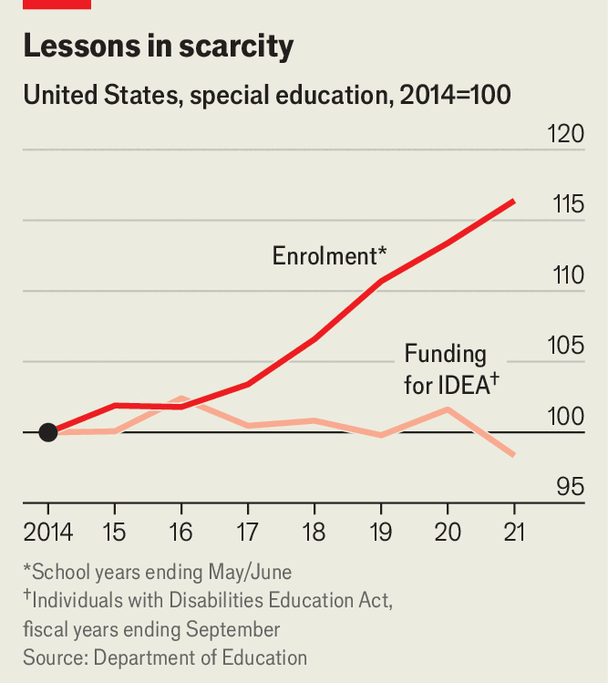
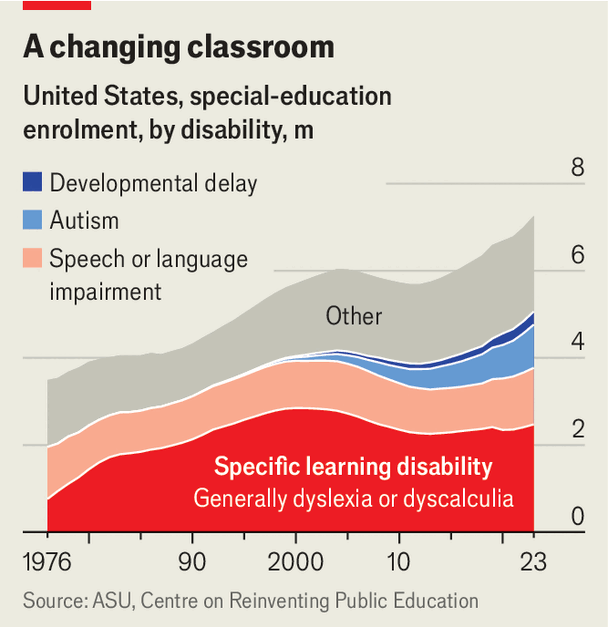
Minnesota’s paralysis(瘫痪,停滞) reflects a national dilemma(困境,两难): educating disabled children is a popular policy, but the sums required under current laws are eye-watering(令人瞠目的,巨大的). Across the country, school districts are pulling money from general-education funds to pay for services for pupils with special needs. Even as school enrolment(入学人数) declines, the number of students in special education across the country is rising. Between 2014 and 2023 it grew by 1.4m, from 11.6% of all pupils to 14.7%. In several states—including Indiana, Massachusetts, Minnesota, Pennsylvania and Wyoming—that figure is higher still at roughly one in five. As costs rise, states are confronting fraught(充满问题的,棘手的) questions about who should pay, how well programmes work and what must be pared back to cover the bill.
明尼苏达州的困境折射出一个全国性的难题:教育残障儿童是一项受欢迎的政策,但现行法律所需的资金数额令人瞠目。在全国范围内,各学区正从普通教育基金中挪用资金,为有特殊需求的学生支付服务费用。尽管学校入学率在下降,全国特殊教育学生的数量却在上升。2014年至2023年间,这一数字增加了140万,占所有学生的比例从11.6%升至14.7%。在包括印第安纳州、马萨诸塞州、明尼苏达州、宾夕法尼亚州和怀俄明州在内的几个州,这一比例更高,约为五分之一。随着成本上升,各州正面临棘手的问题:谁该买单、项目效果如何、以及为了支付账单必须削减哪些开支。
Fifty years ago, it was estimated that over half of the country’s disabled children received an insufficient(不足的,不充分的) education. To remedy(补救,纠正) this, in 1975 Congress passed what eventually became the Individuals with Disabilities Education Act (IDEA)(《残疾人教育法案》,保障残障儿童教育权利。), one of several laws that together guarantee disabled children a “free appropriate public education”. Each eligible(符合条件的) child receives an Individualised Education Programme (IEP) specify(明确规定)ing the services a school district must provide. These range from occasional speech therapy to a classroom aide or placement(安置,安排) in a specialised school, which can cost districts hundreds of thousands of dollars each year.
五十年前,据估计全国超过一半的残障儿童未能接受足够的教育。为了改变这一状况,1975年国会通过了后来成为《残疾人教育法案》(IDEA)的法律,该法案是共同保障残障儿童获得“免费且适当的公立教育”的几部法律之一。每个符合条件的儿童都会获得一份个性化教育计划(IEP),其中规定了学区必须提供的服务。这些服务从偶尔的言语治疗到课堂助教,再到进入专门学校就读,每年可能花费学区数十万美元。