IN JUST THE past two months Donald Trump has described Democratic candidates as “jihadists(圣战分子)” and “radical lunatics”. He has mocked opponents’ weight and appearance, said he hated Adam Schiff, a Democratic senator from California, and referred to James Talarico, the Democratic Senate candidate in Texas, as “Tal-a-freak-o”.(他嘲笑对手的体重和外貌,称他恨亚当·希夫,并称塔拉里科为“塔拉怪胎”。) He has also attacked former Republican allies(盟友,同盟者), calling them “losers”.
就在过去两个月里,唐纳德·特朗普将民主党候选人描述为“圣战分子”和“激进疯子”。他嘲笑对手的体重和外貌,称他恨加利福尼亚州民主党参议员亚当·希夫,并将得克萨斯州民主党参议员候选人詹姆斯·塔拉里科称为“塔拉怪胎”。他还攻击了昔日的共和党盟友,称他们为“失败者”。
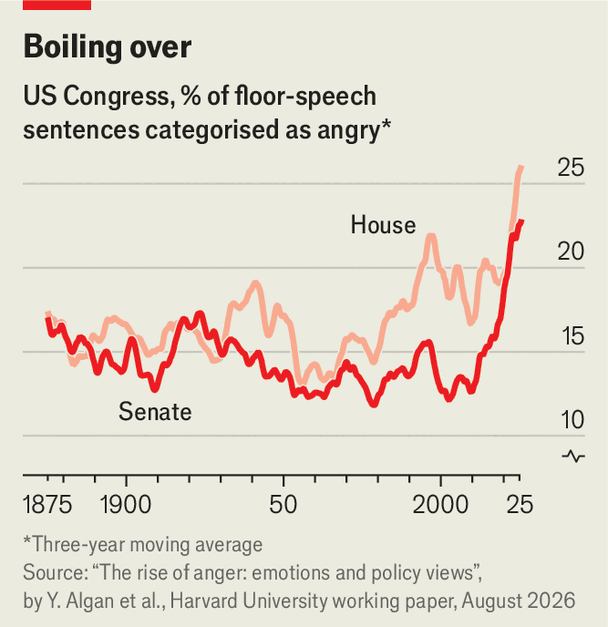
Though more hostile than most, the president is hardly the first politician to trade in outrage.(尽管比大多数人更具敌意,但总统远非第一个利用愤怒的政客。) New research suggests he is part of a broader trend: American politics is angrier than ever.
尽管比大多数人都更具敌意,但这位总统远非第一个利用愤怒情绪的政治家。新研究表明,他属于一个更广泛的趋势:美国政治比以往任何时候都更加愤怒。
Economists at Harvard, HEC Paris, Paris-Saclay and the University of California, Berkeley, set out to(着手做某事) explore the evolution of political fury. They trawled(搜索,搜集) more than 150 years of congressional speeches and millions of social-media posts, categorising(分类,归类) their emotional character using artificial intelligence, including large language models and natural-language processing. For each text they assigned(分配,指定) a score for eight emotions—anger, sadness, pride, gratitude, fear, disgust, joy and hope—as well as(以及,也) for the overall level of emotion.
哈佛大学、巴黎高等商学院、巴黎萨克雷大学和加州大学伯克利分校的经济学家着手探究政治愤怒的演变。他们梳理了150多年的国会演讲和数百万条社交媒体帖子,利用人工智能(包括大型语言模型和自然语言处理)对其情感特征进行分类。对于每段文本,他们为八种情绪——愤怒、悲伤、自豪、感激、恐惧、厌恶、快乐和希望——以及整体情绪水平打分。