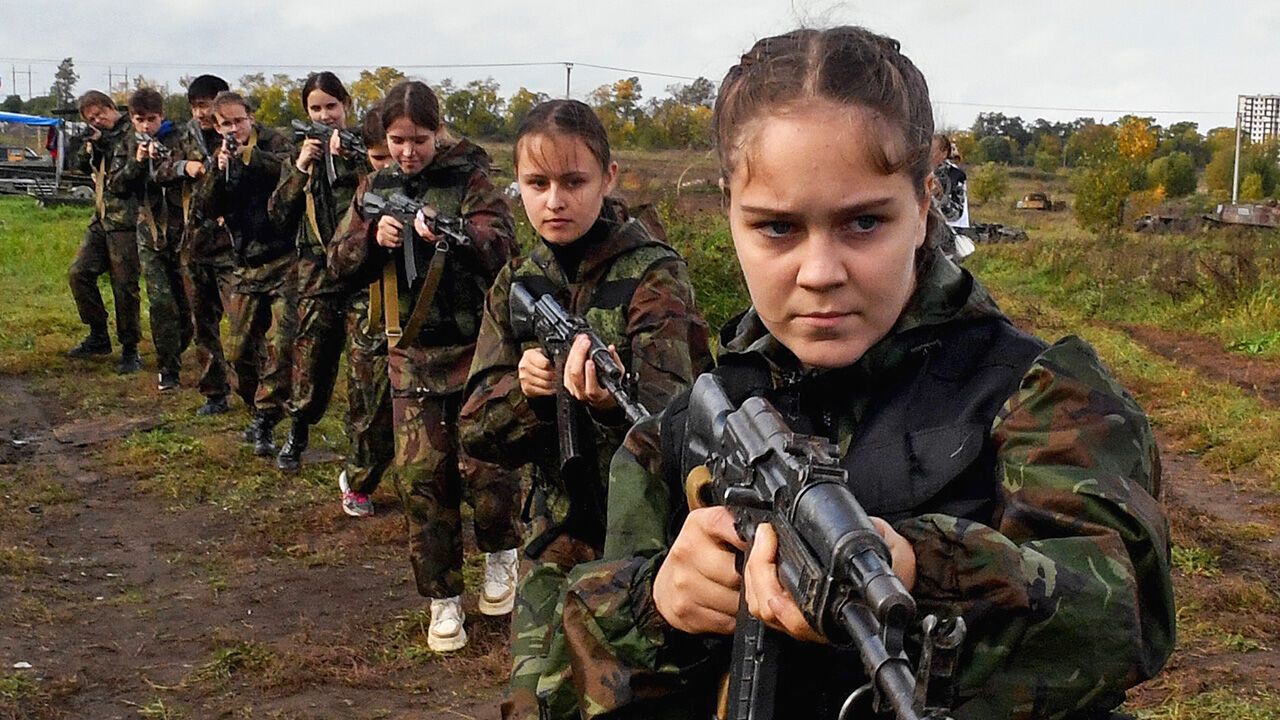
“HOW DID you feel when you committed your first murder?” a pupil in a classroom asks a man in military uniform. The teacher interject(插话,打断)s: “These are not murders. This is war.” The officer is unfazed(不为所动,镇定自若): “It’s the destruction of enemy manpower(人力,兵员), you shoot and you don’t know whether he is dead or wounded. Only with a grenade launcher(榴弹发射器) can you be sure.”
“你第一次杀人时是什么感觉?”教室里一名学生问一位身穿军装的男子。老师插话道:“这不是杀人。这是战争。”军官不为所动:“这是消灭敌方有生力量,你开枪时并不知道他是死是伤。只有用榴弹发射器才能确定。”
The exchange took place in October 2024 in a ninth-grade classroom in Vladimir, a city 200km east of Moscow. It was part of a “Lesson of Courage”, a regular event in classrooms across the country since Russia invaded Ukraine. The lessons are part of a massive programme of indoctrination(灌输,洗脑式教育): Vladimir Putin calls the battle for children’s minds(争夺儿童思想的斗争) a “new front”. “Patriotic education” has entered the curricula(课程(curriculum 的复数)) of schools and universities. On September 1st it was introduced in kindergartens.
这段对话发生在2024年10月,地点是莫斯科以东200公里的弗拉基米尔市一间九年级教室。它是一堂“勇气课”的环节,自俄罗斯入侵乌克兰以来,这类课已成为全国教室的常规活动。这些课程是一场大规模灌输计划的一部分:普京把争夺儿童思想的斗争称为“新前线”。“爱国主义教育”已进入中小学和大学的课程。9月1日,它又被引入幼儿园。
“A sovereign(主权的,有主权的) education system…is an absolutely fundamental matter,” Mr Putin declared in 2023. Making education “sovereign” has meant rolling back the autonomy(自主权,自治) Russian schools enjoyed after the Soviet Union collapsed. In 2022 Mr Putin signed a law mandating a “federal programme of upbringing”, so that citizens “know and respect Russia’s…military exploit(功绩,英勇事迹)s and labour achievements”. Each week pupils of all ages gather for “Conversations about Important Things”. Scripts are assigned by the Ministry of Education. Most concern Russian scientists, musicians, nature and sport. But about 10% are military, including “Russia: A Nation of Victors” and “The Reunification of Crimea with Russia”.
“一个主权教育体系……是绝对根本的大事,”普京在2023年宣称。让教育变得“主权化”,意味着收回苏联解体后俄罗斯学校享有的自主权。2022年,普京签署法律,强制推行“联邦教育培养计划”,以使公民“了解并尊重俄罗斯的……军事功绩和劳动成就”。每周,各年龄段的学生都会聚在一起参加“重要话题对话”。讲稿由教育部统一指定。多数内容涉及俄罗斯科学家、音乐家、自然和体育。但约10%是军事主题,包括“俄罗斯:胜利者之国”和“克里米亚与俄罗斯的统一”。