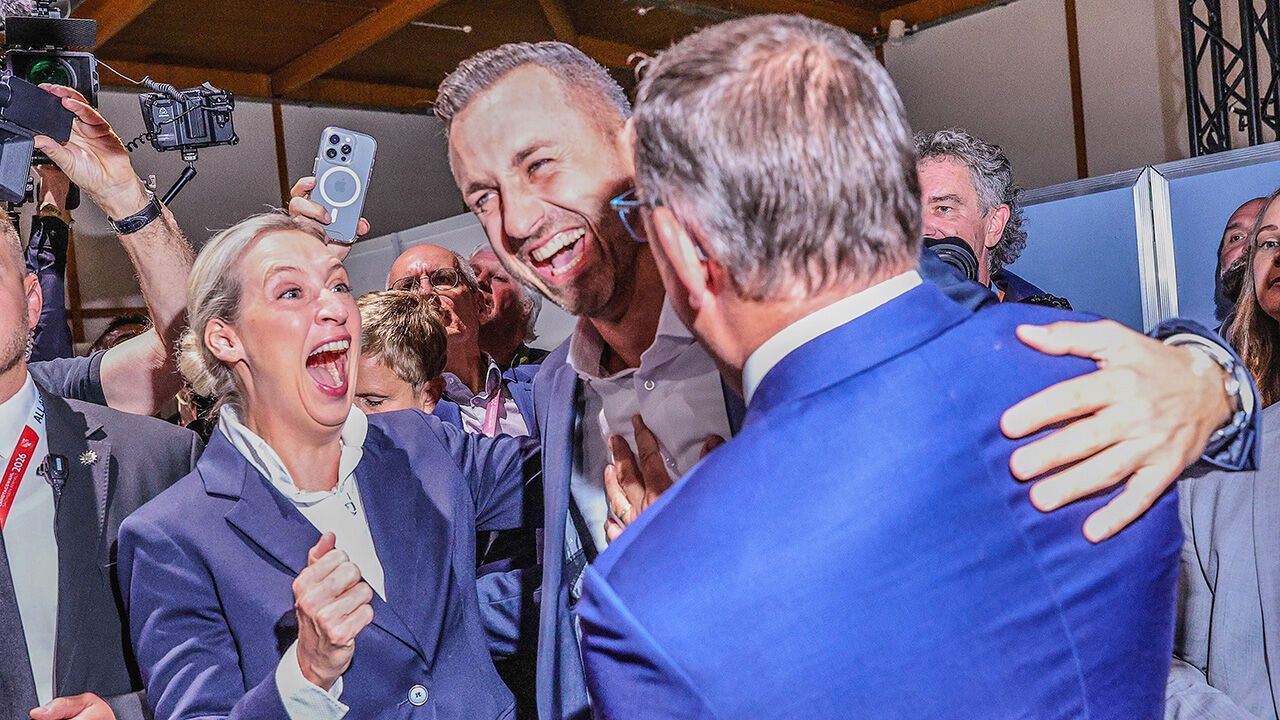
THEIR FACES said it all(说明了一切). As Friedrich Merz, Germany’s chancellor(总理;财政大臣), addressed the Bundestag(德国联邦议院) on September 9th he was booed(发出嘘声), jeered(嘲笑;讥讽) and whistled at by MPs from the populist-right Alternative for Germany (AfD). Boorish(粗鲁的;粗野的) behaviour in parliament is nothing new for the AfD, which occupies nearly a quarter of the seats in the Bundestag. But after securing a record-breaking 44% of the vote at an election in Saxony-Anhalt, an eastern state, three days earlier, the party was drunk on victory(陶醉于胜利) and spoiling for a scrap(摩拳擦掌想打架).
他们的表情说明了一切。9月9日,德国总理弗里德里希·默茨在联邦议院发表讲话时,遭到右翼民粹政党德国选择党(AfD)议员的嘘声、嘲笑和口哨。对AfD来说,在议会里粗鲁无礼早已不是新鲜事——该党占据了联邦议院近四分之一的席位。但三天前,它在东部萨安州选举中拿下创纪录的44%选票,此刻正陶醉于胜利之中,摩拳擦掌想大干一场。
Mr Merz’s speech was supposed to be devoted to the government’s draft budget for 2027. Instead he trained both barrels on(把火力全部对准) the AfD, sounding at times almost like the leader of the opposition. He accused the AfD of cloaking(掩盖;掩饰) its desire for “ethnic cleansing(种族清洗)” behind the term “remigration(再移民(极右翼用语))”, and taunted(嘲讽;讥讽) it for falling short of(未达到;差一点) a majority in Saxony-Anhalt (Mr Merz’s Christian Democrats slumped(暴跌;骤降) to 17%). Leaders of the Social Democrats (SPD)—the junior coalition partner to the CDU and its Bavarian sister party, the CSU—also reserved most of their remarks for the AfD. So did the opposition Greens. When they finally highlighted their differences with other parties, it felt like democratic courtesy. It is a dynamic familiar in Germany’s eastern states, where the AfD’s strength has forced mainstream parties into “popular-front” coalitions united by little else. But it leaves the AfD free to make the political weather(主导政治风向).
默茨的演讲本应围绕政府2027年预算草案展开,但他却把火力全部对准了AfD,有时听起来几乎像是反对党领袖。他指责AfD用“再移民”一词掩盖其“种族清洗”的企图,并嘲讽该党在萨安州未能获得多数席位(默茨所在的基民盟得票率跌至17%)。社民党(SPD)——基民盟及其巴伐利亚姊妹党基社盟(CSU)的初级执政伙伴——的领导人也将大部分言论留给AfD。反对党绿党也是如此。当他们最终强调与其他政党的分歧时,反倒像是一种民主礼节。这种动态在德国东部各州并不陌生:AfD的强势迫使主流政党组成除了反AfD之外几乎毫无共识的“人民阵线”联盟。但这让AfD得以自由地主导政治风向。
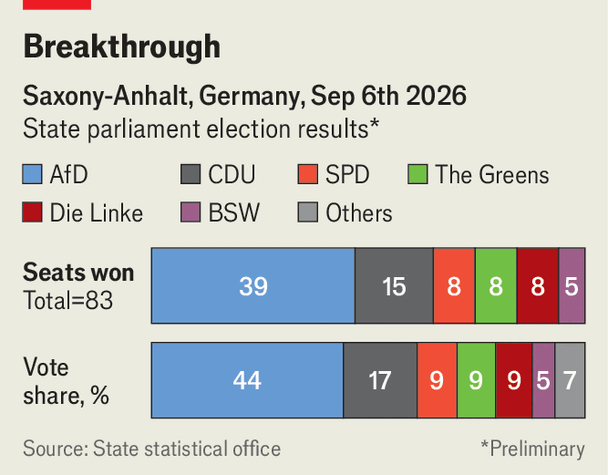
The next steps in Saxony-Anhalt are unclear. The AfD’s score, fuelled in part by a huge mobilisation(动员;发动) of previous non-voters (see chart), was better than it had dared hope. But it is three seats short of a majority in the 83-seat Landtag(州议会), and other parties refuse to work with it. The exception is the Sahra Wagenknecht Alliance (BSW)(萨拉·瓦根克内希特联盟), a populist pro-Russian party that squeaked(勉强通过;险胜) over the 5% threshold to win five seats (see chart). It could strike a deal with the AfD, or at least decline to stand in its way(挡路;阻碍). But Ulrich Siegmund, the cheerful face of the AfD in Saxony-Anhalt, may not want to lead a government built on such shaky foundations, not least since the BSW itself is a fractious(易怒的;难驾驭的) outfit. Much is at stake for a party seeking its first bite of executive office(首次执掌行政权力). There are signs of tension between the Saxony-Anhalt AfD and the party’s national leadership, which has its eyes on(着眼于;瞄准) the next federal election, due in 2029.
萨安州接下来的局势尚不明朗。AfD的得票率——部分得益于大量此前不投票的选民被动员起来(见图表)——好于该党最大胆的期望。但它在拥有83个席位的州议会中距离多数还差三席,而其他政党拒绝与其合作。唯一的例外是萨拉·瓦根克内希特联盟(BSW),这个亲俄的民粹政党刚刚越过5%的门槛,赢得五个席位(见图表)。它可能与AfD达成协议,或至少不挡其路。但AfD在萨安州的阳光面孔乌尔里希·西格蒙德,可能并不想领导一个建立在如此脆弱基础上的政府,尤其是因为BSW本身也是一个内部分裂的团体。对于一个渴望首次执掌行政权力的政党来说,利害关系重大。有迹象表明,萨安州AfD与该党全国领导层之间存在紧张关系,后者正着眼于定于2029年的下届联邦选举。