EVERY THREE years the OECD(经合组织), a club of mostly rich countries, releases the results of international school tests sat by 15-year-olds all across the world. There were reasons to hope that the latest data, published on September 8th, would bring good news. Marks in mathematics, reading and science had collapsed(暴跌;崩塌) in the previous round of testing, which was carried out just after the pandemic. Policymakers dared hope that, with the calamity well in the past(灾难早已过去), grades might start to rebound(反弹;回升).
每三年,由富裕国家组成的经合组织(OECD)都会发布全球15岁学生参加的国际学校测试结果。人们原本有理由期待,9月8日发布的最新数据会带来好消息。上一轮测试在疫情刚结束后进行,数学、阅读和科学成绩曾大幅崩塌。政策制定者曾大胆期望,既然灾难已经过去,成绩或许会开始回升。
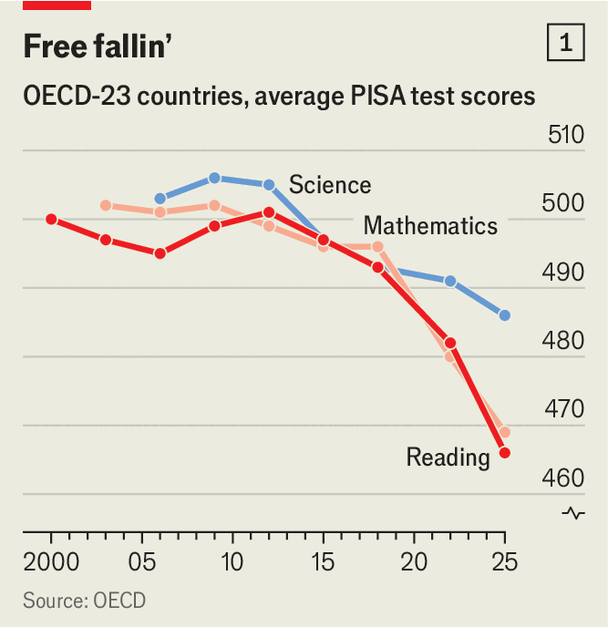
That is not what happened. On the contrary(恰恰相反), in rich countries—the primary focus of the tests—scores have fallen further (see chart 1). In literacy(读写能力), the decline is actually speeding up. These data suggest that there are long-running factors pushing down achievement in schools, and that without swift correction, pupils’ abilities could plumb yet further depths.(这些数据表明,有一些长期因素在压低学校成绩,如果不迅速纠正,学生的能力可能还会跌得更深。) Anyone who cares about the young of today—and in turn the societies of tomorrow—ought to be alarmed(应当感到警惕).
但事实并非如此。恰恰相反,在测试主要关注的富裕国家,成绩进一步下滑(见图表1)。在阅读能力方面,下降实际上正在加速。这些数据表明,有一些长期因素在压低学校成绩,如果不迅速纠正,学生的能力可能还会跌得更深。任何关心今日青少年——进而关心明日社会——的人都应当感到警惕。
The OECD’s project, known as PISA(国际学生评估项目), takes a measure of young people’s aptitudes(能力;天资) as they approach the end of their compulsory school days(义务教育阶段). The number of school systems taking part has expanded over the years: the latest tests were sat in all 38 OECD member-countries and in 53 other places (many of them developing economies). The results are used to create an international league table(排行榜) of sorts.
经合组织的这个项目名为PISA(国际学生评估项目),旨在衡量年轻人在即将结束义务教育时的能力。参与该测试的学校系统数量多年来不断扩大:最新一轮测试在全部38个经合组织成员国以及另外53个地区(其中许多是发展中经济体)进行。测试结果被用来编制一份某种意义上的国际排行榜。
Is our children learning?
我们的孩子在学习吗?