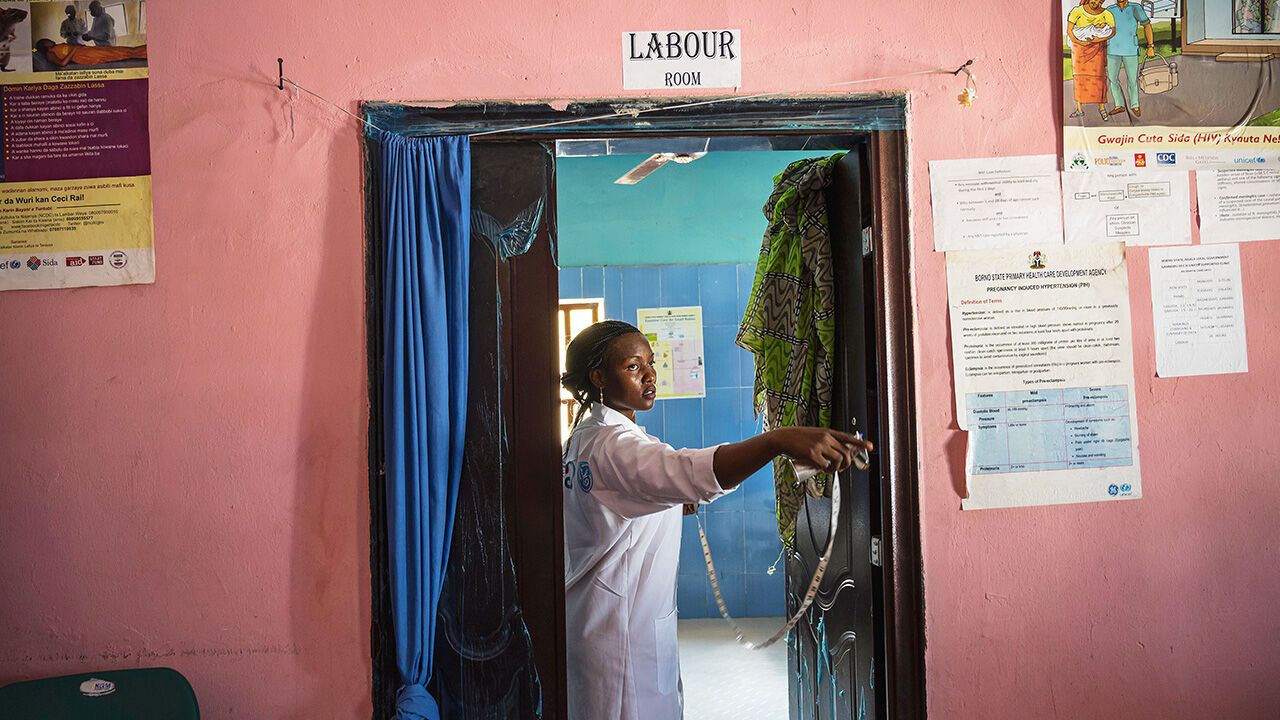
On Peculiar Umensofor’s first day on the labour ward(产房), the young nurse says she watched as a patient’s amniotic sac(羊膜囊) began to bulge out onto the bed. Though it was still intact(完好无损的), this was an emergency for a 26-week-old pregnancy. Luckily for the mother and her child, it was happening at a hospital in Nigeria’s relatively wealthy Lagos state, with the staff and equipment to perform a life-saving Caesarean section(剖宫产). Thousands of expectant mothers across Nigeria would not be as lucky if their own pregnancies were to take such a turn(出现这样的转折). Bosede Afolabi, an obstetrics professor at the University of Lagos who also supports pregnant women in poorer parts of the state, recalls travelling in canoes and on tricycles to reach patients.(拉各斯大学产科学教授博塞德·阿弗拉比同时在为该州较贫困地区提供孕产妇支持,她回忆说自己曾划独木舟、坐三轮车去探访病人。)
年轻护士佩库利尔·乌门索福回忆说,她在产房上班的第一天,眼看着一位病人的羊膜囊开始鼓出到床面上。虽然羊膜囊尚未破裂,但对26周的妊娠来说,这已是紧急情况。对这位母亲和孩子来说幸运的是,事情发生在尼日利亚相对富裕的拉各斯州的一家医院里,那里有足够的人手和设备实施救命的剖宫产。而在尼日利亚各地,成千上万的准妈妈如果也遇到同样的情况,就不会这么幸运了。拉各斯大学产科学教授博塞德·阿弗拉比同时在为该州较贫困地区提供孕产妇支持,她回忆说自己曾划独木舟、坐三轮车去探访病人。
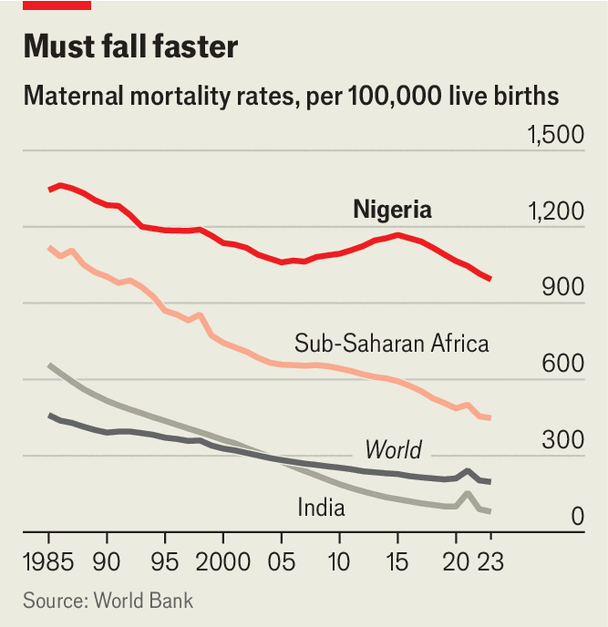
Around the world, the share of women dying in childbirth has been declining for decades, except for a brief uptick(小幅上升) during the covid-19 pandemic (see chart). That includes sub-Saharan Africa, even though its share of the world’s maternal deaths is still disproportionately high at 70% (in 2021 around 30% of the world’s babies were born in the region).(撒哈拉以南非洲也是如此,尽管该地区占全球孕产妇死亡人数的比例仍高达70%,高得不成比例(2021年全球约30%的婴儿出生在该地区)。) Yet Nigeria, the continent’s most populous(人口众多的) country, stands out as both particularly dangerous for expectant mother(准妈妈)s and particularly slow to improve. In 2023 nearly one in every 100 women giving birth there died, reckons the World Health Organisation, a share only slightly lower than 20 years ago.
在世界范围内,死于分娩的女性比例几十年来持续下降,只有新冠疫情期间出现过短暂回升(见图表)。撒哈拉以南非洲也是如此,尽管该地区占全球孕产妇死亡人数的比例仍高达70%,高得不成比例(2021年全球约30%的婴儿出生在该地区)。然而,作为非洲人口最多的国家,尼日利亚却格外突出:对孕妇而言尤其危险,改善又尤其缓慢。据世界卫生组织估计,2023年该国每100名分娩女性中就有近1人死亡,这一比例仅比20年前略低。
The most common deadly complication(并发症) in pregnancy, in Nigeria as elsewhere, is post-partum haemorrhaging(产后出血), or rapid blood loss after delivery. Globally, some 45,000 women are estimated to die this way every year. The risk is aggravate(加剧)d by being pregnant with more than one baby, having high blood pressure or living with fibroid(子宫肌瘤)s, growths in the womb that are especially common in black women. Severe anaemia(贫血) and sickle-cell disease(镰状细胞病), both common problems in Nigeria, also increase the risk. So does having had lots of children before, as many Nigerian women do.
在尼日利亚和在其他地方一样,妊娠中最常见的致命并发症是产后出血,即分娩后迅速大量失血。据估计,全球每年约有4.5万名女性因此死亡。怀多胞胎、患有高血压或长有子宫肌瘤(子宫内的增生组织,在黑人女性中尤为常见)都会加剧这一风险。严重贫血和镰状细胞病——这两种在尼日利亚都很常见的问题——也会增加风险。此前生育过很多孩子同样如此,而许多尼日利亚女性正是如此。