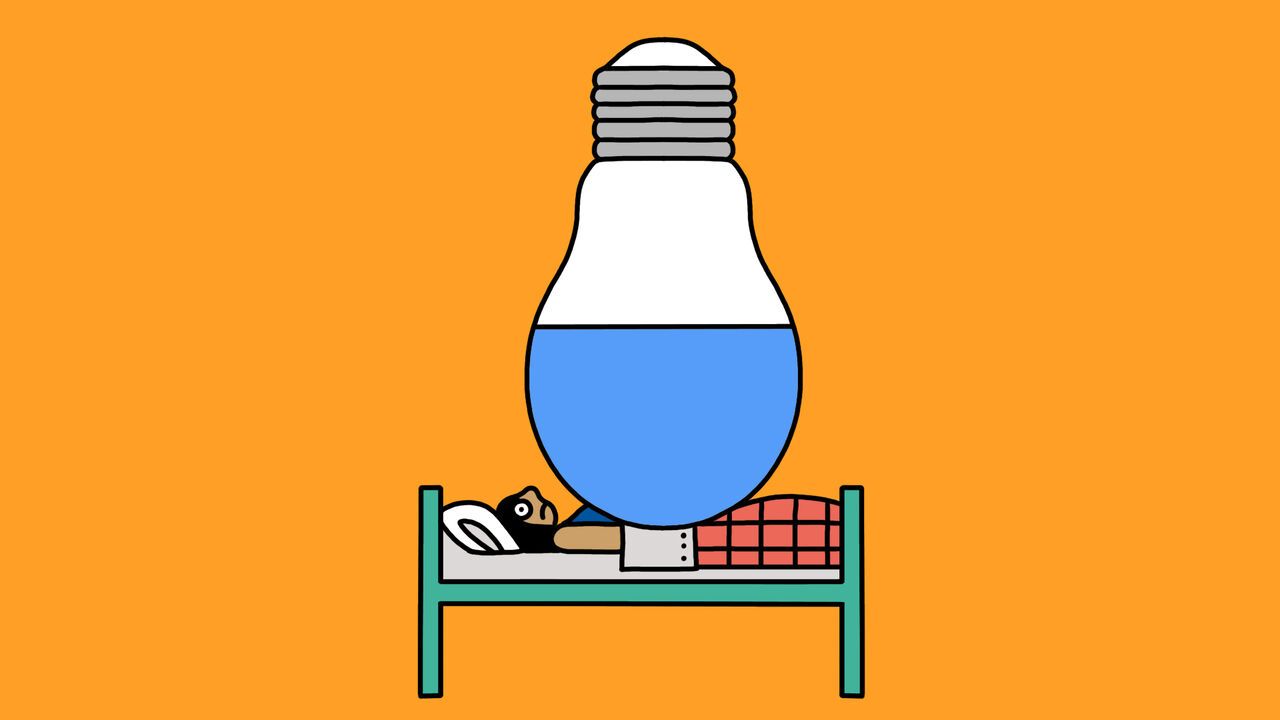
WHEN SETTLING into bed, some might find themselves passing over a long-neglected book and reaching instead for a phone. They would not be alone. A survey of 122,058 adults, published in 2025, found 41% used a screen every night in the hour before bedtime. Only 17% reported no pre-slumber(入睡前的) screen-use at all. The adverse(不利的、有害的) effects might not just be limited progress on “War and Peace(托尔斯泰的巨著《战争与和平》)”. A number of studies have linked evening screen-use to a subsequent bad night’s sleep.(多项研究都把晚间使用屏幕与随后一夜糟糕的睡眠联系在一起。)
钻进被窝时,有些人会发现自己放着那本久未翻开的书不理,伸手去拿手机。这样的人不在少数。2025年发表的一项针对122,058名成年人的调查发现,41%的人每晚睡前一小时都会看屏幕,只有17%的人表示睡前完全不碰屏幕。其不良后果可能不只是《战争与和平》读不下去。多项研究都把晚间使用屏幕与随后一夜糟糕的睡眠联系在一起。
Light from screens often has a lot of blue in its spectrum(光谱), leading some to suggest that blue is to blame for poor kip(睡眠(英式俚语)). Retailers have taken note. A gaggle(一群(原指鹅群)) of products to filter blue light is now available, including glasses, software and screen attachments. But the evidence justifying such bias against blue hardly passes with flying colours.(但要说这些证据足以支撑对蓝光的这种偏见,恐怕远远谈不上过硬。)
屏幕发出的光,光谱中往往含有大量蓝光,于是有人提出,睡眠不好要怪蓝光。商家已经注意到了这一点。如今市面上有一大堆过滤蓝光的产品,包括眼镜、软件和屏幕贴膜。但要说这些证据足以支撑对蓝光的这种偏见,恐怕远远谈不上过硬。
The body’s daily rhythm is run by the brain’s circadian(昼夜节律的、生物钟的) clock. This promotes alertness(警觉、清醒) in the morning and drowsiness(困倦、昏昏欲睡) in the evening. Light sets the tempo. A handful of cells in the eye contain a light-sensitive pigment called melanopsin(黑视素(一种感光色素)). These cells do not assist vision but instead send signals to the circadian clock’s neurons. That suppresses production of melatonin(褪黑素)—a hormone which induces night-related physiological processes—and thereby synchronise(使同步、使协调)s the body to Earth’s day-night cycle.
人体的日常节律由大脑的生物钟掌控。生物钟让人早晨清醒、傍晚困倦,而光则决定着它的节奏。眼睛里有少量细胞含有一种感光色素,叫作黑视素。这些细胞不参与视觉,而是向生物钟的神经元发送信号。这会抑制褪黑素的分泌——褪黑素是一种激素,能启动与夜间相关的生理过程——从而让身体与地球的昼夜循环保持同步。