
In one part of Britain, a government is in effect(实际上,事实上) insolvent(破产的,无力偿债的). Northern Ireland has become an unwelcome experiment in what happens when fiscal discipline collapses under Britain’s devolved constitution.(北爱尔兰成了一项不受欢迎的实验,检验当财政纪律在英国权力下放的宪制框架下崩溃时会发生什么。) The Northern Ireland Assembly, which meets at Stormont(斯托蒙特,北爱尔兰议会所在地), has not passed a budget more than five months into the financial year. Politicians do not expect one soon.
在英国的一个地区,政府实际上已经破产。北爱尔兰成了一项不受欢迎的实验,检验当财政纪律在英国权力下放的宪制框架下崩溃时会发生什么。北爱尔兰议会(开会地点在斯托蒙特)在新财年已过去五个多月后仍未通过预算。政界人士预计短期内也不会有预算。
The lack of a budget is the latest example of Northern Irish politicians ducking(回避,躲避) hard fiscal choices. Last year Stormont had a budget but ignored it, overspending by hundreds of millions of pounds. The British government, Stormont’s lender of last resort(最后贷款人), understands that the situation is chronic(长期的,积重难返的), yet it has played along with the pretence(配合着假象) that things are not so bad. It is growing exasperated(恼火的,恼怒的): Sir Chris Bryant(克里斯·布莱恩特爵士,英国北爱尔兰事务大臣), the government’s Northern Ireland secretary, exhorted(敦促,力劝) local politicians on September 4th to stop “accommodating madness(迁就疯狂)” and find a path to fiscal sustainability.
没有预算,是北爱尔兰政客回避艰难财政抉择的最新例证。去年斯托蒙特有预算却置之不理,超支数亿英镑。英国政府作为斯托蒙特的最后贷款人,明白问题已积重难返,却一直配合着“情况没那么糟”的假象。它正变得越来越恼火:9月4日,英国北爱尔兰事务大臣克里斯·布莱恩特爵士敦促当地政客停止“迁就疯狂”,找到一条财政可持续之路。
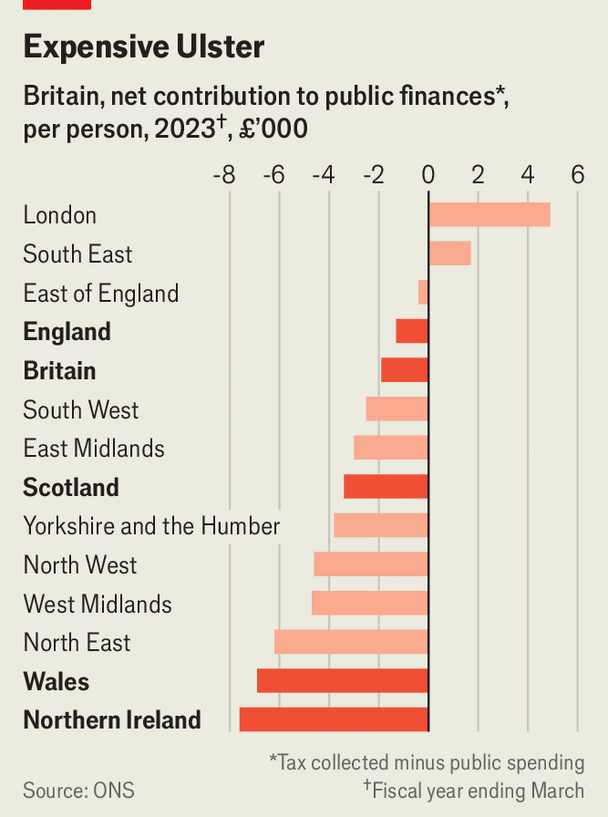
Northern Ireland is comparatively poor and generously funded by the British government. In 2023 it raised £22bn ($27bn) in revenue(收入,财政收入), equivalent to(相当于,等于) 34% of its gdp. Government spending, including directly by Westminster(威斯敏斯特,英国议会及中央政府的代称), amounted to(总计达,合计为) £36bn, or 57% of gdp. The deficit(赤字,逆差) per person was £7,600, the highest of any British region or nation (see chart).
北爱尔兰相对贫穷,却得到英国政府慷慨的资助。2023年,它筹集了220亿英镑(270亿美元)的收入,相当于其GDP的34%。政府支出(包括威斯敏斯特的直接支出)达360亿英镑,占GDP的57%。人均赤字为7600英镑,居英国各地区和构成国之首(见图表)。