
IT IS A curious venue for a sober(沉稳的,严肃的) politician. Inside a circus big top in Rostock, a port on Germany’s Baltic coast, Manuela Schwesig, the Social Democratic (SPD) premier(州长,总理) of the state of Mecklenburg-Vorpommern, is pitching to the party faithful(党内忠实支持者) ahead of elections on September 20th. Ms Schwesig offers mild red meat((政治)煽动性言论) (swipes at oil firms), empathy for voters weather(经受住,度过)ing price rises, and a few personal anecdotes. Yet there is one killer sales pitch(杀手锏式的推销话术). Only voting SPD, she says, can “prevent the AfD from becoming the strongest force”.(她说,只有投票给社民党,才能“阻止AfD成为最强力量”。)
对一位沉稳的政治家来说,这是个奇特的场地。在德国波罗的海沿岸港口城市罗斯托克的一座马戏团大帐篷里,梅克伦堡-前波莫瑞州的社会民主党(SPD)州长马努埃拉·施韦西格正在9月20日选举前向党内忠实支持者拉票。施韦西格女士抛出了一些温和的“红肉”(对石油公司的抨击)、对承受物价上涨的选民表达共情,还讲了几段个人轶事。但真正杀手锏式的推销只有一条。她说,只有投票给社民党,才能“阻止AfD成为最强力量”。
On September 6th the far-right Alternative for Germany won a spectacular(惊人的,壮观的) victory in the eastern state of Saxony-Anhalt. It long expected to repeat the feat(复制这一壮举) in “Meck-Pom(梅克伦堡-前波莫瑞州的昵称)”. Lilly Blaudszun, Ms Schwesig’s campaign manager, pulls out her phone to display a poll(民意调查) from a year ago showing the SPD on just 19%, half the AfD score. But Ms Schwesig has staged a dramatic comeback. The SPD is now just two percentage point(百分点)s behind the AfD (see chart).
9月6日,极右翼政党德国选择党(AfD)在东部萨克森-安哈尔特州取得了一场惊人的胜利。它长期以来一直期望在“梅克-波莫”(梅克伦堡-前波莫瑞州的简称)复制这一壮举。施韦西格的竞选经理莉莉·布劳德松掏出手机,展示了一年前的一项民调:社民党支持率仅为19%,只有AfD的一半。但施韦西格已经上演了一场戏剧性的逆转。社民党现在仅落后AfD两个百分点(见图表)。
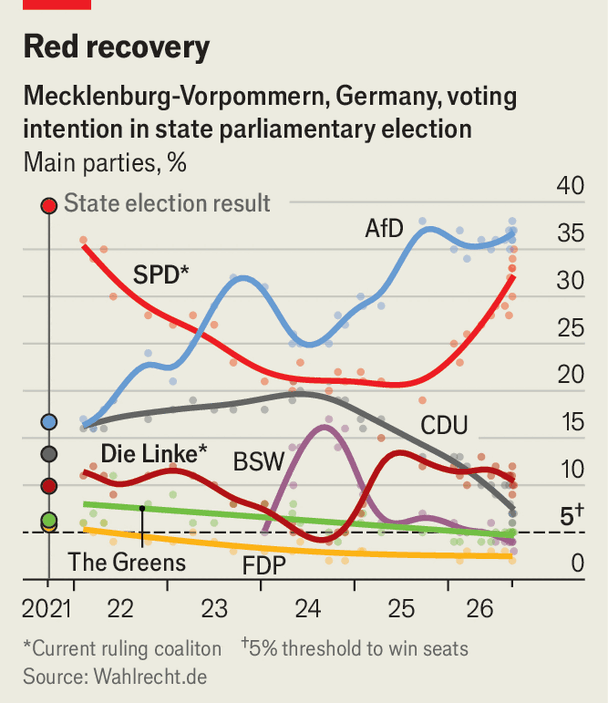
For that, she can thank the AfD bogeyman(吓唬人的怪物,魔鬼). An SPD poster depict(描绘,刻画)s Ms Schwesig, in socialist red, as “Die Frau gegen blau(德语竞选口号:“对抗蓝色的女人”)” (“The woman against blue”), the AfD’s colour. By reducing the vote to a two-horse race(两强相争,双雄对决), Ms Schwesig, in office since 2017, is exploiting her popularity to nab(获取,抢到) support from other parties, including the Christian Democrats (CDU)(德国基督教民主联盟,中右翼政党). Most voters want her to keep her job.
为此,她得感谢AfD这个“魔鬼”。一张社民党海报将施韦西格描绘成身着社会主义红色的“Die Frau gegen blau”(“对抗蓝色的女人”),蓝色是AfD的代表色。通过将选战简化为两强相争,自2017年起任职的施韦西格正在利用自己的个人声望,从包括基民盟(CDU)在内的其他政党手中争取支持。多数选民希望她继续留任。