AN UNFORTUNATE CLUB of countries is gaining new members. China, the world’s second-biggest economic power, and Russia, the most belligerent(好战的,咄咄逼人的) one, have joined. So have Germany, a far richer big economy, and Brazil, which may soon export more farm products than America. Some 3.3bn people, or more than two in five humans, now live in places where GDP per person grew half as fast or less(增速不到一半或更低) in the decade to 2024 than in the previous ten years. In 2014 the figure was 1.1bn, or fewer than one in six people. Over 730m are experiencing outright(完全的,彻底的) declines in economists’ favourite gauge of living standards(经济学家最青睐的生活水平指标).
一个不幸的俱乐部正在吸纳新成员。世界第二大经济体中国和最咄咄逼人的俄罗斯已经加入。富裕得多的大型经济体德国,以及可能很快在农产品出口上超过美国的巴西,也加入了。如今约有33亿人——超过全球人口的五分之二——生活在这样的地方:截至2024年的十年间,人均GDP增速不到此前十年的二分之一。2014年这一数字为11亿,不到全球人口的六分之一。超过7.3亿人正在经历经济学家最青睐的生活水平指标的绝对下降。
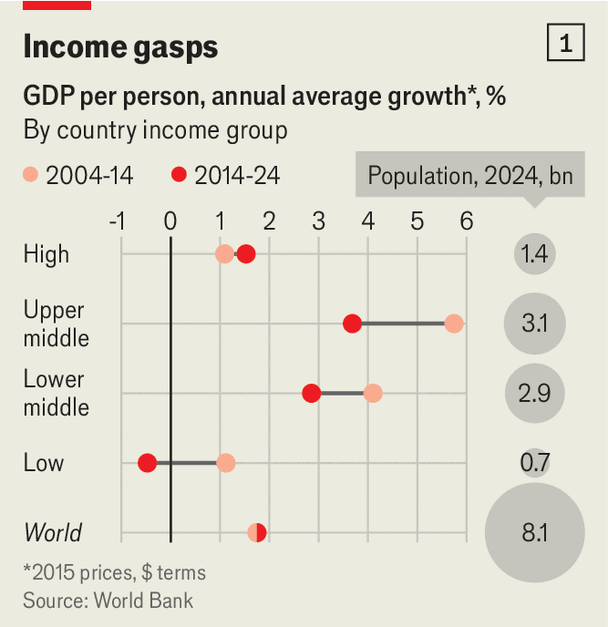
Some places continue to grow richer. The average resident of these lucky locale(地点,场所)s saw their real income grow by 38% between 2014 and 2024. Nearly half of that was thanks to the improving lot of(……境遇的改善) 1.5bn Indians, whose economy is catching up with well-off places as birth rates fall. America, which continues to outperform(表现优于,跑赢) the rest of the rich world, has pushed up the average for high-income countries (see chart 1).
一些地方仍在变得更富裕。这些幸运地区的居民实际收入在2014年至2024年间增长了38%。其中近一半要归功于15亿印度人境遇的改善——随着出生率下降,印度经济正在追赶富裕地区。美国继续跑赢其他富裕国家,拉高了高收入国家的平均水平(见图表1)。
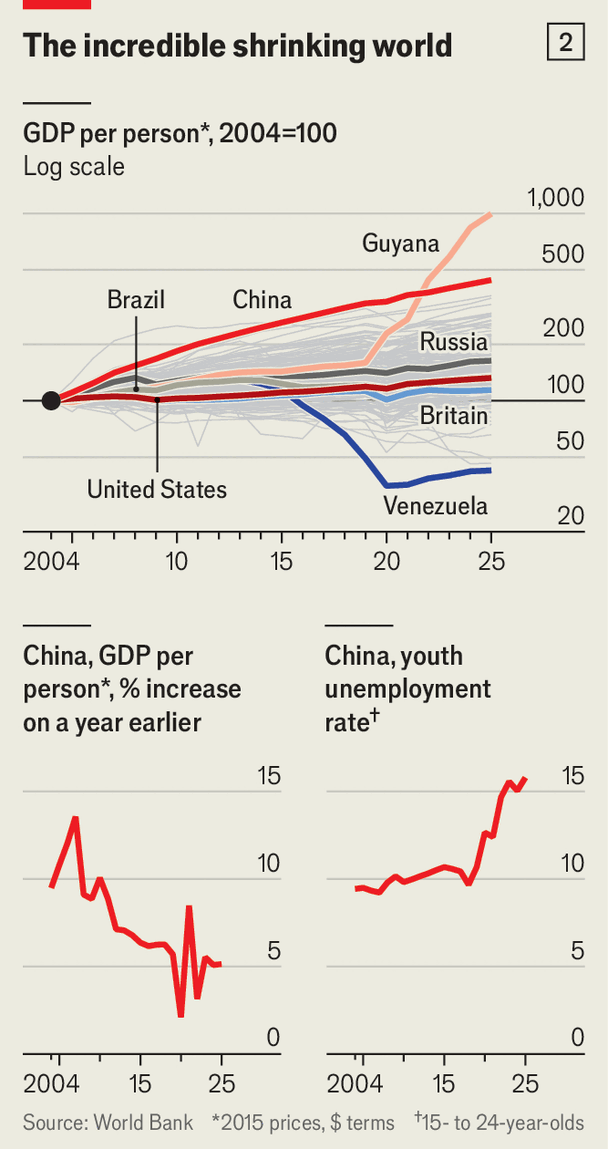
But the number of countries and territories in the low- or no-growth club has risen from 68 in 2014 to 80 in 2024. They range from rich Canada to the dirt-poor(赤贫的,极度贫困的) Democratic Republic of Congo; their problems from demography(人口结构,人口统计学) to economic mismanagement. All face some of the same risks. A stagnating(停滞的,不景气的) standard of living, let alone(更不用说) a declining one, undermine(削弱,动摇)s the assumption which has for decades dictate(支配,决定)d how people approach work and politics: that they will be better off than their parents (see chart 2, top panel). In countries where young adults who have grown up in the slowdown era are coming of age(步入成年), it is already remaking society and rewriting the social contract(社会契约).
但低增长或零增长俱乐部的国家和地区数量已从2014年的68个增至2024年的80个。它们既有富裕的加拿大,也有赤贫的刚果民主共和国;问题从人口结构到经济管理不善,不一而足。它们都面临一些相同的风险。生活水平停滞——更不用说下降——会动摇几十年来支配人们对待工作和政治方式的假设:下一代人会比父母过得更好(见图表2上半部分)。在那些在放缓时代长大的年轻人正步入成年的国家,这一趋势已经在重塑社会、改写社会契约。