WHAT IS AI good for? If polls of Americans are anything to go by, not much. A large majority oppose the building of artificial-intelligence data centres in their backyards. Nearly as many dislike the technology in general, fearing it may cost them their job or even humanity its future. Boosters retort that even before AI turbocharges(大幅提升、加速) productivity, as it promises to do, the data-centre investment boom is fuelling economic growth. And those benefits, the argument goes, trickle down(涓滴、向下渗透) to everyone, not just a handful of tech plutocrats(财阀、富豪统治阶层).
AI 有什么用?如果美国民调可信的话,用处不大。绝大多数人反对在自己家附近修建人工智能数据中心。几乎同样多的人总体上不喜欢这项技术,担心它可能让自己丢掉工作,甚至让人类失去未来。支持者反驳说,即便 AI 尚未如承诺的那样大幅提升生产率,数据中心投资热潮已经在推动经济增长。而且按照这种说法,这些好处会涓滴到每个人身上,而不只是少数科技富豪。
In America, any early effects are likely to be diluted(被稀释、被削弱) by the economy’s vastness and variegation(多样性、参差多态). Better places to look for hints of trickle-down chiponomics are South Korea, the world leader in advanced memory chips necessary to manage machine-learning workloads, and Taiwan, the global powerhouse in all other AI silicon.(要寻找芯片涓滴经济学的线索,更好的观察对象是韩国和台湾——韩国是管理机器学习负载所需先进内存芯片的全球领先者,台湾则是其他所有 AI 芯片的全球重镇。)
在美国,任何早期效应都可能因经济体量庞大、结构多样而被稀释。要寻找“芯片涓滴经济学”的线索,更好的观察对象是韩国和台湾——韩国是管理机器学习负载所需先进内存芯片的全球领先者,台湾则是其他所有 AI 芯片的全球重镇。
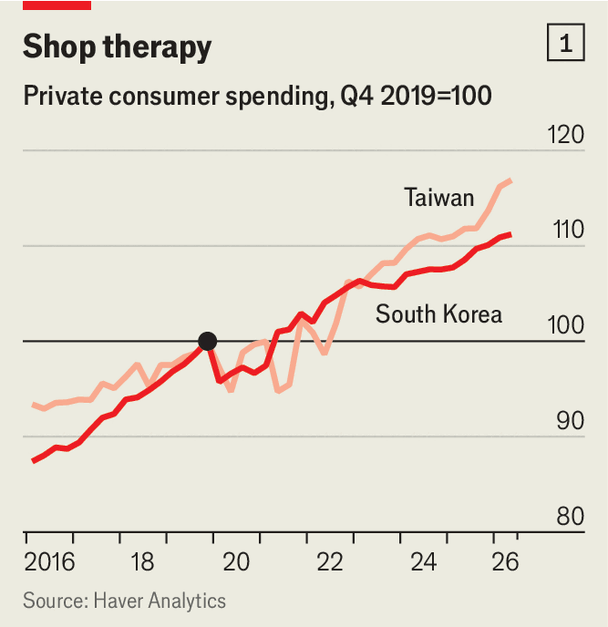
The AI bonanza(财源、繁荣) is already evident in the two countries’ headline statistics. Swelling exports have lifted annual GDP growth in South Korea to a brisk(轻快的、强劲的) 4% or so and to a blistering(极快的、火热的) 12% in Taiwan. Private consumption, which was stagnant(停滞的、不景气的) a year ago, is accelerating (see chart 1). In the second quarter of this year it accounted for around a fifth of the increase in Taiwanese GDP and roughly a third of South Korea’s.
AI 带来的财富效应已经体现在两国的总体统计数据中。出口膨胀推动韩国年度 GDP 增长达到约 4% 的较快水平,台湾更是高达 12% 的火热水平。一年前还停滞不前的私人消费正在加速(见图表 1)。今年第二季度,私人消费约占台湾 GDP 增量的五分之一,约占韩国增量的三分之一。
From the government, here to help
政府来帮忙了