Not since Socrates complained that the written word might make people lazy about remembering things has there been such an outpouring of academic angst against a new technology.(自苏格拉底抱怨文字可能让人懒得记东西以来,还从未有过如此强烈的学术焦虑针对一项新技术喷涌而出。) In an open letter published on September 11th 25 Fields Medal(菲尔兹奖,数学界的最高荣誉) winners—akin to(类似于;相当于) Nobel laureates in the field of mathematics—said that AI could ruin the foundations of their subject. AI companies, they claimed, are solving mathematical problems merely to benchmark(测试……的水平;基准) the strength of their models, rather than in a true spirit of intellectual inquiry(出于真正的求知精神). Doing so, they argue, is “detrimental(有害的;不利的) to the science of mathematics, and to the mathematical community”.
自苏格拉底抱怨文字可能让人懒得记东西以来,还从未有过如此强烈的学术焦虑,针对一项新技术喷涌而出。9月11日发表的一封公开信中,25位菲尔兹奖得主——相当于数学界的诺贝尔奖得主——表示,AI可能毁掉他们这门学科的基础。他们声称,AI公司解数学题,只是为了测试自家模型的实力,而非出于真正的求知精神。他们认为,这样做“有害于数学科学,也有害于数学共同体”。
Their letter was in response to AI making a spate of apparent breakthroughs at the subject’s frontier, the latest being announced on September 8th by OpenAI, one of the leading firms in this area.(这封信是对AI在该学科前沿取得一连串表面突破的回应,其中最新一项由该领域领先企业之一OpenAI于9月8日宣布。) A group from OpenAI said they had solved the Navier-Stokes problem(纳维尔-斯托克斯方程问题,流体力学核心难题), one of seven “Millennium Problems” chosen in 2000 by the Clay Mathematics Institute(克莱数学研究所,千禧年难题的发起机构) as the hardest and most important in the field.
这封信是对AI在该学科前沿取得一连串表面突破的回应,其中最新一项由该领域领先企业之一OpenAI于9月8日宣布。OpenAI的一个团队称,他们解决了纳维尔-斯托克斯方程问题,这是克莱数学研究所2000年选出的七个“千禧年难题”之一,被认为是该领域最难、最重要的问题。
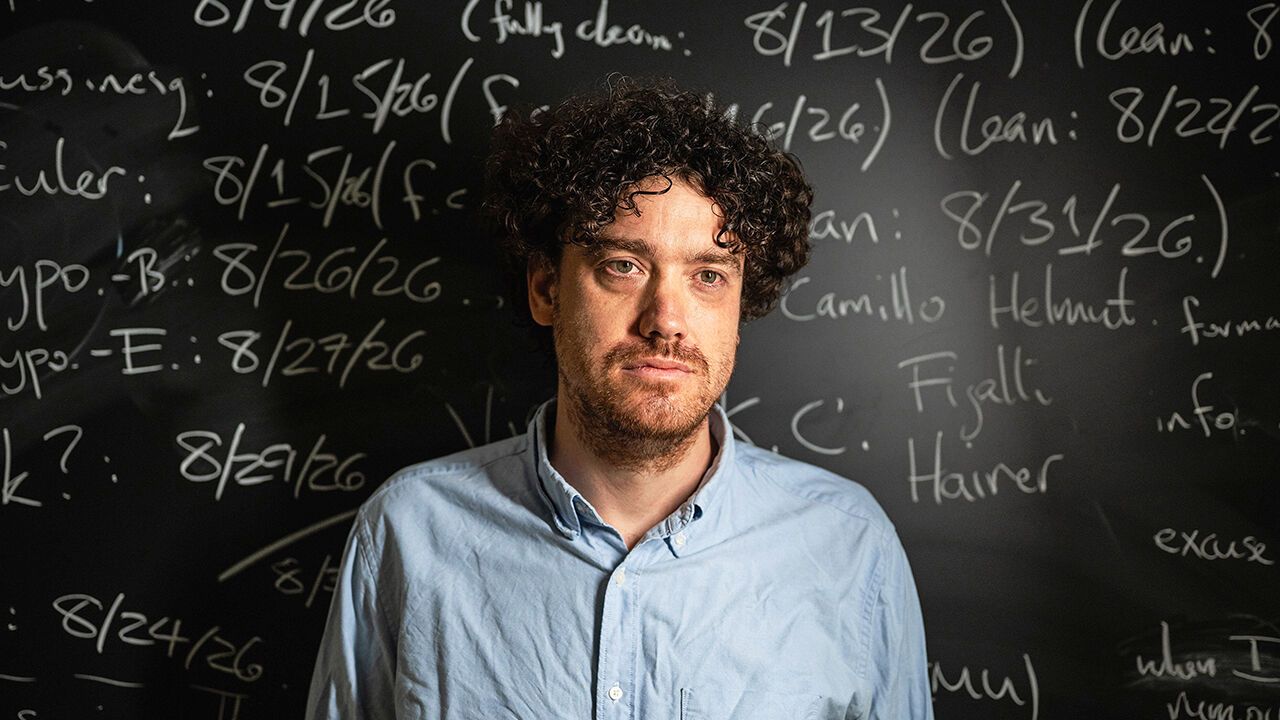
OpenAI thus seems to have gazumped Tristan Buckmaster (pictured) and Levent Alpöge, two mathematicians who had been labouring on that task, alongside some AI, and were thought close to a solution.(OpenAI似乎就这样抢在了特里斯坦·巴克马斯特(见图)和莱文特·阿尔珀格前面,这两位数学家一直在借助AI攻克该问题,据信已接近解决。) The firm released a 166-page paper describing its work, which employed models not yet publicly available. Despite its length, however, this paper contained little of the explanatory(解释性的;说明的) detail which mathematicians typically provide when sharing a new discovery.
OpenAI似乎就这样抢在了特里斯坦·巴克马斯特(见图)和莱文特·阿尔珀格前面,这两位数学家一直在借助AI攻克该问题,据信已接近解决。该公司发布了一篇166页的论文描述其工作,其中使用了尚未公开的模型。然而,尽管篇幅很长,这篇论文却几乎没有数学家分享新发现时通常会提供的那种解释性细节。