The world’s largest civilian(民用的;平民的) fleet of bullet-proof cars roam(漫游;游荡)s Brazilian cities. Security guards with automatic weapons patrol posh(高档的;豪华的) shopping centres. Armed robbery, carjacking(劫车) and murder dominate the news. Despite violent crime having fallen sharply in recent years (see chart), voters still cite crime as Brazil’s biggest problem.(尽管近年来暴力犯罪大幅下降(见图表),选民仍将犯罪列为巴西最大的问题。) Brazilians are frightened.
全球规模最大的民用防弹车车队穿行于巴西各大城市。手持自动武器的保安在高端购物中心巡逻。持械抢劫、劫车和凶杀占据着新闻头条。尽管近年来暴力犯罪大幅下降(见图表),选民仍将犯罪列为巴西最大的问题。巴西人感到恐惧。
Changing business models help explain this apparent paradox(悖论;矛盾现象). In recent years Brazil’s two main gangs, First Capital Command (PCC)(巴西最大黑帮“第一首都司令部”) and Red Command (CV), have diversified beyond drug-trafficking. The Brazilian Forum on Public Security(巴西公共安全论坛,圣保罗智库), a think-tank in São Paulo, says gangs made just $3bn from cocaine in 2022, but brought in $26bn from stolen fuel, illegal gold, contraband(走私货;违禁品) cigarettes and alcohol. Another $36bn came from scam(诈骗;骗局)s and selling stolen phones. Crime now generates revenue equivalent to(相当于) about 5% of GDP.
商业模式的转变有助于解释这一表面上的悖论。近年来,巴西两大黑帮——“第一首都司令部”(PCC)和“红色司令部”(CV)——已不再局限于贩毒,而是走向多元化。圣保罗智库“巴西公共安全论坛”称,2022年黑帮从可卡因中仅获利30亿美元,但从被盗燃油、非法黄金、走私香烟和酒类中进账260亿美元。另有360亿美元来自诈骗和销赃手机。如今,犯罪带来的收入相当于巴西GDP的约5%。
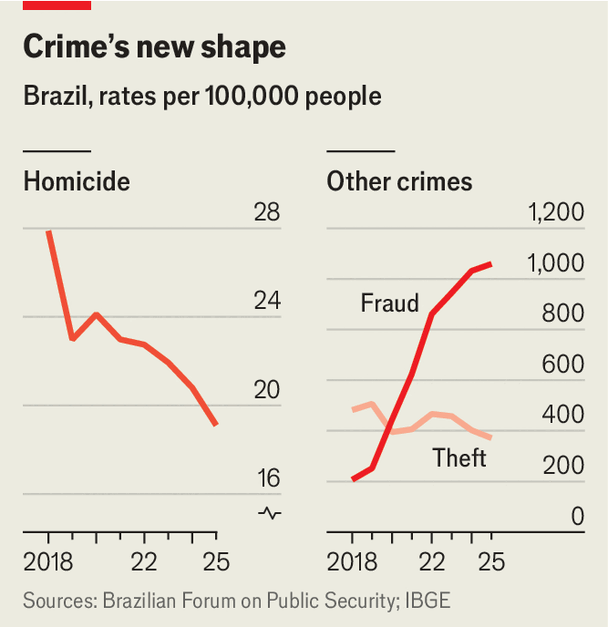
These activities are inherently(本质上;内在地) less violent than drug-trafficking. The PCC and the CV are entrenched(根深蒂固的) and relatively stable. So Brazil’s murder rate reached a record low(历史最低点) of 19 per 100,000 people in 2025, down from more than 30 a decade ago. Robberies fell by half between 2018 and 2024, but theft of smartphones in rich neighbourhoods is rising.(2018年至2024年间抢劫案减少了一半,但富裕社区的智能手机盗窃案却在上升。) Online fraud increased more than five-fold(五倍) in the same period.
这些活动本质上不像贩毒那样暴力。PCC和CV根基深厚,相对稳定。因此,巴西的凶杀率在2025年降至每十万人19起的历史低点,而十年前还超过30起。2018年至2024年间,抢劫案减少了一半,但富裕社区的智能手机盗窃案却在上升。同期,网络诈骗增加了五倍以上。
The latest from Lula
卢拉的最新举措