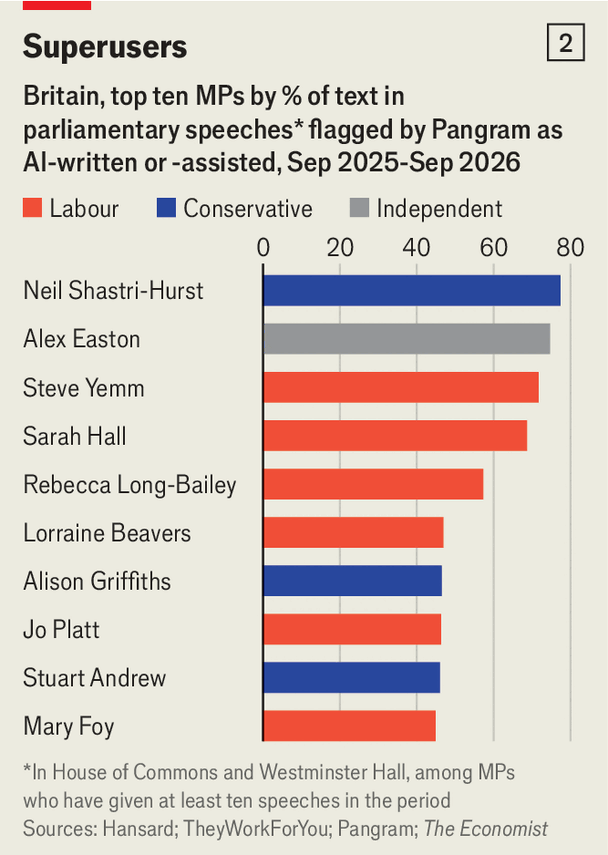
Steve Yemm put “a fundamental(根本性的) question” to his fellow MPs this June. “Who is shaping whom? Is technology serving society or is society being reshaped to serve the interests of technology companies?” Onlookers may not have realised quite how intimately technology had shaped that particular intervention(发言、介入). Pangram(一款AI文本检测工具), a tool for detecting text written by artificial-intelligence models, flag(标记、标示)ged Mr Yemm’s speech as entirely AI-written.
今年六月,史蒂夫·耶姆向同僚议员们提出了“一个根本性问题”:“谁在塑造谁?是科技在服务社会,还是社会正被重塑,以服务于科技公司的利益?”旁观者或许没有意识到,科技对那次发言的塑造有多么深入。Pangram是一款检测人工智能模型生成文本的工具,它把耶姆的演讲标记为完全由AI撰写。
Unusually, Mr Yemm freely credit(归功于、承认)s his machine co-author. He tells The Economist that “my office uses general-purpose(通用的) AI productivity tools within parliamentary guidelines(议会准则)” for many tasks, including preparing speeches. He is hardly alone(绝非个例).
不同寻常的是,耶姆先生坦然承认了他的机器合著者。他告诉《经济学人》:“我的办公室在议会准则范围内使用通用型AI生产力工具”来完成许多任务,包括准备演讲稿。他绝非个例。
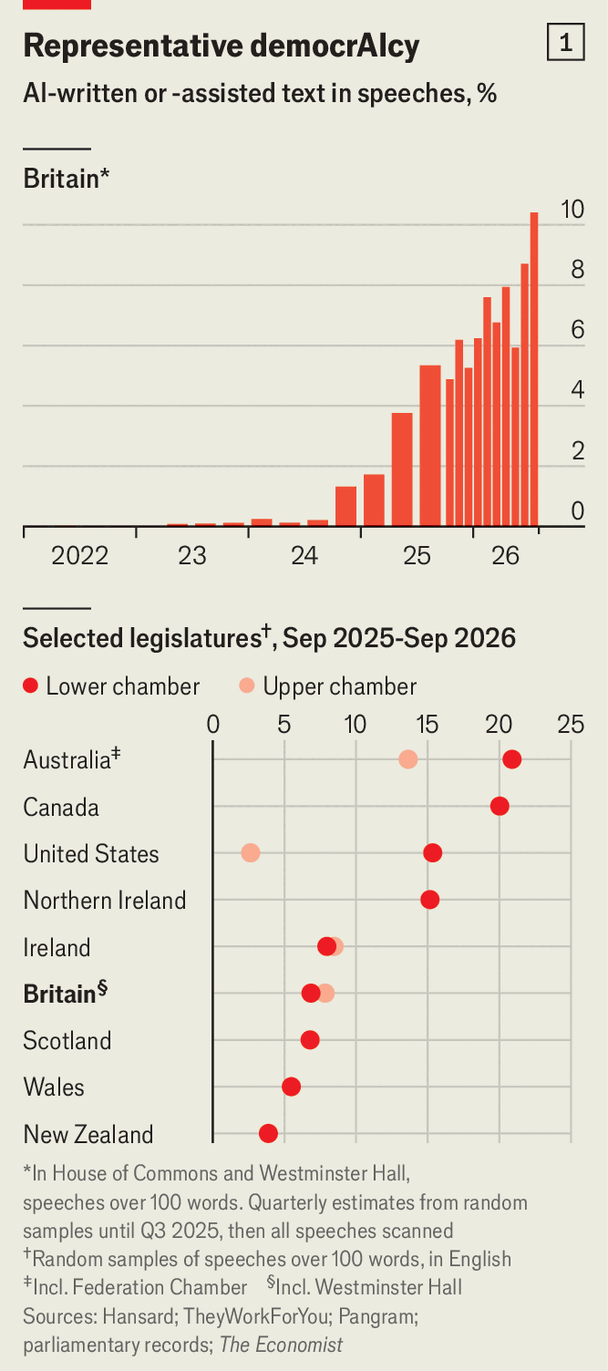
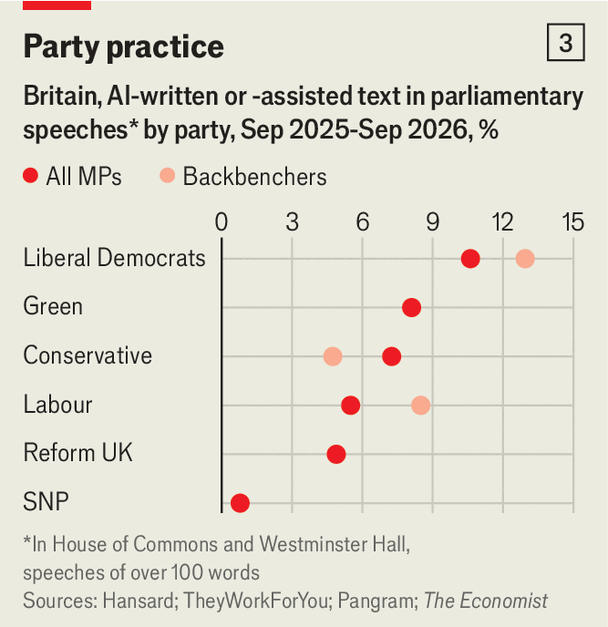
Our analysis, using Pangram, finds that one in ten of the words spoken in Britain’s parliamentary debates are draft(起草)ed by AI (see chart 1, top panel). That share is rising, from near-zero in 2024. Other MPs are less willing to fess up(坦白、承认). The most common response of Parliament’s most prolific(高产的) AI users was surprise and denial. One MP, a quarter of whose speeches appear to be AI-written, denied using the technology at work.(一位演讲中四分之一似乎由AI撰写的议员否认在工作中使用该技术。) He added that he and his parliamentary assistant “do have a bit of a running joke, though, that his writing style often uses some of the AI-generated trope(套路、惯用模式)s”.
我们利用Pangram进行分析后发现,英国议会辩论中每十个词就有一个是由AI起草的(见图1上半部分)。这一比例正在上升,而2024年时还几乎为零。其他议员则不太愿意坦白。议会中最高产的AI用户最常见的反应是惊讶和否认。一位演讲中四分之一似乎由AI撰写的议员否认在工作中使用该技术。他补充说,他和他的议会助理“确实有个小玩笑,说他的写作风格常常带有一些AI生成的套路”。