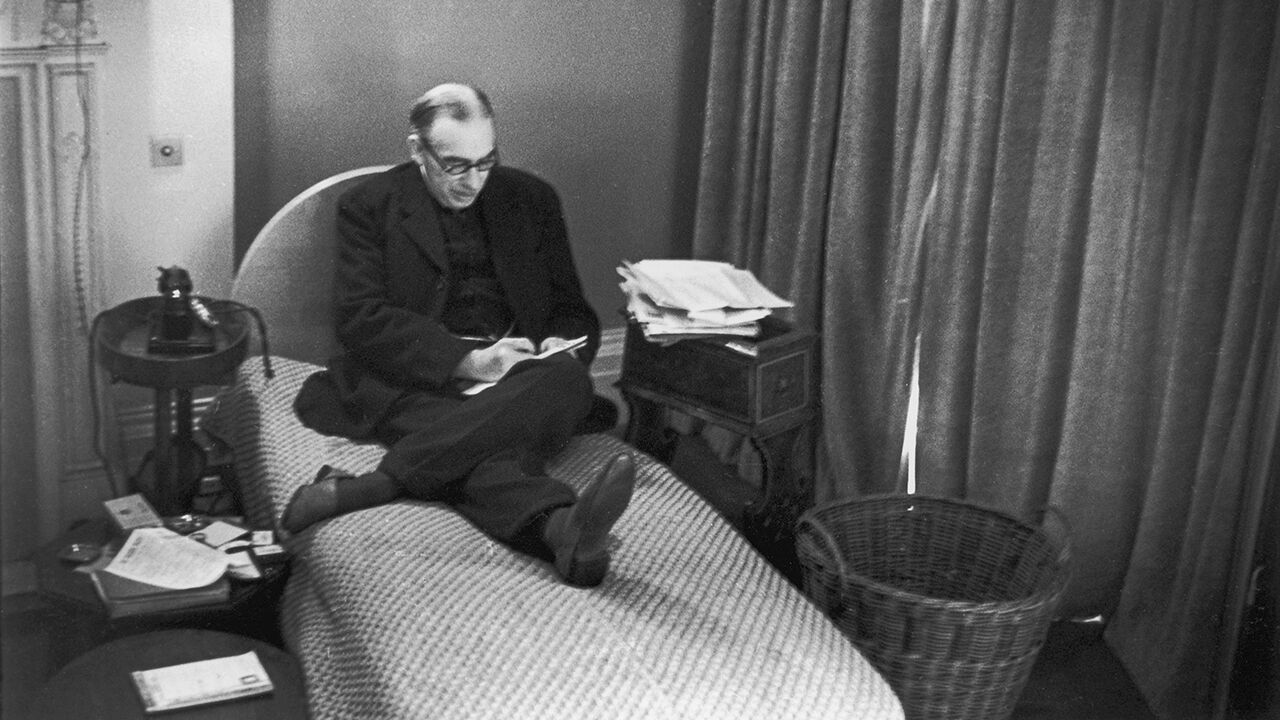
“In the long run, we are all dead,” John Maynard Keynes famously quip(打趣地说,俏皮地说)ped, impatient with waiting for economic downturn(经济衰退,低迷)s to correct themselves naturally. The British economist argued that governments should step in(介入,出手干预) to fix short-term crises. “The Standard of Living”, a new play which opened for previews on September 21st at the Theatre Royal Haymarket in London, takes a fresh look at Keynes’s legacy(遗产,遗留影响).
“从长远看,我们都会死。”约翰·梅纳德·凯恩斯这句名言带着几分戏谑,透露出他对坐等经济衰退自行好转的不耐烦。这位英国经济学家主张,政府应当出手干预,解决短期危机。新剧《生活水准》于9月21日在伦敦海玛克特皇家剧院开始预演,重新审视凯恩斯留下的思想遗产。
Written by James Graham, author of “Dear England”, a hit drama about football, and directed by Nicholas Hytner, this is a timely(适时的,恰逢其时的) piece of theatre. Keynes (played by Rory Kinnear) is surrounded by the Bloomsbury group(布卢姆斯伯里团体:20世纪初英国知识分子圈)—Virginia Woolf, Lytton Strachey and others—and married to a ballerina, Lydia Lopokova (Natalia Osipova), despite his homosexual past. The play traces his professional arc((人生的)轨迹,弧线) from work at the Treasury, the publication of “The Economic Consequences of the Peace(《和平的经济后果》:凯恩斯1919年成名作)” after the Treaty of Versailles(《凡尔赛条约》:1919年结束一战的和平条约) to establishing funding of the arts in Britain before his death in 1946.
该剧由《亲爱的英格兰》——一部关于足球的热门剧作——的作者詹姆斯·格雷厄姆编剧,尼古拉斯·希特纳执导,可谓恰逢其时。凯恩斯(罗里·金尼尔饰)身边围绕着布卢姆斯伯里团体——弗吉尼亚·伍尔夫、利顿·斯特雷奇等人——尽管他有过同性恋经历,却娶了芭蕾舞演员莉迪亚·洛波科娃(娜塔莉亚·奥西波娃饰)。该剧追溯了他的职业生涯轨迹:从在财政部任职,到《凡尔赛条约》后出版《和平的经济后果》,再到1946年去世前推动英国艺术资助体系的建立。
Keynesianism(凯恩斯主义) remains as relevant today as ever. His view that governments should spend more to prop up(支撑,扶持) demand during crises has dominated policymaking in recent years, most notably in the lavish(慷慨的,大量的) support schemes run during the pandemic and its aftermath. Yet this approach has had its critics (just as, in his time, Keynes clash(冲突,交锋)ed with Friedrich Hayek(哈耶克:奥地利学派经济学家,自由市场捍卫者), who argued that government control over the economy is a slippery slope(滑坡,危险的开始), ultimately undermining the free market). Covid-era spending has left countries saddled with huge debts. And the energy-price shock caused by the wars in Iran and Ukraine is a reminder that when the trouble lies with supply, demand-side measures are inadequate(不足的,不够的).
凯恩斯主义在今天依然切合时宜。他主张政府应在危机期间增加支出以支撑需求,这一观点近年来主导了政策制定,最显著的例子是疫情期间及其后实施的大规模救助计划。然而,这一思路也招致批评(正如当年凯恩斯与弗里德里希·哈耶克交锋,后者认为政府对经济的控制是一条滑坡,最终会侵蚀自由市场)。疫情时代的支出让各国背上巨额债务。而伊朗和乌克兰战争引发的能源价格冲击则提醒人们:当问题出在供给端时,需求侧的措施远远不够。