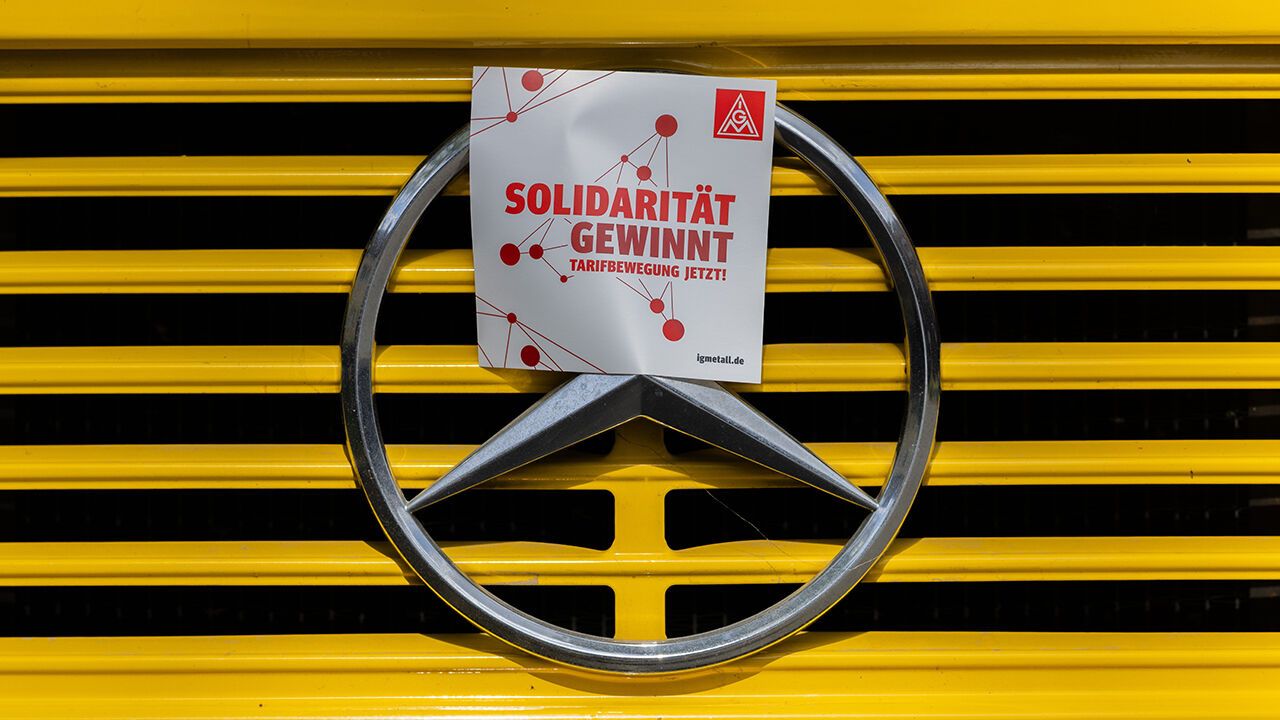
The mood at Gate One of the Mercedes-Benz factory at Marienfelde, on the southern edge of Berlin, was combative(好斗的;斗志旺盛的). Several hundred people—workers in black factory uniforms and trade unionists in red T-shirts—blew whistles and waved placard(标语牌;海报)s demanding “Ola out!” (Ola Källenius is chief executive of Mercedes) and “The 35-hour workweek must stay”. Yasmin Fahimi, who chairs Germany’s trade-union confederation(联合会;联盟), told them 35 hours was “a red line(红线;不可逾越的底线)”. Constantin Borchelt, head of the Berlin branch of IG Metall, the metalworkers’ union, produced a red vest, emblazoned with the number 35 and a smiling sun, worn by workers during the bitter but successful seven-week strike in 1984 that cut the week from 40 hours to 35.(康斯坦丁·博尔歇尔特,金属工业工会柏林分会负责人,拿出一件红色背心,上面印着数字35和一个微笑的太阳——那是1984年工人经过七周艰苦但成功的罢工、将每周工时从40小时削减到35小时时所穿的。)
在柏林南郊马里恩费尔德,梅赛德斯-奔驰工厂一号门前,气氛剑拔弩张。数百人——身穿黑色工装的工人和身着红色T恤的工会成员——吹着哨子,挥舞标语牌,高喊“奥拉下台!”(奥拉·凯莱尼乌斯是梅赛德斯首席执行官)和“35小时工作制必须保留”。德国工会联合会主席雅斯敏·法希米对他们说,35小时是“一条红线”。金属工业工会(IG Metall)柏林分会负责人康斯坦丁·博尔歇尔特拿出一件红色背心,上面印着数字35和一个微笑的太阳——那是1984年工人经过七周艰苦但成功的罢工、将每周工时从40小时削减到35小时时所穿的。
IG Metall, the world’s biggest industrial trade union, with 2.2m members, had called for a “day of action” on September 21st for car-industry workers. Some 175,000 gathered at 280 events, at places including Wolfsburg (home to Volkswagen), Stuttgart (Mercedes and Porsche) and Ingolstadt (Audi). As well as aiming to defend the 35-hour week, the union wants a 5% pay rise and commitments that jobs and factories will be safe.(除了捍卫35小时工作制,工会还要求加薪5%,并要求资方承诺保障工作岗位和工厂。) Südwestmetall(德国西南金属雇主协会,资方谈判代表), an influential regional employers’ association, declared itself “aghast(震惊的;惊骇的)” at these demands. Talks about wages are due to begin on October 7th. Strikes could start as soon as(一……就;最早) November 1st. “This autumn will be uncomfortable,” predicts Marcus Berret of Roland Berger, a consulting firm.
拥有220万成员的金属工业工会是全球最大的工业工会,它号召汽车业工人在9月21日举行“行动日”。约17.5万人参加了280场活动,地点包括沃尔夫斯堡(大众汽车总部)、斯图加特(梅赛德斯和保时捷所在地)和英戈尔施塔特(奥迪所在地)。除了捍卫35小时工作制,工会还要求加薪5%,并要求资方承诺保障工作岗位和工厂。颇具影响力的地区雇主协会Südwestmetall表示对这些要求“感到震惊”。工资谈判定于10月7日开始,罢工最早可能在11月1日爆发。咨询公司罗兰贝格的马库斯·贝雷特预测:“这个秋天会很难熬。”
On the employers’ side, Mercedes is taking the lead on dismantling the 35-hour week, which is subject to separate talks. “If one carmaker nix(否决;取消)es the 35 hours, the others will follow,” says Ferdinand Dudenhöffer, director of the Centre for Automotive Research, a think-tank. Mercedes is threatening to close two German factories unless workers agree to painful measures. It wants to extend the week to 40 hours without extra pay and to reconsider perks such as bonus pay for Christmas and holidays, in a “productivity offensive”.(它希望在不加薪的情况下将每周工时延长至40小时,并重新考虑圣诞和假日奖金等福利,以此发起一场“生产力攻势”。)
在雇主一方,梅赛德斯正带头废除35小时工作制,该议题需另行谈判。智库“汽车研究中心”主任费迪南德·杜登赫费尔说:“如果一家汽车制造商废除了35小时制,其他厂商就会跟进。”梅赛德斯威胁称,除非工人同意痛苦的措施,否则将关闭两家德国工厂。它希望在不加薪的情况下将每周工时延长至40小时,并重新考虑圣诞和假日奖金等福利,以此发起一场“生产力攻势”。