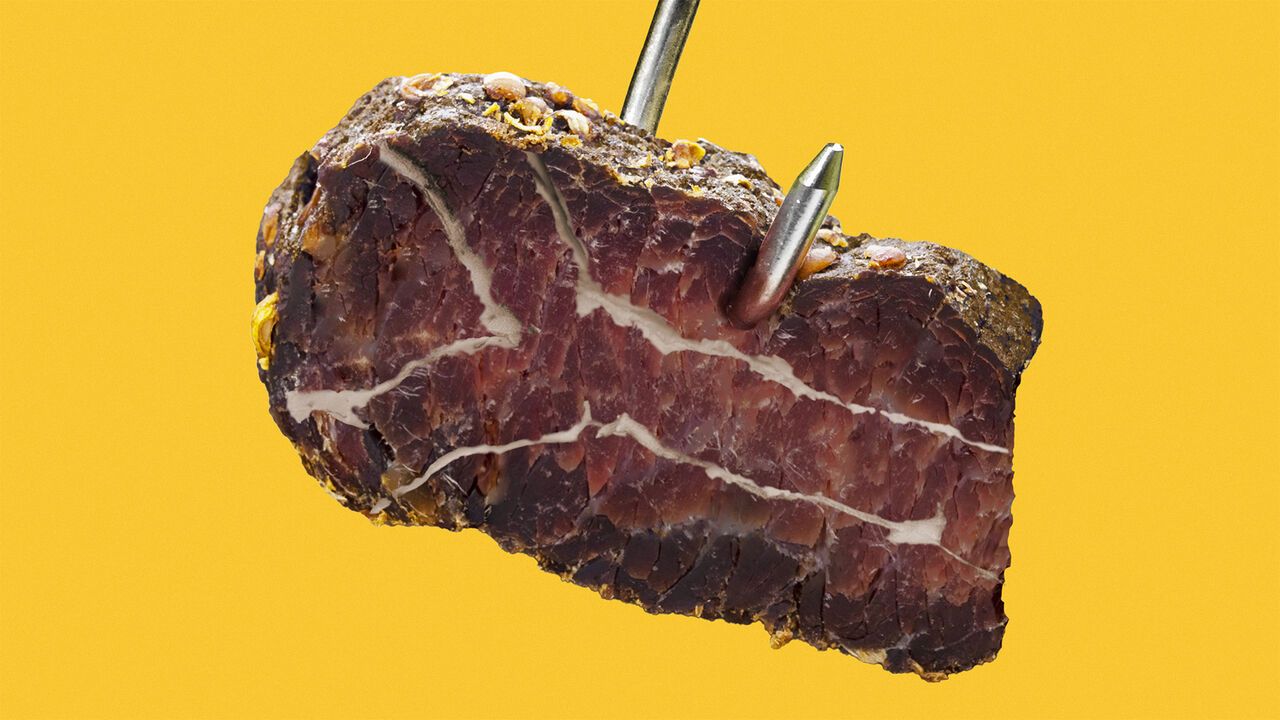
“It all started in 1652,” explains Greg White, as he smooths the creases from his apron. The meat connoisseur(鉴赏家) could be talking about South Africa. The country’s modern history began that year, when Jan van Riebeeck of the Dutch East India Company(荷兰东印度公司) settled in what would become Cape Town. But he is referring to biltong, a quintessentially(典型地,精髓地) South African cured(腌制的,风干的) meat. On September 24th, Heritage Day(南非遗产日), South Africans will munch on the savoury(咸香的,开胃的) snack as they celebrate their country’s cultures.
“这一切都始于1652年,”格雷格·怀特一边抚平围裙上的褶皱,一边解释道。这位肉类鉴赏家说的可能是南非。这个国家的现代史正是从那一年开始的——荷兰东印度公司的扬·范里贝克在后来成为开普敦的地方定居下来。但他指的是比尔通,一种极具南非特色的腌制肉干。9月24日遗产日那天,南非人将一边咀嚼这种咸香零食,一边庆祝本国的多元文化。
Today biltong is a “massive industry”, says Wandile Sihlobo, an agricultural economist. Beef is the standard meat, but there are versions using ostrich, springbok, wildebeest and kudu(南非的野生动物:跳羚、角马、捻角羚). The chewy shards(碎片,薄片) and cheaper “snap sticks” are sold at petrol stations, township((南非)乡镇,黑人聚居区) butchers and rugby stadiums. Wineries offer biltong pairings(搭配,配对). Teething babies are given biltong to soothe(舒缓,安抚) gums. “Other than Trevor Noah(特雷弗·诺亚,南非喜剧演员),” says Anna Trapido, a food writer, “it’s the one thing all South Africans agree on.”
农业经济学家万迪莱·西赫洛博说,如今比尔通是一个“庞大的产业”。牛肉是标准原料,但也有用鸵鸟肉、跳羚肉、角马肉和捻角羚肉制作的版本。耐嚼的肉片和更便宜的“脆条”在加油站、乡镇肉铺和橄榄球场都有出售。酒庄还推出比尔通配酒套餐。出牙期的婴儿会得到比尔通来舒缓牙龈。“除了特雷弗·诺亚,”美食作家安娜·特拉皮多说,“这是所有南非人唯一能达成共识的东西。”
And, like the South African-born comedian, biltong is becoming famous worldwide. A growing diaspora(侨民群体,离散族群) and hunger for protein are driving demand. New brands are popping up(涌现,突然出现) everywhere from Berlin and Brooklyn to Hong Kong and Singapore. Firms are trying new flavours like peri-peri(霹雳霹雳辣椒) and plant-based versions (mushroom is a common vegan(纯素食的) substitute).
而且,就像这位南非出生的喜剧演员一样,比尔通正在全球走红。不断壮大的侨民群体和对蛋白质的需求正在推动这一趋势。新品牌如雨后春笋般涌现,从柏林到布鲁克林,从香港到新加坡,随处可见。各公司正在尝试新口味,比如霹雳霹雳辣椒味和植物基版本(蘑菇是常见的纯素替代品)。