The European Union prides itself on(以……为傲) being a regulatory superpower(监管超级大国), setting standards that are adopted around the world. In some cases it works(在某些情况下奏效), as with the bloc’s tight limits on pollutants. In others it flops(失败,惨败), as with a complicated supply-chain law whose implementation has been delayed until next year. The EU’s latest big new rule is the Packaging and Packaging Waste Regulation (PPWR), which came into force(生效) in August. Among other things, it will eventually ban single-use(一次性的) shampoo bottles used by hotels, and mini-sachets(迷你小袋) of ketchup or other condiments(调味品). However valuable its aspirations(抱负,志向) might be, much of it is, unfortunately, a bureaucratic mess(官僚主义的混乱).
欧盟以监管超级大国自居,制定全球采用的标准。有些时候这招管用,比如欧盟对污染物的严格限制;有些时候则一败涂地,比如一项复杂的供应链法律,其实施已推迟到明年。欧盟最新的重大法规是《包装和包装废弃物法规》(PPWR),已于8月生效。除其他内容外,该法规最终将禁止酒店使用的一次性洗发水瓶,以及番茄酱或其他调味品的迷你包装袋。无论其初衷多么可贵,遗憾的是,其中很大一部分是一场官僚主义的混乱。
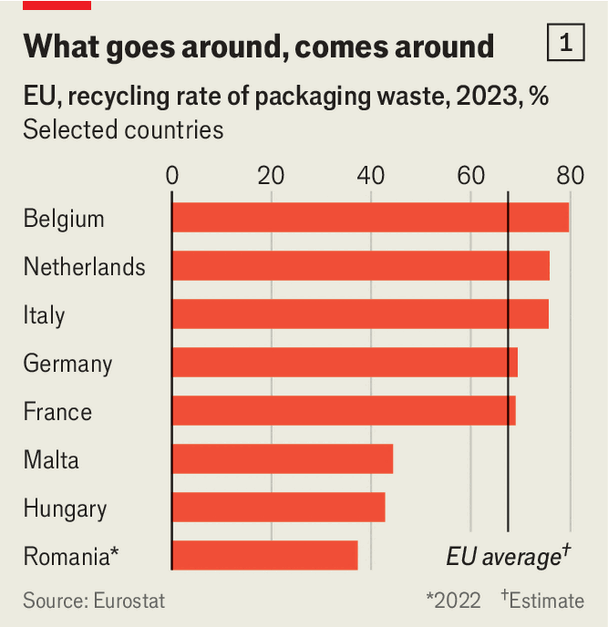
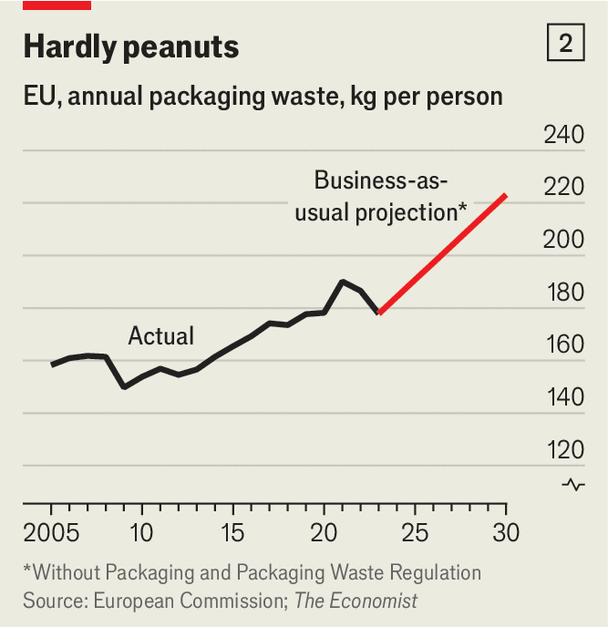
The goals of the roughly 300-page-long PPWR are worthy(值得的,有价值的). It aims to reduce the rapid growth of packaging rubbish, increase recycling, harmonise(统一,协调) national laws and make food wrappers(食品包装) safer for consumers by restricting substances such as pFAS(全氟和多氟烷基物质), widely used chemicals that break down(分解,降解) slowly and are linked to(与……有关) cancer. Annually, each person in the EU generates(产生) 178kg of packaging waste, of which 68% is recycled. Plastic accounts for(占(比例)) 35kg of that, and only 42% of it is recycled (see chart 1). Without the law, packaging wasteis forecast(预测) to grow by 19% by 2030 (see chart 2), driven by(由……推动) the relentless(持续不断的) increase of online shopping.
这份约300页的PPWR目标值得肯定。它旨在减少包装垃圾的快速增长、提高回收率、统一各国法律,并通过限制PFAS等物质让食品包装对消费者更安全——PFAS是广泛使用的化学物质,降解缓慢,且与癌症有关。欧盟每人每年产生178公斤包装垃圾,其中68%被回收。塑料占35公斤,仅42%被回收(见图1)。如果没有该法规,受网购持续增长的推动,到2030年包装垃圾预计将增长19%(见图2)。
Many of the law’s new rules will be introduced gradually(逐步地). Makers of packaging have until 2028 to introduce standardised labels(标准化标签) showing the materials in their products and how to dispose of(处理,丢弃) them. Single-use plastic packaging for fresh produce(生鲜农产品), and for those mini shampoo bottles or ketchup packets, won’t be gone until 2030.
该法律的许多新规将逐步引入。包装制造商须在2028年前采用标准化标签,标明产品所用材料及处理方法。生鲜农产品的一次性塑料包装,以及那些迷你洗发水瓶或番茄酱包,要到2030年才会消失。