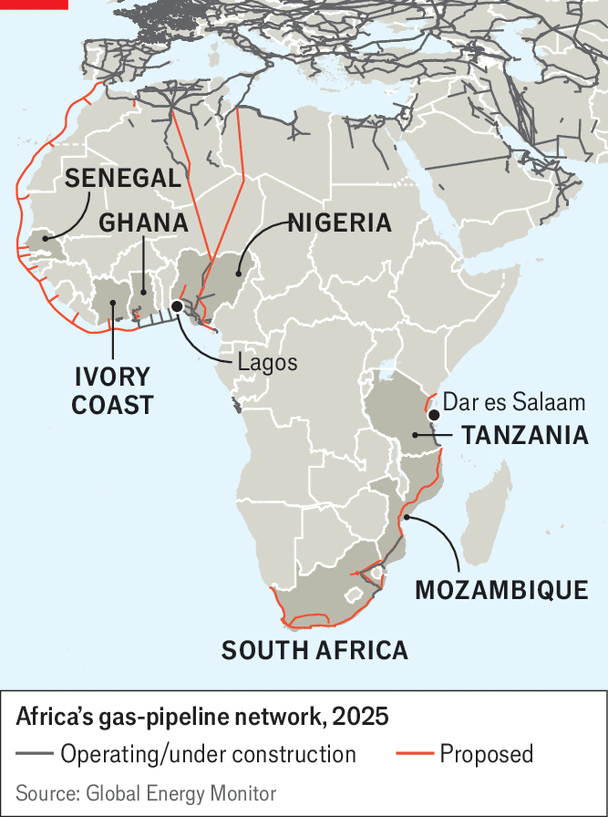
To tell the story of African gas, Alain Ebobissé explains, he carries his “gas map” with him everywhere. The boss of Africa50, an infrastructure investment platform, produces a sheet of paper showing the world laced(布满、交织着) with pipelines. Africa is almost entirely blank (see map). “Look at that!” Mr Ebobissé exclaims. “We have almost no pipelines, no infrastructure—it’s terrible.” Africa holds 13% of the world’s natural-gas reserves(储量), with deposits in 24 of its 54 countries and more still to be found. Yet it burns less than 5% of the gas used for power worldwide. Its pipeline network is one-tenth as dense as North America’s. “Who is using that gas?” Mr Ebobissé asks. “It’s not us.”
阿兰·埃博比塞解释说,为了讲述非洲天然气的故事,他走到哪里都随身带着他的“天然气地图”。作为基础设施投资平台Africa50的掌门人,他拿出一张纸,上面画着遍布管道网络的世界地图。而非洲几乎是一片空白(见图)。“看看这个!”埃博比塞感叹道,“我们几乎没有管道,没有基础设施——太糟糕了。”非洲拥有全球13%的天然气储量,54个国家中有24个蕴藏天然气,还有更多有待发现。然而,非洲燃烧的天然气还不到全球发电用气量的5%。其管道网络密度仅为北美的十分之一。“这些天然气是谁在用?”埃博比塞问道,“不是我们。”
Politicians, business leaders and investors across the continent hope that using more gas will spur(刺激、推动) industrialisation and growth. “The objective isn’t just to produce more gas: the objective is to make sure that you have more productive economies across Africa,” says Olu Verheijen, the energy adviser to Nigeria’s president, Bola Tinubu. Volatility in global energy markets because of wars in Ukraine and in the Gulf, combined with a reduced focus on net-zero targets(净零排放目标), has renewed interest in gas. But in Africa, it may not live up to the hype.
非洲各地的政界人士、商界领袖和投资者都希望,更多地使用天然气能推动工业化和经济增长。“目标不仅仅是生产更多天然气:目标是确保整个非洲拥有更高生产率的经济体,”尼日利亚总统博拉·蒂努布的能源顾问奥卢·韦雷金说。乌克兰战争和海湾战争引发的全球能源市场波动,加上对净零排放目标的关注度下降,重新点燃了人们对天然气的兴趣。但在非洲,天然气可能达不到宣传中的期望。
To its African champions, gas could solve many energy problems. Currently generating 14% of electricity south of the Sahara, the fuel could grow in importance as coal, the largest source at 40%, declines. Cheap solar power may prove a readier source of electricity for the 600m Africans who still do without(没有……也能对付). But the flexibility of natural gas means it is useful in almost every corner of a modern economy: as a heat source for steel plants and cement factories, and as a feedstock(原料、给料) for fertilisers and petrochemicals. Liquefied petroleum gas (LPG) can replace dirtier kerosene(煤油) and charcoal in household stoves. Compressed natural gas (CNG) offers drivers a cheaper, cleaner alternative to petrol and diesel. For big producers such as Nigeria, exports of liquefied natural gas (LNG) to Europe and Asia also bring in scarce hard currency(硬通货).
在非洲天然气的支持者看来,天然气可以解决许多能源问题。目前,天然气在撒哈拉以南非洲的发电量中占14%,随着占比40%的最大电力来源煤炭的衰落,天然气的重要性可能上升。对于6亿仍无电可用的非洲人来说,廉价的太阳能或许是更现成的电力来源。但天然气的灵活性意味着它几乎在现代经济的每个角落都有用武之地:作为钢铁厂和水泥厂的热源,以及化肥和石化产品的原料。液化石油气(LPG)可以替代家庭炉灶中污染更重的煤油和木炭。压缩天然气(CNG)为司机提供了比汽油和柴油更便宜、更清洁的选择。对于尼日利亚等大型生产国来说,向欧洲和亚洲出口液化天然气(LNG)还能带来稀缺的硬通货。
Problems in the pipeline
管道中的难题