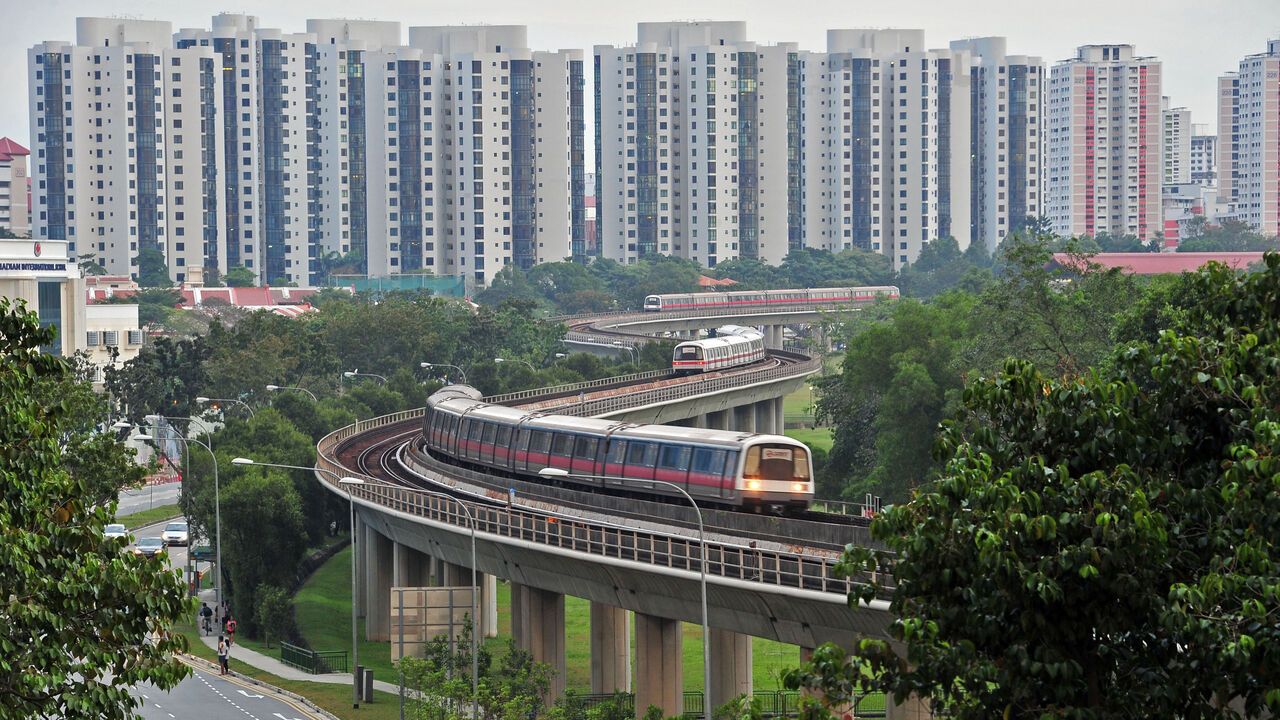
YOU WOULD not expect an 85-page equation-packed(满是公式的) economics treatise(专题论文;论著) to stir public feeling(激起公众情绪). Yet in Singapore, a new working paper by four economists, Tomasz Piskorski, Amit Seru, Jian Zhang and Chun Zhao, has. It finds that between 2007 and 2019 civil servants in the squeaky-clean(极其廉洁的;一尘不染的) city-state were 60% more likely to buy private flats within a kilometre of planned but unannounced Mass Rapid Transit (MRT) metro stations, compared with a control group(对照组). Those who subsequently sold got S$80,000 ($62,000) or so more than owners of similar flats in other parts of town for every year they held on to their purchases. The paper’s publication within a week of Singapore’s generously remunerated(报酬丰厚的) ministers being awarded a pay rise of up to 9% added to the furore(轩然大波;公愤). “Tip of the iceberg?” grouse(抱怨;发牢骚)d one netizen.
你大概不会想到,一篇长达85页、满是公式的经济学论文能激起公众情绪。但在新加坡,四位经济学家——托马什·皮斯科尔斯基、阿米特·塞鲁、张健和赵春——新发表的一篇工作论文就做到了。论文发现,2007年至2019年间,与对照组相比,这个以廉洁著称的城邦国家的公务员,在已规划但尚未公布的大众捷运系统(MRT)地铁站一公里范围内购买私宅的可能性要高出60%。那些随后卖出房产的人,持有期间每年比城中其他地段类似公寓的业主多赚约8万新元(合6.2万美元)。论文发表后不到一周,新加坡薪酬优厚的部长们又获加薪,涨幅最高达9%,这进一步加剧了舆论哗然。一位网民抱怨道:“这只是冰山一角吧?”
On September 25th the government said it took the unearthed(发掘出的;揭示的) “statistical patterns” seriously and launched a probe(调查) into potential cases of “actual misconduct(不当行为;渎职)”. The paper has also caused a scholarly stink. Among the 20 academics named in the acknowledgments(致谢) was Shengwu Li of Harvard University. Mr Li is the grandson of Lee Kuan Yew(李光耀,新加坡建国总理), Singapore’s late founding father. He is also a vociferous(大声疾呼的;激烈的) critic of his homeland’s recent governments. In a highly unusual step, two professors from the National University of Singapore (NUS), Ivan Png and Jessica Pan, asked for their names to be removed from the thank-yous, claiming they were there by mistake.
9月25日,政府表示认真对待论文中揭示的“统计模式”,并对可能的“实际不当行为”展开调查。这篇论文还引发了一场学术界的风波。致谢名单中列出的20位学者里,包括哈佛大学的李绳武。他是新加坡已故建国总理李光耀的孙子,也是新加坡近年政府的激烈批评者。极为罕见的是,新加坡国立大学(NUS)的两位教授伊万·彭和陈金兰要求将自己的名字从致谢中删除,声称他们出现在那里是个错误。
The intrigue is surprising because, if you look closely, the paper is not actually that damning.(这出闹剧令人意外,因为细看之下,论文其实并没有那么大的杀伤力。) Its starting point is that a government cannot tell precisely how corrupt or honest its society is. It gets signals from things like corruption-attitude surveys, or the odd scandal. All these, though, are noisy data(有噪声的数据): both could reflect broader rot(腐败;腐朽) or be an outlier(异常值;离群值).
这出闹剧令人意外,因为细看之下,论文其实并没有那么大的杀伤力。它的出发点是:政府无法精确判断社会有多腐败或多廉洁。它只能从腐败态度调查或偶发丑闻等渠道获取信号。然而,这些都是有噪声的数据:它们既可能反映更广泛的腐败,也可能只是异常值。