
With just over three months to go until Nigerians vote for a president, the incumbent(现任者、在职者) does not look particularly worried about his re-election prospects. On September 29th Bola Tinubu (pictured), who expects to win a second term in January, returned from Paris after a month-long stay in Europe.(9月29日,博拉·蒂努布(见图)结束在欧洲长达一个月的逗留,从巴黎回国。) He had previously extended his “working holiday(带引号的“工作假期”)” by several days, raising eyebrows(引人侧目、令人惊讶) at home.
距离尼日利亚人投票选举总统只剩三个多月,现任总统看上去并不特别担心自己的连任前景。9月29日,博拉·蒂努布(见图)结束在欧洲长达一个月的逗留,从巴黎回国。他此前还把这次“工作假期”延长了数日,在国内引发侧目。
On the face of it(表面上看), Mr Tinubu’s cool is surprising. Nigeria is suffering a worsening security crisis, with people kidnapped and killed by bandits or insurgents(叛乱分子) on a near-daily basis. His economic reforms, though lauded(称赞、赞扬) by investors, have yet to(尚未、还没有) make life better for most of the country’s 240m people. Add to that political challengers who are more popular than him, especially in the northern states worst affected by violence and economic deprivation(贫困、匮乏), and the president should be quaking in his suede loafers(吓得发抖(幽默夸张)). That he is not says less about him and more about Nigeria’s complicated electoral dynamics.(他却没有,这与其说说明了他本人,不如说揭示了尼日利亚复杂的选举生态。)
表面上看,蒂努布的从容令人意外。尼日利亚的安全危机不断恶化,几乎每天都有人被匪徒或叛乱分子绑架、杀害。他的经济改革虽受投资者称赞,却尚未改善全国2.4亿人口中大多数人的生活。再加上那些比他更受欢迎的挑战者——尤其是在受暴力和经济贫困打击最严重的北部各州——总统本该吓得连他的麂皮乐福鞋都在发抖。他却没有,这与其说说明了他本人,不如说揭示了尼日利亚复杂的选举生态。
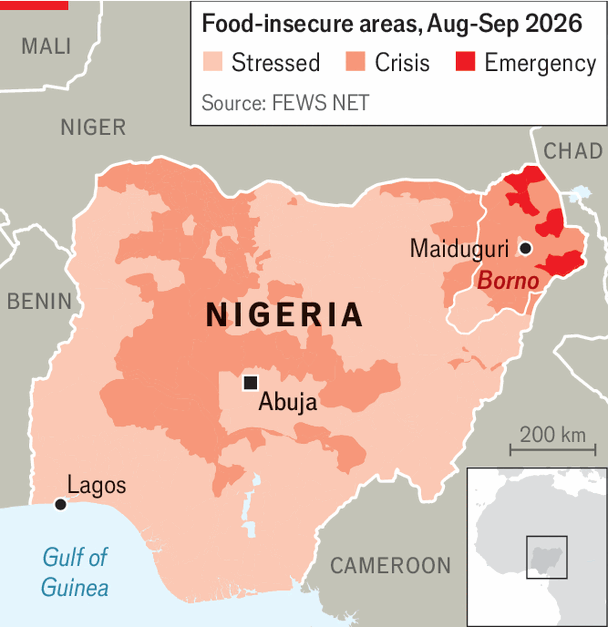
To understand the misery over which Mr Tinubu and his ruling All Progressives Congress (APC) have been presiding, consider Borno, in Nigeria’s north-east.(要理解蒂努布及其执政党全体进步大会党(APC)治下的民生疾苦,不妨看看尼日利亚东北部的博尔诺州。) The poor state, which the APC also runs, is in the grip of(深陷于、受制于) an insurgency that has raged(肆虐、猛烈持续) unchecked for two decades. Jihadists fight both the government and each other. Rival factions make money by kidnapping schoolchildren and extorting(敲诈、勒索) or looting cash and grain from already poor farmers. Such violence has wrecked(摧毁、破坏) the economy, leaving young people jobless and traders without customers. One 27-year-old in Maiduguri, the capital, complains that he is forced to travel to neighbouring Chad to sell his grain, as locals cannot afford it. Youngsters “pack all their things and leave Borno state” for Chad, Cameroon or Ghana, he says, “because if you sit down here, there is no food in this country.”
要理解蒂努布及其执政党全体进步大会党(APC)治下的民生疾苦,不妨看看尼日利亚东北部的博尔诺州。这个同样由APC执政的贫困州,正深陷一场已肆虐二十年、无人遏制的叛乱。圣战分子既打政府,也互相厮杀。敌对派系靠绑架学童、向本已贫困的农民勒索或掠夺现金和粮食来牟利。这样的暴力摧毁了经济,让年轻人失业、商贩没有顾客。首府迈杜古里一名27岁的年轻人抱怨说,他不得不跑到邻国乍得去卖粮食,因为当地人买不起。他说,年轻人“收拾好所有家当,离开博尔诺州”前往乍得、喀麦隆或加纳,“因为如果你待在这里,这个国家根本没有吃的。”
No need to deliver
无需兑现承诺