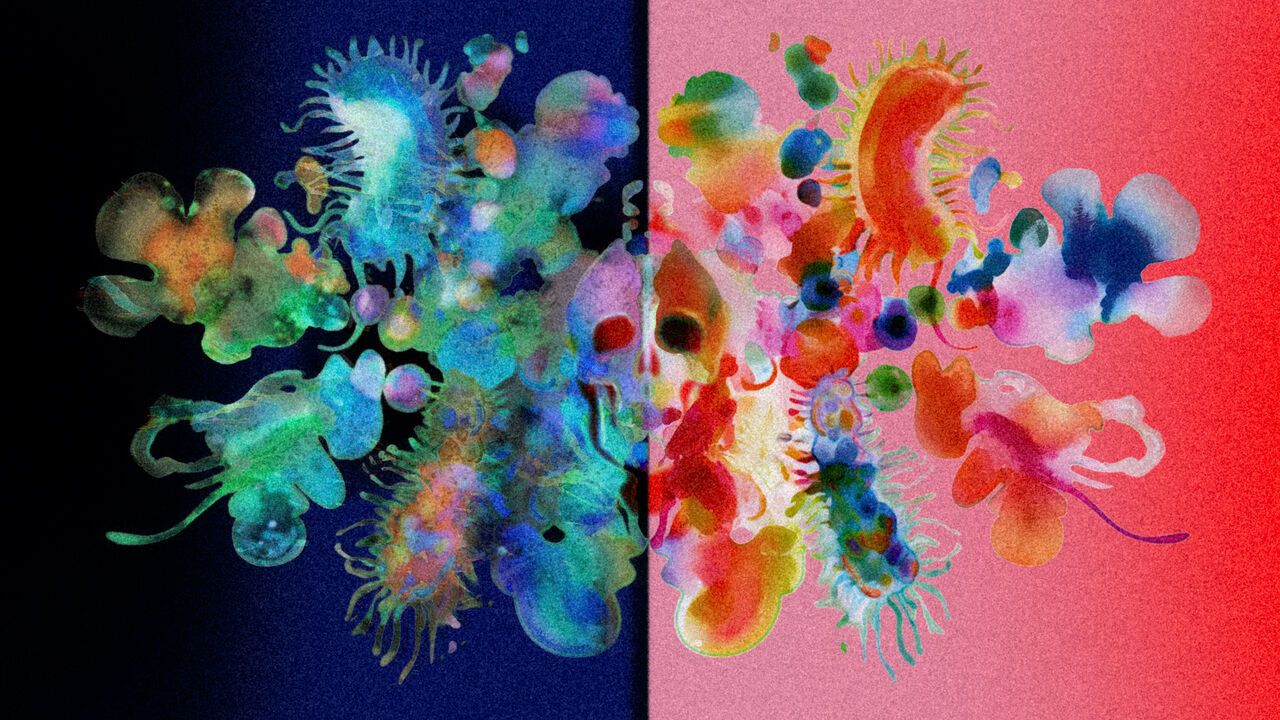
BIOLOGY IS HANDED. In other words, many molecules essential to living organisms come in two distinct forms which, like human hands, are non-identical(不完全相同的) mirror images of one another(互为镜像). For a lot of those molecules, though, life on Earth employ(采用,利用)s only one of the two possibilities.
生物学是有“手性”的。换句话说,许多生命体必需的分子都有两种截然不同的形态,它们就像人的左右手一样,互为镜像却并不完全相同。然而,对于其中许多分子,地球生命只利用了两种可能形态中的一种。
Why this should be so is lost in evolutionary history.(为什么会这样,已经湮没在进化史中。) And, until recently, only evolutionary biologists cared. But that is changing. Although biotechnologists are not there yet, they can see on the horizon(即将出现) the possibility of synthesising biological cells from scratch(从零开始). This has led some to wonder what might happen if someone tried to reverse life’s handedness and create a cell—probably a bacterium—that held a mirror to normal biochemistry.(这让一些人开始思考:如果有人试图逆转生命的手性,创造出一个细胞——很可能是一种细菌——让它在正常生物化学面前竖起一面镜子,会发生什么?)
为什么会这样,已经湮没在进化史中。而且直到不久前,只有进化生物学家关心这个问题。但情况正在改变。尽管生物技术专家尚未做到,但他们已经能看到从零合成生物细胞的可能性出现在地平线上。这让一些人开始思考:如果有人试图逆转生命的手性,创造出一个细胞——很可能是一种细菌——让它在正常生物化学面前竖起一面镜子,会发生什么?
The answer, discussed this week by a conclave(秘密会议) of concerned biologists meeting at the Singapore Conference on Mirror Life, is potentially terrifying. If such an organism were to escape the confines(范围,界限) of the lab it might create an unstoppable plague or devastate(摧毁) an entire ecosystem. Scientists are, therefore, keen to see what can be done to nip such research in the bud(将研究扼杀在萌芽状态).
本周,一群忧心忡忡的生物学家在新加坡镜像生命会议上讨论了这个问题,答案可能令人恐惧。如果这种生物逃出实验室的束缚,它可能制造出一场无法遏制的瘟疫,或摧毁整个生态系统。因此,科学家们急于探讨能做些什么,将这类研究扼杀在萌芽状态。