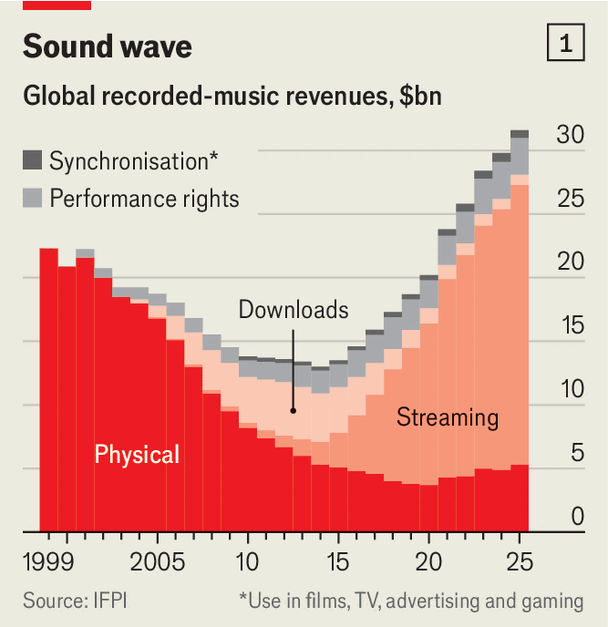
THE MUSIC industry is no stranger to(对……不陌生) technological upheaval(剧变,动乱). From vinyl to cassettes to CDs to streaming, the recording and selling of music has been in a state of constant revolution. The shift to streaming shook the industry hard. After the rise of illicit(非法的,不正当的) file-sharing in the Napster(Napster:早期音乐文件共享服务) era, which eventually gave way to legal streaming, it took more than 20 years for revenue to return, even in nominal(名义上的) terms, to the level of the 1990s (see chart 1). Generative artificial intelligence brings a new age of disruption(颠覆,扰乱). It threatens to transform the whole process of making music itself.
音乐产业对技术剧变并不陌生。从黑胶唱片到盒式磁带,再到CD和流媒体,音乐的录制与销售一直处于不断革命的状态。向流媒体的转变给该行业带来了沉重打击。在Napster时代的非法文件共享兴起之后——这一模式最终让位于合法的流媒体——收入花了20多年时间才恢复到20世纪90年代的水平,即便按名义价值计算也是如此(见图1)。生成式人工智能带来了一个新的颠覆时代。它有可能彻底改变音乐创作的全过程。
Music made by AI is already making its presence felt, in the zeitgeist(时代精神) as “slop(泔水,垃圾内容)” as well as in the charts. There is more dross(糟粕,无价值的东西) than ever. Alexis Lanternier, boss of Paris-based Deezer, says that about 90,000 entirely machine-generated tunes are uploaded to his music-streaming service a day—half the total. Spotify, the biggest streamer, says it has taken down 75m “spammy(垃圾的,滥发的) tracks” in the past year. Much of the slop is uploaded illegally by bot farms(机器人农场) hoping to harvest fraudulent(欺诈性的) royalties. But many human artists use AI legitimately, to enhance their creativity. “It’s like Ozempic(Ozempic:一种减肥药物),” says Mr Lanternier. “Everybody is using it, but no one wants to say.”
AI创作的音乐已经崭露头角,既在时代精神中被称为“泔水”,也登上了排行榜。垃圾作品比以往任何时候都多。总部位于巴黎的Deezer的老板亚历克西斯·兰特尼耶表示,每天约有9万首完全由机器生成的曲目上传到他的音乐流媒体服务——占总上传量的一半。最大的流媒体平台Spotify表示,过去一年已下架7500万首“垃圾曲目”。许多泔水是由机器人农场非法上传的,目的是骗取版税。但许多人类艺术家合法地使用AI来增强创造力。“这就像Ozempic,”兰特尼耶先生说,“每个人都在用,但没人愿意承认。”
A bigger question is the legality of AI-made music. Some record labels accuse AI-music labs of piracy(盗版,侵犯版权) and have sued. Some have settled, hoping to make more money from licensing than from lawsuits. Confusingly, some do both. As Mark Mulligan of MIDiA Research, a consultancy, puts it, all are grappling with the problem of how to stay in control of the industry when the ability to create music with AI lowers barriers to entry.(正如咨询公司MIDiA Research的马克·穆里根所言,当AI创作音乐的能力降低了准入门槛时,所有公司都在努力解决如何保持对行业控制的问题。) Many top music executives cut their teeth(初出茅庐,开始职业生涯) (and their first record contracts) in the Napster era. They do not want to get caught napping(被打个措手不及) again.
更大的问题是AI创作音乐的合法性。一些唱片公司指控AI音乐实验室盗版并提起诉讼。一些公司则达成和解,希望从授权中赚取比诉讼更多的钱。令人困惑的是,有些公司两者都做。正如咨询公司MIDiA Research的马克·穆里根所言,当AI创作音乐的能力降低了准入门槛时,所有公司都在努力解决如何保持对行业控制的问题。许多顶级音乐高管在Napster时代初出茅庐(并签下第一份唱片合同)。他们不想再次被打个措手不及。